L'Alfàs del Pi has 2,856 pools on the Catastro register
According to the Catastro there are 2,856 open-air pools on record in the municipality of l'Alfàs del Pi, 69 more than in 2022. The province of Alicante as a whole adds up to 132,495 pools spread across 141 municipalities and has gained 6,360 since 2022, 5.0 % more, which makes it the second province in Spain by registered pools, behind only Madrid (147,555). The provincial average works out at some 940 pools per municipality: l'Alfàs triples that average in an area of barely 19.26 km².
But the figure that really explains l'Alfàs del Pi is the comparison with its neighbour to the south. Benidorm, right next door to l'Alfàs and with a far larger population, has only 1,163 pools on record: fewer than half as many as l'Alfàs. It is not a mistake in the Catastro, it is town planning. In the nineteen-sixties Benidorm chose the vertical city, concentrating its building rights in apartment towers where thousands of residents share one communal body of water, or none at all. L'Alfàs del Pi did the opposite: low-density horizontal urbanisations, the detached house on its own plot, a garden of pines, almonds and orange trees. And a plot like that almost always ends up with a pool. In the same comarca, Altea has 2,890 pools on record, La Nucía 2,542 and Finestrat 1,471.
Looked at across the province as a whole, the ranking is headed by Jávea / Xàbia with 9,317 pools, followed by Orihuela (7,375), Dénia (5,175), Torrevieja (4,931), Teulada-Moraira (4,887), the city of Alicante (4,866), Calpe (4,744) and Benissa (4,120). L'Alfàs del Pi comes in just behind Altea with its 2,856, ahead of La Nucía and of Benitachell (2,000). In other words: a small municipality of 19.26 km², placed high in the provincial pool ranking ahead of far larger areas. That only happens where the single-family house is the dominant model.
A necessary warning about these numbers, so that nobody reads more into them than is there. The Catastro census under-records: it is a floor, not a ceiling. Some pools were never declared, others are entered late and small ones never make it onto the register at all, so the real figure is higher than the published one. The Catastro does not separate the private pool from the communal one, from a hotel's or from a club's either: the 2,856 in l'Alfàs are all the bodies of water registered in the municipality, not 2,856 houses with a pool. And the figure does not go below municipality level: there is no official breakdown by centre or by urbanisation, so it cannot be said how many are in l'Albir and how many in the town centre, nor how many in Escandinavia or in El Cautivador. When we divide the area up by urbanisation we do it by geography and by our own work, never by attributing figures to a neighbourhood.
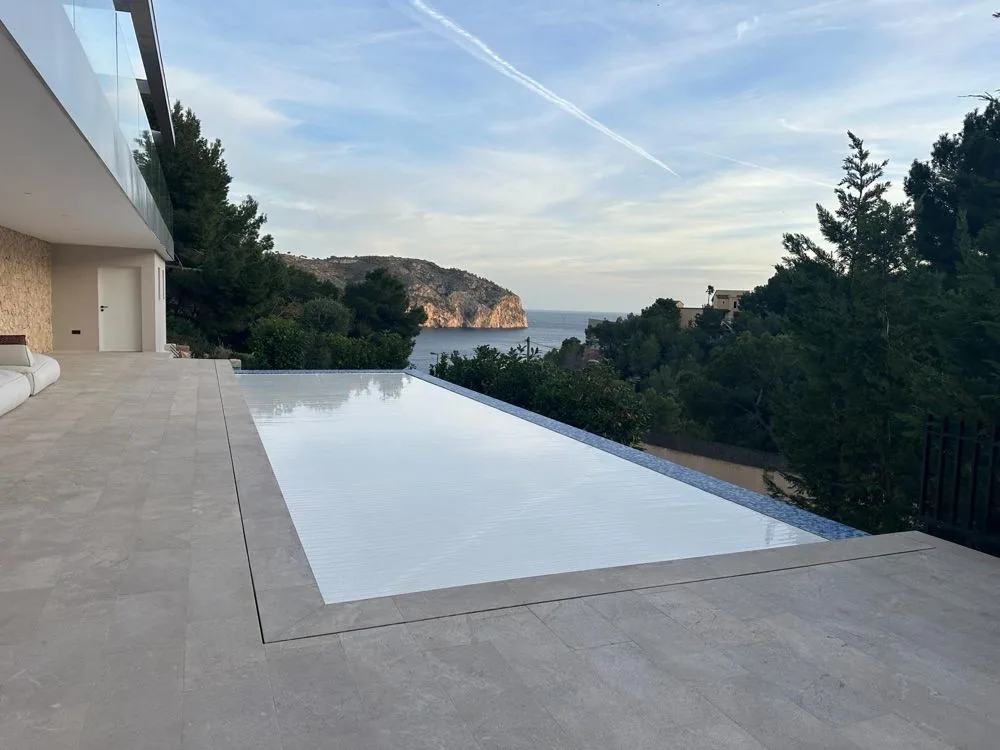
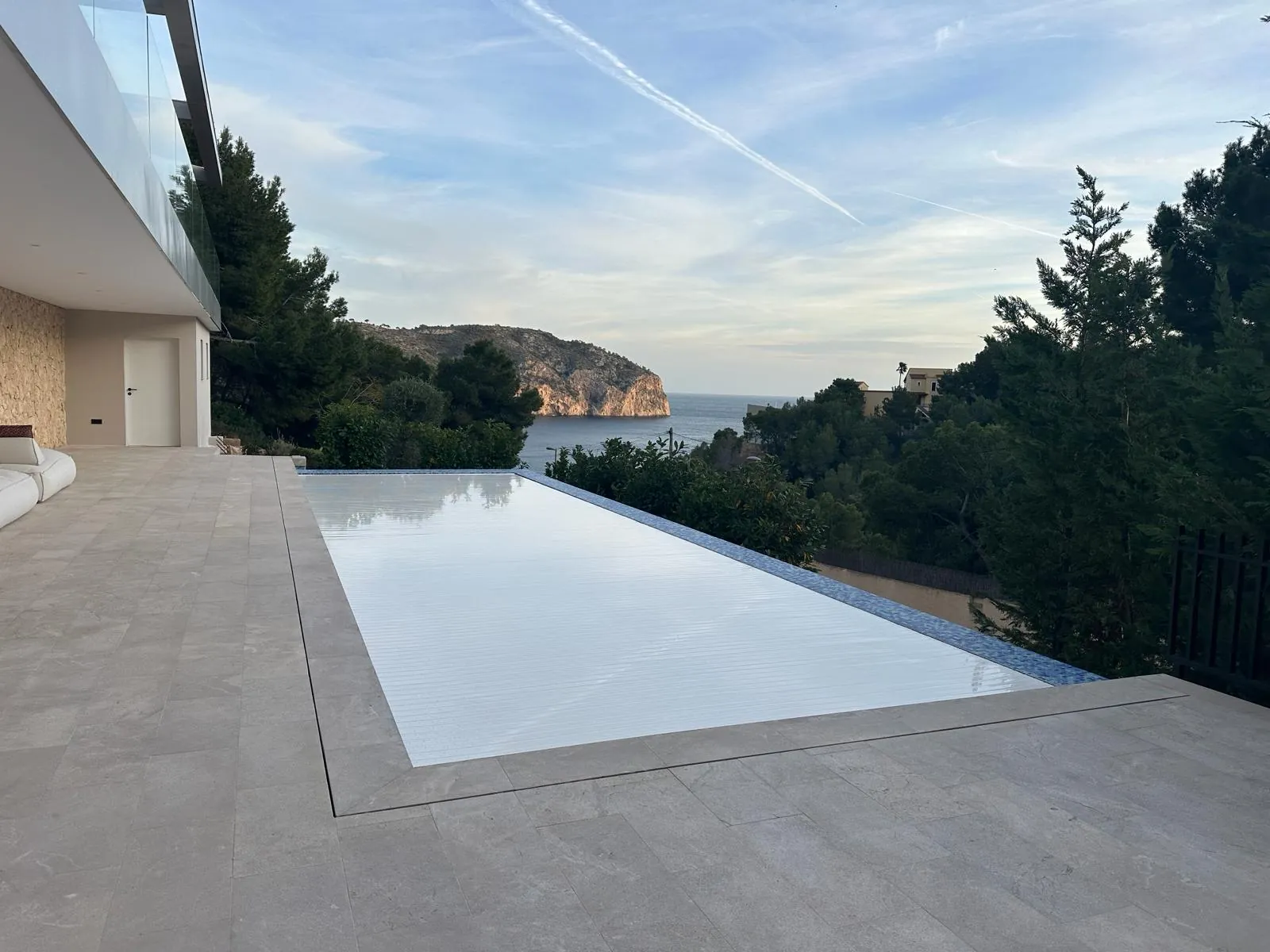
In practice, that profile of a family pool on its own plot is the one that gets most out of a cover, and the argument here is not an aesthetic one. A closed slatted cover cuts evaporation by between 70 % and 80 %: in an 8 × 4 metre pool that is between 15,000 and 25,000 litres a year you do not have to replace, and in an area where it does not rain for most of the year and water is paid for, that is no small detail. If there is a heat pump, the system's consumption falls by between 50 % and 60 %, and with solar polycarbonate slats the water gains 6 or 7 °C during the day at no running cost. The other reason people call us is safety: closed, the slats form a continuous surface that keeps anyone out of the water and holds 100 kg as required by NF P90-308, which is a French standard, not a European one. It is worth saying plainly: that does not make it walkable or trafficable, and nobody should get on top of it. You can see the whole province on our page for pool covers in Alicante.