Ingerclima — automatic slatted pool covers
+34 91 631 59 40 Get a Quote
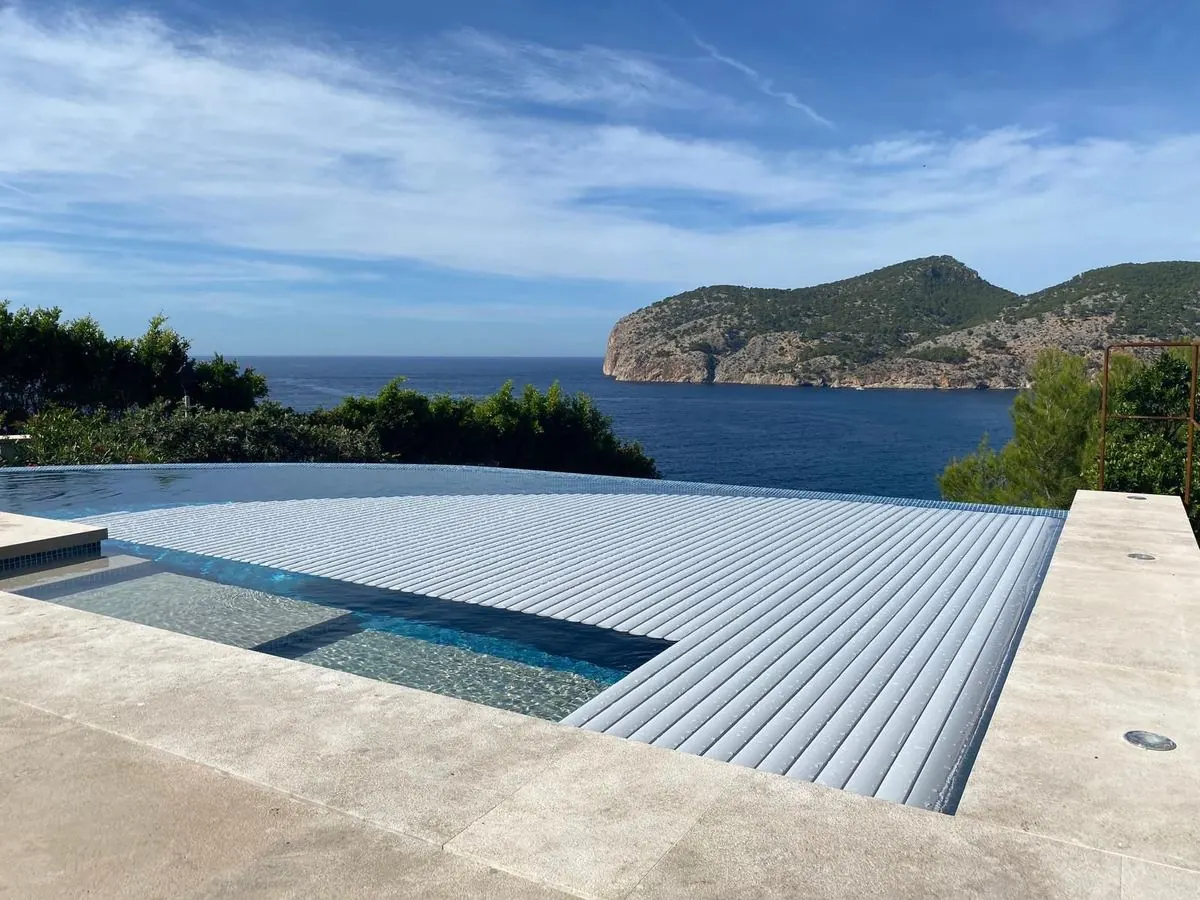
Automatic slatted pool cover closing over a villa pool
Heat pump · Solar slats · The cover that decides the bill

Heating a pool in Spain: heat pump, cover or both

Sun on the terrace is not the same as warm water in the pool. Here is what each of the three ways of putting heat into a pool actually does, and why the cover is the part that decides what the rest of it costs you.

Warm air is not warm water

Almost every owner who buys here arrives with the same reasonable assumption: with this much sun, the pool will look after its own temperature. In the middle of summer it does. Either side of that the air is pleasant and the water is not, and that gap is what people are really asking about when they ask how to heat a pool in Spain. This page sets out what changes it, and which part is worth your money first.

20+
years in the trade
5,000+
covers installed
100%
made in our own Spanish workshop
NF
P90-308 safety standard

Why a pool in Spain still needs heating

A pool loses heat through its surface every hour of every day, all year round. In July the sun puts it back faster than it goes, so nobody thinks about it. In May and again in October the midday sun is still generous, but the nights undo most of what the day gave, and the water you find on Saturday is colder than the one you left the weekend before. Technically usable, practically not.

That reframes the question. What owners want is not a number on a thermometer but more usable weekends at each end of the year. If you live here all year, heating is about the shoulder months; if the villa is used at Easter and at half term, the equipment only has to earn its keep for the weeks you are in it. Either way the first job is the same.

Where the heat comes from, and where it goes

Only three things put meaningful heat into an outdoor pool in Spain. The sun landing on the water is the first and much the largest. A heat pump is the second: it burns nothing, it moves warmth out of the outside air into the water, which is why it costs so much less to run than a boiler. The third is a special case — a cover whose slats let sunlight through and then trap it under the surface.

There is really only one way heat leaves, and that is the surface. Evaporation does most of it: every drop that lifts off takes with it the energy that turned it into vapour, which is why an open pool cools faster on a warm, breezy evening than it seems it should. Radiation to a clear night sky does the rest. Almost nothing goes through the walls, so the surface is where heating a pool is won or lost.

That is what makes a cover part of the heating conversation rather than an accessory to it. Closed, a slatted cover cuts evaporation by roughly 70 to 80 per cent and puts a physical lid between the water and the night sky. It generates nothing — that is the honest version, and it is worth being clear about it — but on a pool with no equipment at all, it is what stretches the swimming year at both ends.

What actually decides the running cost

We cannot tell you what heating your pool will cost per month, and you should be wary of anyone who quotes that from a web page. It depends on the volume of water, the temperature you want to hold, how exposed the garden is, how windy the plot gets in the evening, and what you pay for electricity. Those are your circumstances, not our price list. What we can tell you is which of them you control.

The one you control most is whether the water spends its nights covered. Across a season, a closed cover working alongside a heat pump cuts heating consumption by roughly 50 to 60 per cent. The mechanism is not mysterious: the pump starts each morning near where it finished the evening, instead of buying back ground lost overnight. The chemistry moves with it — with no sunlight burning disinfectant off an open surface, consumption falls by about a third.

Running a heat pump over an open pool is heating a room with the window open. It works; you are simply paying for the same degrees twice. That is why we would rather you fitted the cover first and the equipment second — on plenty of coastal pools a cover with solar slats moves the season far enough that the pump never turns out to be worth the outlay. If you do want one, the equipment side of it is on our pool heating page.

PVC, solar polycarbonate or transparent: the thermal choice

PVC slats are solid and opaque, and they go on the majority of pools. They put nothing into the water, because no light reaches it. What they do better than the alternatives is insulate: they hold the heat that is already there and seal the surface against evaporation. If your problem is losses rather than gains — an inland garden, cold nights, a heat pump doing the heating — PVC is the sensible slat and the rest of the choice is colour.

Solar polycarbonate is the one that genuinely heats. The slats are hollow and translucent, built by triple extrusion, and the cells behave like a small greenhouse laid across the water: sunlight passes through, the structure holds the warmth, and the water underneath takes it up. They can raise the water temperature by up to 8°C compared with an uncovered pool, with no additional energy consumption at all. On a bright coast it is the slat to ask about.

Transparent polycarbonate is picked for how it looks and for the daylight it keeps in an indoor pool hall, not for what it does to the temperature: shut, it leaves you looking at water instead of at a lid. Underneath any of the three, the roller and everything that carries it are AISI 316L stainless steel, and a 230 V motor does the driving. Where that roller sits, on the deck or below the water, is set out on our models page; the three slats are compared side by side on our slat types page.

Coast or inland: two different calendars

Spain is not one climate. On the Costa del Sol the winter still delivers long runs of bright, quiet days, and a solar slat is built to use them. Owners in Marbella, Mijas, Estepona, Fuengirola, Benalmádena and Sotogrande who choose solar polycarbonate find that, in a mild year, the season runs on into November and sometimes December on the cover alone, with a heat pump brought in only for the coldest weeks. What limits them is rarely the midday sun; it is the length of the night.

Inland is a different climate wearing the same flag. Around Madrid, and in the province of Toledo where we manufacture, the heat drains out of the night far faster than it does on the coast, and January sun will not bridge that on its own, so the priority inverts: an opaque slat holding on to whatever the pump has put in. If the plan is to close the pool for the winter instead, we have set those choices out separately.

Running the cover and the heat pump together

Programme the pump for the middle of the day. A heat pump takes its heat from the outside air, so it is at its most efficient when the air is warmest — late morning to mid-afternoon — and at its worst at four in the morning, which is precisely when a cheap night tariff tempts you to run it. Between price and efficiency, the daytime hours usually win.

Then close the cover whenever nobody is swimming, not only overnight. That is the habit that does the work, and it is an easy one to keep, because the cover closes on a remote or a wall switch: there is no manual version to wrestle with, and no sheet to drag off the water by hand. If the slats are solar polycarbonate, an afternoon spent closed is not an afternoon wasted — that is exactly when they are collecting.

Coordinate the filtration with both. Under a closed cover almost nothing falls into the water, so the filter has far less to do and a shorter daily cycle is usually enough; run part of it while the heat pump is working, so the warmed water circulates instead of sitting in a layer near the inlet. Keep the level at its normal mark, roughly halfway up the skimmer: the slats float, and the surface holds the cover up.

An indoor pool is a different problem

Under a roof the enemy changes. The water still evaporates, but now it has nowhere to go: it condenses on the glass, the ceiling and the structure, and the room becomes the thing you are paying to control. Closing a cover cuts that evaporation at source, which makes it the cheapest humidity control an indoor pool hall can get before any machine is specified, and the only one with no running cost.

It is not the whole answer, though. An indoor pool usually needs a dehumidifier, and often air heating as well, both sized to the room rather than to the water — a different specification from an outdoor heat pump. We are an official Calorex distributor and we handle that side too, so if your pool is under a roof, start from our pool heating page and send us the room's dimensions as well as the pool's.

Common questions

How much does it cost to heat a pool in Spain?

There is no honest single figure: it depends on the volume of the pool, the temperature you want to hold, how exposed the garden is and what you pay for electricity. What is measurable is the effect of the cover. Across a season, a closed automatic cover working alongside a heat pump cuts heating consumption by roughly 50 to 60 per cent, because the pump starts each morning close to the temperature it reached the evening before instead of recovering heat lost overnight.

What is the best way to heat a pool in Spain?

For most private pools the order is to stop the losses first and add equipment second. A closed slatted cover cuts evaporation by roughly 70 to 80 per cent and puts a barrier between the water and the night sky, which is where almost all the heat escapes. Solar polycarbonate slats go further and actually put heat in, raising the water by up to 8°C with no additional energy consumption. A heat pump is what you add when you want to hold a temperature whatever the weather does.

Does an automatic slatted cover heat the water on its own?

Only if you choose solar polycarbonate slats. A PVC cover adds no heat at all; it keeps the heat the water already has by sealing the surface against evaporation and against radiation to the night sky, which in practice lengthens the usable season at both ends of the year. Solar polycarbonate is different: its triple-extrusion cells work like a small greenhouse and transfer solar heat into the water, up to 8°C more than an uncovered pool, with no additional energy consumption.

Which slat makes the best use of the sun?

Solar polycarbonate. The slats are hollow and translucent, built by triple extrusion, and the air cells trap solar heat and pass it down to the water — up to 8°C more than an uncovered pool, with no additional energy consumption. PVC is opaque, so it insulates rather than collects. Transparent polycarbonate is chosen for appearance and for the daylight it lets into an indoor pool. All three float, and all three run on the same AISI 316L stainless steel roller and 230 V motor.

Can I swim in December on the Costa del Sol?

In a mild year, often yes. Along the coast — Marbella, Mijas, Estepona, Fuengirola, Benalmádena and Sotogrande — bright winter days are common, and a cover with solar polycarbonate slats can carry the season into November and December by collecting that sun and holding it overnight. Inland, around Madrid and Toledo, the winter nights are far colder and that is unrealistic without a heat pump; there the cover's job is to stop you paying for the same heat twice.

Do I need a heat pump if I already have an automatic cover?

Not necessarily, and on the coast many owners never fit one. The cover decides how much of the heat stays in the water; the heat pump decides whether you can hold a temperature on demand, regardless of cloud or a cold week. If you swim at weekends whenever the weather allows, the cover may be enough by itself. If you want the pool ready on a fixed date, or you are inland where the nights are cold, the pump is what makes that possible.

Talk to the people who make and fit your cover

Tell us about your pool in Mijas and we'll recommend the right slat, then give you a clear price and timeline. Call +34 916 315 940, message us on WhatsApp at +34 675 651 156, or ask us to arrange a site visit from our San Pedro de Alcántara base.

Chat with us on WhatsApp