Ingerclima — automatic slatted pool covers
+34 91 631 59 40 Get a Quote
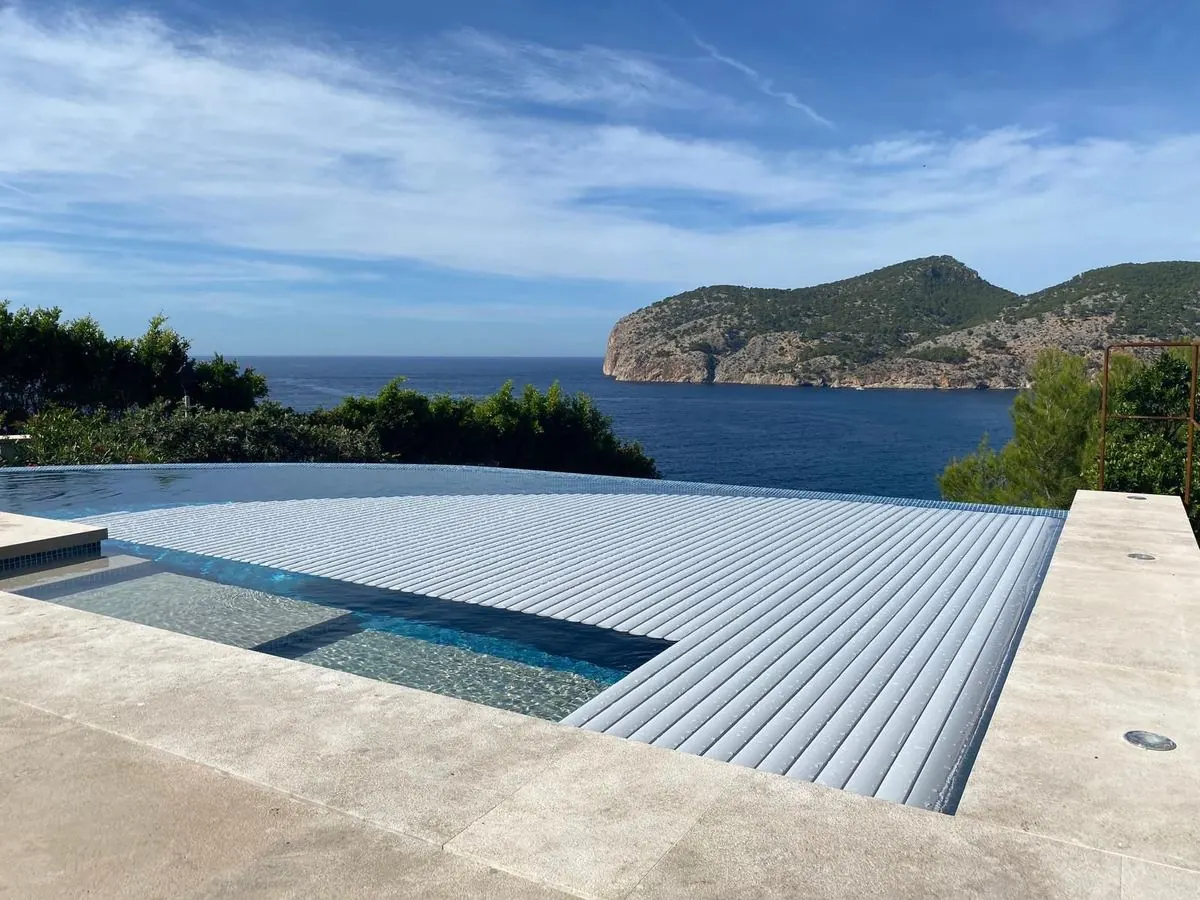
Automatic slatted pool cover closing over a villa pool
Industry terms, explained by the manufacturer

Pool cover glossary

The vocabulary around automatic pool covers can be confusing, especially in a second language. Here is every term we use with clients, explained plainly by a manufacturer that has built and fitted slatted covers in Spain since 2005.

The words you will meet when buying a cover

If you are buying a villa in Spain, or fitting a cover to a pool you already own, you will come across the same handful of words in every quotation you receive — and not every supplier uses them the same way. The most important distinction is where the roller sits: above the water or hidden beneath it. The second is what the slats are made of, since that governs whether the cover is opaque, whether it warms the water and how the pool looks when it is closed. Everything else follows from those two choices. The terms below are grouped in the order you will meet them, and each one is written as we would explain it on site rather than as a catalogue entry.

20+
years in the trade
5,000+
covers installed
100%
made in our own Spanish workshop
100 kg
the closed-cover load in NF P90-308

The cover and its main parts

Automatic slatted pool cover
A motorised system of rigid slats that float on the surface and wind onto a shaft, covering or uncovering the pool in under a minute from a remote or a wall button.
Slat
The hollow, rigid profile that forms the covering surface. Slats clip to one another to form a continuous platform, and are produced in either PVC or polycarbonate.
Shaft
The motorised tube that the slats wind on and off. In most installations the tubular motor sits inside it. This is the correct trade term; you will also hear it called the roller.
Roller unit
The shaft, its motor and its supports taken as one assembly. Where this unit is placed is the single biggest decision in the whole project.
End cap
The moulded plug that closes each end of a slat, keeping water out of the hollow profile.
316L stainless steel
The marine grade of stainless steel, containing molybdenum, which resists chloride corrosion. Every structural part we make — shaft, supports and fittings — is 316L stainless steel, never aluminium. It is what stands up to salt-chlorinated water and coastal air.
Bench
The structure that houses a submerged roller, built either into the floor of the pool or at the entry end, depending on how the pool is designed.
Coping stone
The perimeter edge that finishes the top of the pool shell. On above-water models the roller supports are anchored to it.
Motorisation
The drive as a whole: motor, control panel and remote or button. Every Ingerclima cover is motorised and runs at 230 V / 50 Hz. There is no manual version.

Where the roller sits: above water or submerged

Above-water roller (raised, or visible)
The roller stays above the waterline, resting on the coping stone or on its own supports at one end of the pool. Because nothing is built into the pool shell, this is the option for a pool that already exists: no water is drained and there is no building work inside the pool. It can be left visible or enclosed in a housing that conceals the slats once the cover is open.
Submerged roller (hidden)
The roller sits below the waterline in a bench inside the pool, so that all you see is the slats themselves. It gives the cleanest result and is the usual choice for a new pool or a full refurbishment, because the bench has to be allowed for while the shell is being built. Retro-fitting one to a finished pool means major building work, which is why we ask to see drawings or photographs before recommending it.

Slat materials and what they change

PVC slat
An opaque slat, and the most common choice. It is hard-wearing, easy to keep clean and available in a range of colours, so it can be matched to the coping stone or to the tiling. Because it is opaque it blocks light, which slows algae growth while the pool is closed, and it hides the water completely when the cover is drawn across.
Solar polycarbonate slat
A translucent slat that lets sunlight through and turns part of it into heat, warming the water with no energy cost at all. In practice it stretches the swimming season at both ends, which matters if you are only in Spain for part of the year and want the pool usable in May and October.
Clear polycarbonate slat
Also translucent, but chosen mainly for appearance: the water stays visible through the closed cover, which suits pools overlooked from the house or from a terrace above. All three slat types do the same structural job; the choice between them is about light, heat and how you want the pool to look during the months it is shut.

Safety, controls and other names for the same thing

NF P90-308
The French safety standard for automatic pool covers and the most demanding one they can be built to. It asks three things of the closed cover: that it carries a 100 kg adult applied at any point without giving way, that it opens only by a deliberate adult action, and that it covers the whole water surface with no gap — so a child or a pet cannot reach the water unsupervised.
Safety cover
Any cover that meets such a standard: closed, it carries the weight of a person and acts as a barrier over the water rather than a simple lid. It is not a surface to walk on, and it does not replace adult supervision.
Motor
A tubular motor inside the shaft, or an external motor driving it, always at 230 V / 50 Hz.
Control panel
The enclosure holding the electrics and the safety cut-outs, normally fitted in the plant room with the filtration.
Key switch
A keyed wall switch, so that only an adult with the key can move the cover. It is what most families with small children choose instead of a handheld remote.
Pool shutter
Pool shutter, slatted cover, roller cover and automatic pool blind all describe the same system, and you will see each of them in Spanish quotations translated in different ways. If you are comparing suppliers, the terms that actually matter are the ones above: where the roller goes, what the slats are made of, and whether the cover is built to a safety standard such as NF P90-308.

Common questions

What is the difference between a slatted cover and a safety cover?

They are not alternatives. A slatted cover is the system itself: rigid slats that wind onto a motorised roller. It becomes a safety cover when it is built to a standard such as NF P90-308, which sets how strong the slats must be and how the closed cover has to work as a barrier: it must hold the weight of a 100 kg adult applied at any point and keep a small child out of the water, it must open only by a deliberate adult action, and it must cover the water from edge to edge with no gap. Ours are made to that standard, so you get both in one product.

Do you make a manual version of the cover?

No. Every cover we build is motorised and runs at 230 V — there is no hand-cranked or manual option in our range, and we would not recommend one. What you choose instead is the roller type, above water or submerged, and the slat material. The cover opens or closes in under a minute from a remote or a key switch, which is the point of having one.

Can a submerged roller be fitted to a pool that is already built?

Only with significant building work inside the pool, because the bench that houses the roller has to be formed in the shell. For a finished pool we almost always fit an above-water roller: it anchors to the coping stone, needs no work in the pool itself and the pool stays in use. A submerged roller is planned in from the start on new builds or during a full refurbishment.

What are the slats and the structure actually made of?

The slats are extruded PVC or polycarbonate, in solar or clear. Everything structural — the roller, the supports, the fixings — is 316L stainless steel, the marine grade, chosen because it lives permanently in chlorinated or salt-treated water and Mediterranean air. We do not use lighter metals for these parts. It is one of the reasons covers we fitted in the mid-2000s are still working today.

Does a French standard mean anything for a pool in Spain?

NF P90-308 is French, but it is the reference the whole European industry works to, and it is what we build against wherever the pool is. Spanish rules on private pools vary by region and are generally less specific about covers. Building to the French standard means that, closed, the cover has to hold a small child out of the water and take the weight of an adult, open only when an adult decides to open it, and cover the pool from edge to edge, which is what matters if children or pets use the garden.

Talk to the people who make and fit your cover

Tell us about your pool in Mijas and we'll recommend the right slat, then give you a clear price and timeline. Call +34 916 315 940, message us on WhatsApp at +34 675 651 156, or ask us to arrange a site visit from our San Pedro de Alcántara base.

Not sure which cover your pool needs?

Tell us how your pool is built — dimensions, coping, whether it is finished or still on the drawings — and we will tell you which roller and which slat suit it. Written quotation within 24 hours. Call +34 91 631 59 40.

Chat with us on WhatsApp