Ingerclima — automatic slatted pool covers
+34 91 631 59 40 Get a Quote
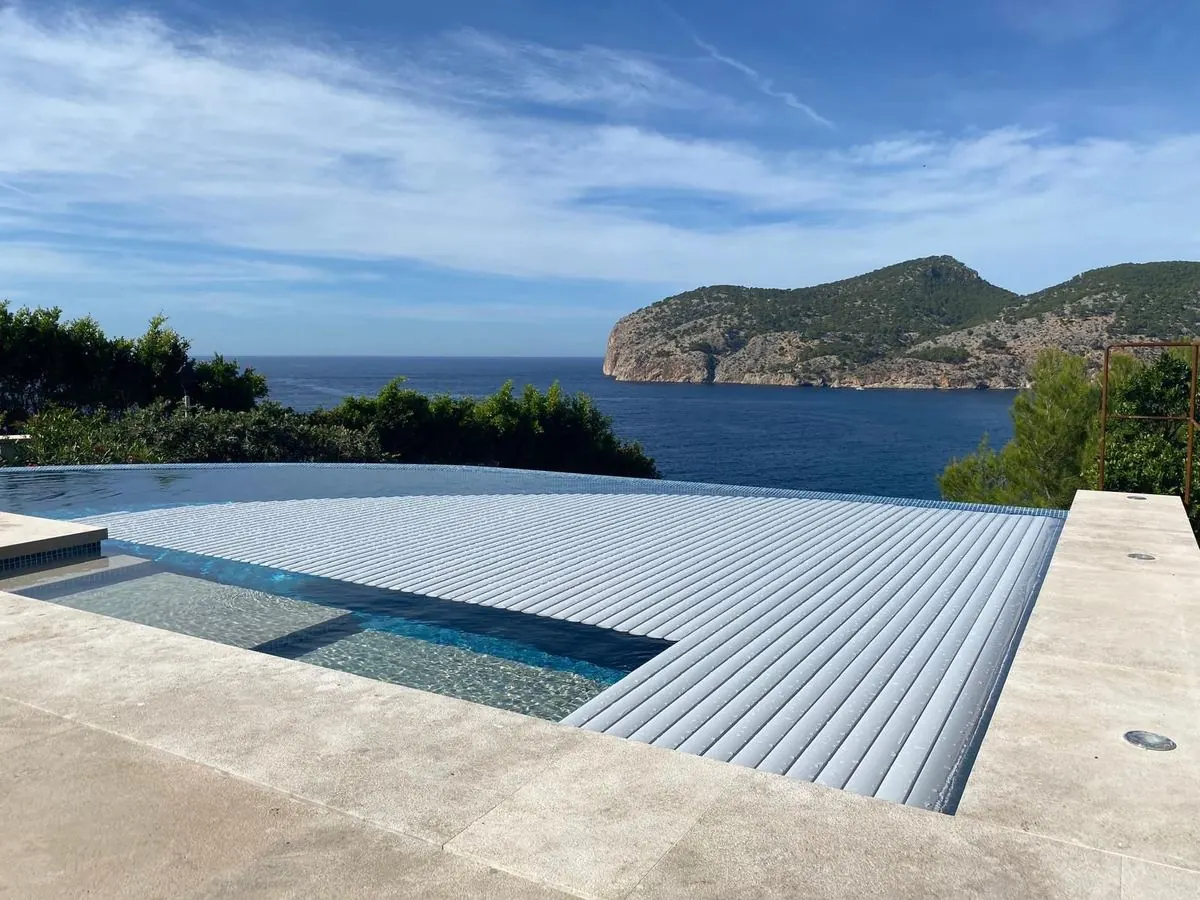
Automatic slatted pool cover closing over a villa pool
An honest comparison from a cover manufacturer

Ways to cover a pool, compared

There are several sensible ways to keep a pool covered, and they solve different problems. This page sets them side by side: what each one asks of you, what it actually protects against, and where an automatic slatted cover genuinely earns its place.

Start with the problem you're solving

Ask ten owners on the Costa del Sol or in the hills above Madrid why they want the pool covered and you'll get four answers: a toddler visiting in August, a heat pump running all night for nothing, leaves and Saharan dust every time the wind turns, or eight months a year when nobody is in the house. Each problem has a different best answer, and no product wins on every count. We make one thing — automatic slatted covers, motorised, built to measure since 2005 — so our bias is obvious and you should read this knowing it. What follows is still honest. There are pools where a net or a bubble cover is the sensible purchase, and we'll say so. There are others where nothing else will do, and we'll explain why.

20+
years in the trade
5,000+
covers installed
100%
made in our own Spanish workshop
NF
P90-308 safety standard

The options, honestly

A bubble cover is a floating polyethylene sheet with air cells moulded into it. It slows evaporation and holds a little warmth overnight, which is real value for a very simple product. It also has to be pulled on and off by hand, it looks like what it is, and it offers no protection whatsoever: a child or a dog goes straight through it. We don't make them.

Winter debris covers and safety nets are stretched across the pool and anchored to the surround. They keep leaves, dust and rain out through the closed season, and a properly tensioned net will hold a child. What they won't do is come off in thirty seconds because the sun appeared. They are a seasonal decision rather than a daily one, and again, not something we supply.

Telescopic enclosures and domes cover the water and the space above it. They stretch the swimming season further than anything else here and shelter you from wind. They are also a structure: they need somewhere to slide back to, consent in some municipalities, and they change a terrace permanently. Some owners love them; others feel they swapped a pool for a conservatory. We don't build them.

An automatic slatted cover is a deck of rigid slats — PVC or polycarbonate — that unrolls across the surface from a stainless steel roller, driven by a motor. One press on a remote or a wall switch and the pool is shut in well under a minute. The slats float, they carry an adult's weight, and ours are built to NF P90-308. This is the only product we make.

Where the slatted cover pulls ahead

Evaporation is the quiet expense of a pool in Spain. A closed cover cuts it by roughly 70 to 80 per cent — on a typical 8 by 4 metre pool, somewhere between 15,000 and 25,000 litres a year that simply stays where you put it. That is water you don't buy, don't top up by hose, and don't rebalance chemically every time the level drops. Water is only one of the five bills a pool sends you each year; the rest are in what a pool costs to run in Spain.

The same barrier holds heat, because the surface is where a pool loses it. If you run a heat pump, the water starts the morning close to where it finished the evening and the pump works far less to recover it. Sunlight stops burning off chlorine, so chemical use falls as well. No single day is dramatic. Across a season the difference is unmistakable.

Then the part that isn't about running costs. A cover made to NF P90-308 is tested to take an adult's weight and to resist a child working at its edges. Closed, the pool stops being an open hazard when grandchildren visit or a gate is left open. A net does some of this; a bubble cover does none of it.

Matching the cover to your pool

Two decisions shape the job. The first is where the roller sits. On a pool that already exists it goes above the water at one end, visible, with or without a housing over it — nothing is cut into the shell and the pool doesn't come out of use. On a new build or a full refurbishment, the roller can instead be hidden below the waterline, out of sight.

The second is the slat. Solid PVC is the workhorse: opaque, tough, available in several colours, the usual answer when protection and insulation are the point. Polycarbonate slats are hollow and translucent — the solar version passes sunlight through to warm the water beneath, the transparent version lets you keep looking at the pool while it's closed. Both float, both meet the same standard.

Everything structural is 316L stainless steel, the marine grade, because a terrace near the sea is salt-laden and chlorinated and lesser metals show it within a few seasons. The drive is a 230 V motor — every cover we build is motorised, with the control placed where you want it, by the coping stone or indoors. There is no hand-cranked version of what we do.

What working with the manufacturer looks like

We build in Torrijos, near Toledo, and have done since 2005 — more than 5,000 installations. Send the length, the width and a photo of the surround, or we come and measure. The cover is made to those dimensions, and installation is normally a single day: we commission it, show you how to run it, and go.

After that you deal with the people who made it. A part or an adjustment goes through us, not a distributor, which is the practical reason so much of our work comes from owners who aren't in Spain all year. On the coast we work from San Pedro de Alcántara in Marbella. Call +34 91 631 59 40 or write to info@ingerclima.com.

Common questions

Which cover makes sense if the house is empty for months at a time?

An automatic cover, provided you shut it before you leave. It keeps out leaves, dust and rain, holds the water level, and removes the open-water hazard while the house is empty. Debris covers do the first part well, but somebody has to be there to fit and remove them. If you have a caretaker, either works. If you don't, the cover you can close on your way to the airport is the useful one.

Can an automatic cover be fitted to a pool that's already built?

Yes — that is most of what we do. The roller sits above the water at one end, on stainless steel supports fixed to the surround, so nothing is cut into the shell and the pool doesn't need emptying. You can leave it in view or have a housing over it. A hidden roller below the waterline is possible too, but that one belongs to a new build or a full refurbishment.

Do slatted covers heat the water, or only stop it cooling?

Both, depending on the slat. Any closed cover sharply cuts overnight losses, since the surface is where the heat escapes. Solar polycarbonate goes further: it lets sunlight through into the water and traps the warmth underneath, so the pool gains temperature on a clear day even while shut. PVC insulates rather than collects. If a longer season is your priority, ask about the solar slat.

Is it safe enough to rely on with small children around?

Our covers are made to NF P90-308, the French standard and the strictest reference applied to pool covers in Europe. Closed, the slats support an adult's weight and resist being forced apart at the edges, so the pool is genuinely barred rather than screened. It is not a substitute for supervision — no manufacturer would claim that — but a closed pool is a very different risk from an open one.

How does it cope with wind, salt air and the Spanish sun?

The structure is 316L stainless steel, chosen for coastal air, and the slats are UV-stabilised for this climate. Closed, the cover rides on the water and is held at the edges, so it deals with wind better than anything strung across a pool. What eventually needs attention is the moving parts, and since we make them ourselves we can service them. We look after what we build.

Talk to the people who make and fit your cover

Tell us about your pool in Mijas and we'll recommend the right slat, then give you a clear price and timeline. Call +34 916 315 940, message us on WhatsApp at +34 675 651 156, or ask us to arrange a site visit from our San Pedro de Alcántara base.

Tell us about your pool

Send the length, the width and a photo of the surround, and say whether the pool is built or still on paper. We'll tell you which arrangement suits it and what installation involves. Call +34 91 631 59 40 or email info@ingerclima.com.

Chat with us on WhatsApp