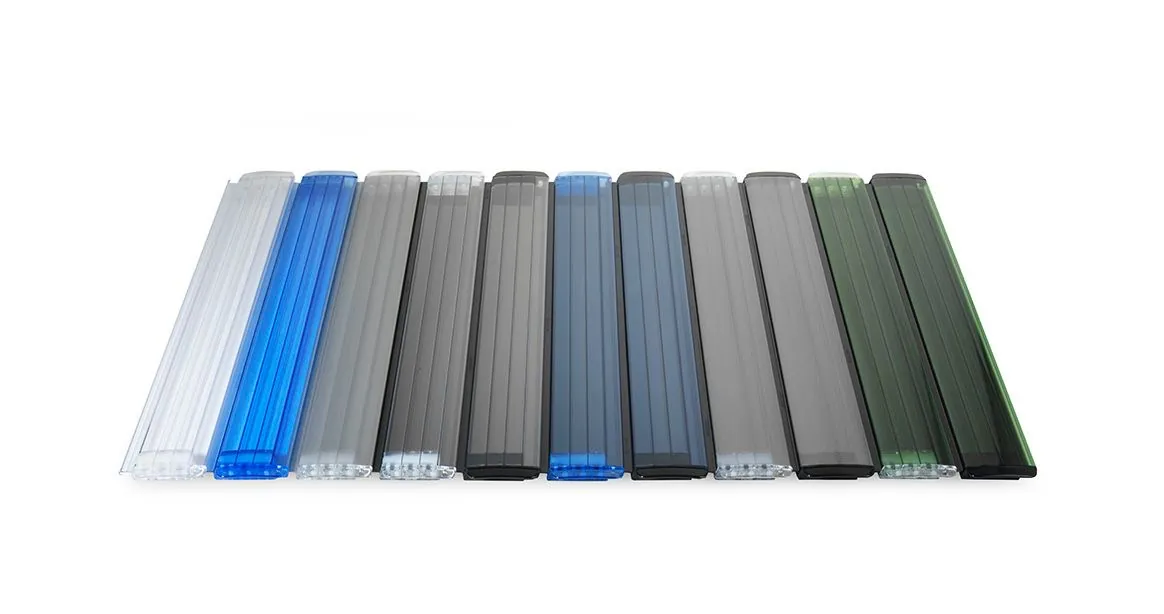
The slat material determines how much your pool heats up, how much light passes through and how it looks. We help you choose.
The slats are the most important part of your cover: they determine solar light entry, water heating, durability and aesthetics. We manufacture in three different materials with different performance.

PVC slats are the most affordable and most widely used option. Made from high-density polyethylene, they are lightweight, resistant to pool chemicals and easy to maintain.
Although they don't transmit sunlight to the water, they are excellent at retaining the heat built up during the day and protecting against evaporation.
Choose the colour

Solar polycarbonate slats are the preferred choice for those seeking to maximise water heating. Their triple-extrusion cellular structure traps solar heat and transfers it directly to the water, working like a natural solar collector.
They can raise the water temperature by up to 6-7°C with no additional energy consumption. Available in 7 colours, each with different thermal absorption properties. Where that 6-7 °C fits alongside a heat pump is explained in heating a pool in Spain.
Choose the colour

The premium option in terms of aesthetics. Transparent slats let you see the pool water even when the cover is closed, preserving the brightness of the space and the visual appeal of the pool.
Especially recommended for indoor pools or shaded areas, as they maximise natural light entry.
Choose the variant
| Feature | PVC | Solar Polycarbonate | Transparent Polycarbonate |
|---|---|---|---|
| Water heating | Medium | High (6-7 °C) | Medium |
| Transparency | Opaque | Semi-transparent | Fully transparent |
| Strength & durability | Very high | High | High |
| Guide price | Economical | Medium | Premium |
| Maintenance | Minimal | Low | Low |
| Ideal for | General use, tight budget | Maximum solar heating | Premium aesthetics, indoor pools |
These are the figures for our slats and for the structure that moves them. The detail most often overlooked is the material: the shaft, the brackets and the fittings are AISI 316L stainless steel, the marine grade, which contains molybdenum. That is what stands up to salt chlorination and coastal air, where sea salt destroys weaker fittings. Every term is explained in the glossary.
We answer the most common questions about our covers' materials and colours.
Solar polycarbonate is the most efficient option: its triple-extrusion cellular structure acts like a small greenhouse and can raise the water temperature by up to 6-7°C compared with an uncovered pool.
No. PVC slats have a specific UV treatment for outdoor use and keep their colour over the years, even with intense, continuous sun exposure.
Yes. Both PVC and solar polycarbonate are available in several colours and finishes. You can view and select the options above in each section.
Yes, transparent polycarbonate allows almost all light to pass through, ideal for preserving the water's appearance and for indoor pools where maximum brightness is desired.
Minimal. A periodic clean with water and mild soap to remove dust or limescale is enough. They need no varnishing or additional treatments.
With proper maintenance the slats last 10 to 15 years, and the 316L stainless steel structure that carries them lasts more than 15. When the time comes the slats are replaced without touching the rest of the cover: we manufacture and supply them ourselves.
The slats are the main component of an automatic pool cover. If you would like to know how to cover your pool or find out the price of an automatic cover, we explain it in detail.
Seven pages comparing PVC, solar polycarbonate and transparent polycarbonate: how much each one warms the water, how much light it lets through and how it looks.
