Ingerclima — automatic slatted pool covers
+34 91 631 59 40 Get a Quote
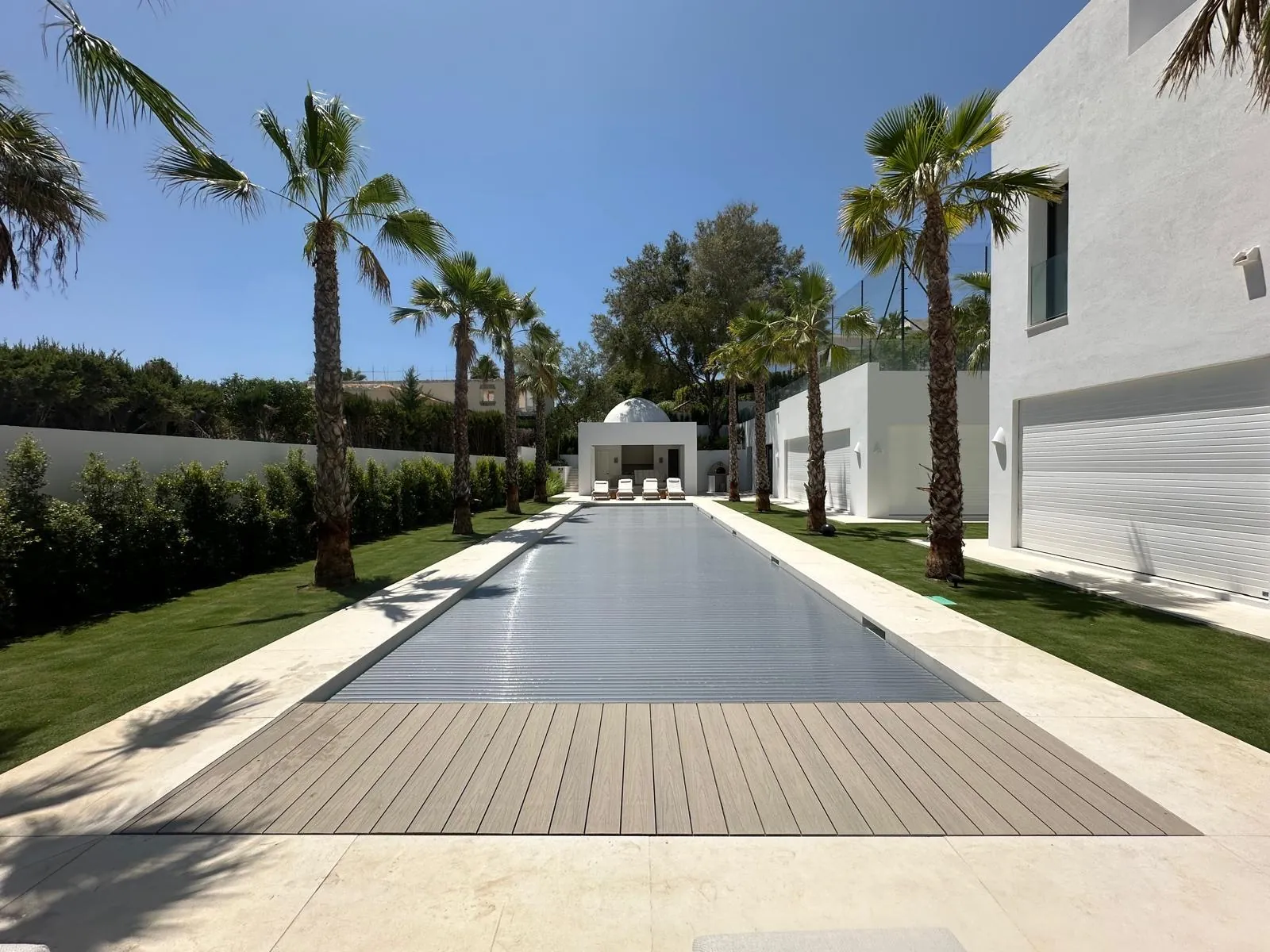
Automatic white PVC slatted cover closed over a private villa pool on the coast
Salobreña · Costa Tropical, Granada, below the Nasrid castle

Automatic pool covers in Salobreña

We make and fit automatic slatted covers across the whole municipality of Salobreña: the old town climbing the castle rock, the urbanisations of the beach front and the Guadalfeo valley, La Caleta-La Guardia, Lobres, and the hillside villas of Monte de los Almendros, Costa Aguilera and El Pargo. Structure in AISI 316L stainless steel, and a three-year warranty covering structure, motor, slats and installation.

Three Salobreñas, three different pools

Salobreña packs three different towns into thirty-five square kilometres, and each of them asks for a different cover. Up above sits the old town, crowded onto the rocky promontory topped by the Nasrid castle, 68 metres above sea level: small courtyards, short pool shells and streets no lorry will get into. Below, between the Peñón and the mouth of the Guadalfeo, runs the beach front, with the apartment blocks and second homes of Mare Nostrum, Salomar 2000, Cala Verde, Los Faroles, El Molino, La Fragata, Mayorazgo and Salobreña Beach, where almost every pool is a communal one. And on the hillside, looking out at the sea and at Sierra Nevada at the same time, stand the villa urbanisations: Monte de los Almendros, which by the urbanisation's own count already has 380 villas and some 126 plots still to be built, Costa Aguilera, El Pargo and Alfamar.

That difference is not incidental: it decides the model. On the hillside the shell sits on terraces and retaining walls, with the coping stone a hand's width from the edge, so a shaft above the water has to fit the width that is actually there, not the one that would suit us. In the old town and in Lobres it is access that rules, because the shaft and the slats arrive in long pieces. In the beach-front communities the deciding factors are safety and how the cleaning gets shared out among a lot of residents. That is why we measure every shell ourselves before anything is cut, make each cover to size in AISI 316L stainless steel, and build it to the NF P90-308 safety standard.

20+
years in the trade
5,000+
covers installed
100%
made in our own Spanish workshop
NF
P90-308 safety standard

What sets us apart in Salobreña

A manufacturer, not a middleman

We design, make and fit the cover ourselves. You deal directly with the people who build it: no commission-only salespeople, no subcontractors and no mark-up for passing the job along.

A slat chosen for the Costa Tropical

With winters around 12 °C and more than 320 days of sun a year, here the slat is chosen to make the most of the radiation: solar polycarbonate warms the water at no running cost, while opaque PVC is the standard when what you want is to insulate and cover. We look at it pool by pool.

Safety built to NF P90-308

Closed, a slatted cover is a physical barrier that keeps children and pets off the water, and it is built to the NF P90-308 standard. More than 5,000 installations across Spain stand behind it.

Where we work around Salobreña

We cover the whole municipality: the nine settlements the Andalusian Institute of Statistics and Cartography recognises in Salobreña, from the old town to Lobres and from the beach to the hillside urbanisations. And we carry on into the neighbouring municipalities, from Motril to Almuñécar and inland through Molvízar, Ítrabo, Vélez de Benaudalla and Los Guájares. If your urbanisation is not on the list, tell us the street or the nearest exit off the A-7 and we will confirm the visit.

Old town and around

  • Old town and castle
  • El Peñón
  • Lobres
  • Calamedina

Beach and vega

  • Playa Salobreña
  • La Charca (Salomar)
  • Playa de La Guardia
  • Vega del Guadalfeo

Hillside urbanisations

  • Monte de los Almendros
  • Costa Aguilera
  • El Pargo
  • Alfamar

La Caleta and neighbours

  • La Caleta-La Guardia
  • Motril and Almuñécar
  • Molvízar and Ítrabo
  • Vélez de Benaudalla and Los Guájares

An honest word about the 18680: in Salobreña, access matters as much as the pool does. The shaft arrives in a single piece several metres long and the slats in long bundles, and there are two places where that gets complicated: the steep lanes of the old town, where unloading ends up being done by hand from the nearest car park, and the ramps and bends of the hillside urbanisations. Before we settle the measurements we ask you for photographs of the ground around the pool and of the way in to it. If the material has to go up by hand, we say so and plan for it; we do not find out on fitting day.

Salobreña has 892 pools on the Catastro register

The Catastro records 892 open-air pools in Salobreña, 18 more than in 2022. That is a large stock for a municipality of barely thirty-five square kilometres and some 12,700 residents: about twenty-five pools per square kilometre, or one for every fourteen inhabitants, in one of the 174 municipalities of the province of Granada.

The figure has to be read with three cautions. The first is that the Catastro records fewer pools than exist, because the register runs behind reality and leaves out undeclared pools: the 892 are a floor, never a ceiling. The second is that it puts the private pool of a villa, an apartment block's communal one, a hotel's and a club's all in the same box, without distinguishing who owns what. And the third is that its smallest unit is the municipality: the 892 are for the whole municipality and cannot be split between the old town, the beach, La Caleta and the hillside urbanisations, nor pinned on any one urbanisation. The province in context, area by area, is on our page on pool covers in Granada (in Spanish).

Salt, subtropical sun and dust off the vega: what Salobreña asks of a cover

Salobreña's climate is semi-arid Mediterranean with a clearly subtropical temperature regime. The town council puts the figures like this: an annual mean above 17 °C, winters around 12 °C, some 24 °C in the warmest months and rainfall of around 500 millimetres a year. That is the climate that made the Guadalfeo valley the last place in continental Europe where sugar cane was grown for industrial use, until the Nuestra Señora del Rosario sugar mill at La Caleta closed in 2006 with the final harvest. Today the vega grows custard apple, mango and avocado, and the pools get what the orchards get: a great deal of sun and very little rain.

The first thing to settle is the salt. At La Caleta-La Guardia, along the beach front and on the slopes of Costa Aguilera and El Pargo the sea is a few hundred metres away, and the breeze leaves a salt haze over everything in the garden. Salt like that makes short work of ordinary fixings. So our whole structure, the shaft, the supports and every fitting are AISI 316L stainless steel, the molybdenum-bearing grade used in marine environments, with no exceptions and no stripped-down version depending on the area. The upkeep we ask of the owner is as simple as rinsing the whole thing down with fresh water now and then.

The second is the sun. With more than 320 days of sun a year and a good share of the hillside terraces facing south, the radiation falls straight onto the cover with nothing to shade the slat from the sky. A badly chosen slat fades and turns brittle in a few summers: the PVC slat we fit has a co-extruded profile and treatment against ultraviolet light, and before recommending a finish and a colour we look at the way your pool actually faces.

And the third is what the air brings. In a municipality with 500 millimetres of rain a year, evaporation is a real expense: an uncovered pool loses water every day of the summer and, with it, the chemicals dissolved in that water. On top of that come the fine dust off the vega and the leaf litter from the subtropical crops, which end up on the bottom every time the wind blows. With the cover closed, evaporation falls by between 70 % and 80 %, chemical consumption drops by around 35 % and the dirt stays up on the slats instead of sinking. You can see the full calculation in how much water a pool loses (in Spanish).

It is worth knowing how it works, because there is a lot of confusion with other systems. Our slats float on the water: they do not rest on the bottom and they never run on rails or side guides. What rests on the coping stone is the legs, the supports with their shaft and, where one is specified, the housing. Every cover is motorised — there is no hand-cranked version — and as standard it is worked beside the pool with a key switch, hold-to-run: the slats move only while the switch is held and with the pool in sight, which is the only safe way to operate it. They carry no alarm and no obstacle sensors: working the cover with something on top of it, or pulling the slats by hand, sets off no warning of any kind — what it does is damage the mechanism. And we do not make walk-on covers, telescopic covers, pool enclosures, domes, winter tarpaulins or bubble blankets: automatic slatted covers only, and since 2005. The sections, the weights and the behaviour of each profile are on our page on slat types, and the roll-up systems on cover models.

Installations along the Andalusian coast

See more photos in the gallery →

How many months can you swim in Salobreña?

With an automatic cover closed overnight, the swimming season in Salobreña runs from May to November. The Costa Tropical helps: with winters around 12 °C the water does not cool as far as it does inland in the province, and even so, without a cover you are left with little more than a short summer, because the pool is slow to warm up in spring and loses that heat as soon as the October sun eases off.

The cover does two things at once: it stops evaporation, which is where most of the heat goes, and if you choose solar polycarbonate slats it lets the sun through and warms the water underneath at no running cost. And to hold the same temperature right through the season, a heat pump with the cover in place uses between 50 % and 60 % less.

What owners say once the cover is in

4.7 15 Google reviews See them on Google →
SR

Santiago R.

June 2026

As my wife rightly says, how lucky we were to find this company. They have done a flawless job because they genuinely know their trade. They know covers, which is what they make and sell, and on top of that they are good people. Thoroughly recommended.

Google review · translated from Spanish
JC

Julia C.

August 2026

The cover is made from excellent materials and the finish is flawless. From the very first contact the service was outstanding and highly professional. They delivered everything they promised and the result exceeded my expectations. I would recommend them without hesitation.

Google review · translated from Spanish
T

Teresa

2025

From the first phone call with the office through to the fitters on the last day, everything was spot on: professional, punctual and tidy. It is a pleasure to find companies that still work like this.

Google review · translated from Spanish
GR

Giuliana R.

August 2026

Excellent pool cover. Everything was good, from the advice to the installation. The cover is very well made, works beautifully and keeps the pool clean and protected. We are delighted with it and would certainly recommend them.

Google Local Guide · translated from Spanish
EV

Eva V.

July 2026

Thoroughly recommended. We are delighted with the cover they fitted for us. The service has been excellent from the very first moment, advising us at every step of the process.

Google review · translated from Spanish

What people ask us in Salobreña

My pool is in Monte de los Almendros, on a terrace and hard up against the retaining wall. Will a cover fit?

Almost always, yes, but it has to be measured first. On a pool that is already built we fit the shaft above the water, with its legs and AISI 316L stainless steel supports resting on the coping stone: the shell is not touched, none of the tiling is chipped out and there is no building work. What decides the job on the Salobreña hillside is the clear width left between the water and the wall, because the shaft and the housing take up real space. We come and look, we measure, and if it will not fit across the short side we look at rolling from the other end. If there is no way of fitting it, we tell you so.

I live right by the sea, at La Caleta. Will it stand up to the salt?

That is exactly what the 316L is for: a molybdenum-bearing stainless steel made for marine environments. It is the material of the whole structure, of the shaft, of the supports and of every bolt, with no exceptions, no substitutes and no stripped-down version depending on the area. The slat is not affected by salt either. All we ask of the owner is to rinse the whole thing down with fresh water now and then, above all after several days of salt-laden breeze.

We bought the house for the view of the Peñón and Sierra Nevada. Is there a way to keep the cover out of sight?

Yes: the submerged shaft. The shaft is hidden inside the shell itself and from the terrace you see nothing but water, which is exactly what anyone who bought on the hillside for the views is after. The drawback is the timing: it has to be allowed for in the shell and decided with the builder before the concrete is poured, not afterwards. If the pool is already built, the clean alternative is the visible shaft with its housing: we supply the housing, and it can be clad in the same material as the rest of the pool, so that the cover blends into the poolside. All our covers are motorised; there is no hand-cranked version.

We are a residents' association down on the beach front. Can the communal pool be covered, and does it count as a safety measure?

Yes, and it is a regular job in the urbanisations of Playa Salobreña. Closed, a slatted cover is a real physical barrier over the water, and it is built to the NF P90-308 safety standard: built to it, not certified to it — that is our own declaration as the manufacturer, because no piece of paper exists that “certifies” a cover under that standard. As standard it is worked beside the pool with a key switch, hold-to-run, so control stays with the administrator or the caretaker rather than with whoever happens to walk past. Two things worth knowing: the cover carries no alarm and no obstacle sensors, so forcing it with something on top of it damages the mechanism without warning anyone, and it is no substitute for adult supervision. We set it out in covers for communal pools (in Spanish).

Do you have an office in Salobreña or on the Costa Tropical? And how long does it all take?

We have no office in Salobreña or on the Costa Tropical, and we would rather say so plainly. The service is run from our factory in Torrijos (Toledo) or from our Andalusian branch in San Pedro de Alcántara (Marbella), which is the one that covers the province of Granada. On timings: once the order is confirmed we make the cover to measure in 4 to 6 weeks, and to that you add the installation, which is done in a day or two depending on the shell and the access. The warranty is three years on the whole system: structure, motor, slats and installation.

Architects, contractors and developers in Salobreña

We manufacture in our own workshop in Torrijos (Toledo), with the structure and all fittings in AISI 316L stainless steel, and we carry out the installation ourselves. For a practice, a main contractor or a developer, what matters is deciding the cover at design stage: a submerged shaft has to be allowed for in the shell before any concrete is poured, whereas a cover that arrives at the end of the build is normally resolved with a visible shaft. On the hillside plots of Salobreña there is a second reason to decide early: the clear width between the water and the retaining wall is fixed when the pool is set out, and it cannot be won back afterwards. If the project is in Salobreña and the client is yours, the relationship stays with you.

How we work with professionals Download the slat comparison (PDF) →

Salobreña: a longer season without the running costs

In Salobreña the sun is with you for much of the year and the winter is mild, but the water in an uncovered pool cools overnight just as it does anywhere else. Which is why owners who want to swim in April or in November end up looking at a heat pump.

Before choosing equipment, this is worth knowing: evaporation is the largest route of heat loss in a pool, and an automatic slatted cover cuts it by between 70 % and 80 %. Heating consumption falls with it by between 50 % and 60 %. Without a cover, the heat pump works all night replacing what evaporates, and in a municipality with around 500 millimetres of rain a year you pay for that twice over: in electricity and in top-up water.

The combination that works best on the Costa Tropical is a solar polycarbonate cover — which adds up to 6-7 °C during the day at no running cost, making use of those 320 days of sun — with equipment sized afterwards, once the losses are under control. You can see it in detail in pool heating.

Ask us to look at your pool in Salobreña

Tell us where your pool is — the old town, the beach, La Caleta, Lobres or the hillside — and its rough measurements, and we will put together a no-obligation quote in under 24 hours, in English. Made in our own factory in Torrijos, fitted by our own crew, with after-sales service and original spare parts.

Chat with us on WhatsApp