Ingerclima — automatic slatted pool covers
+34 91 631 59 40 Get a Quote
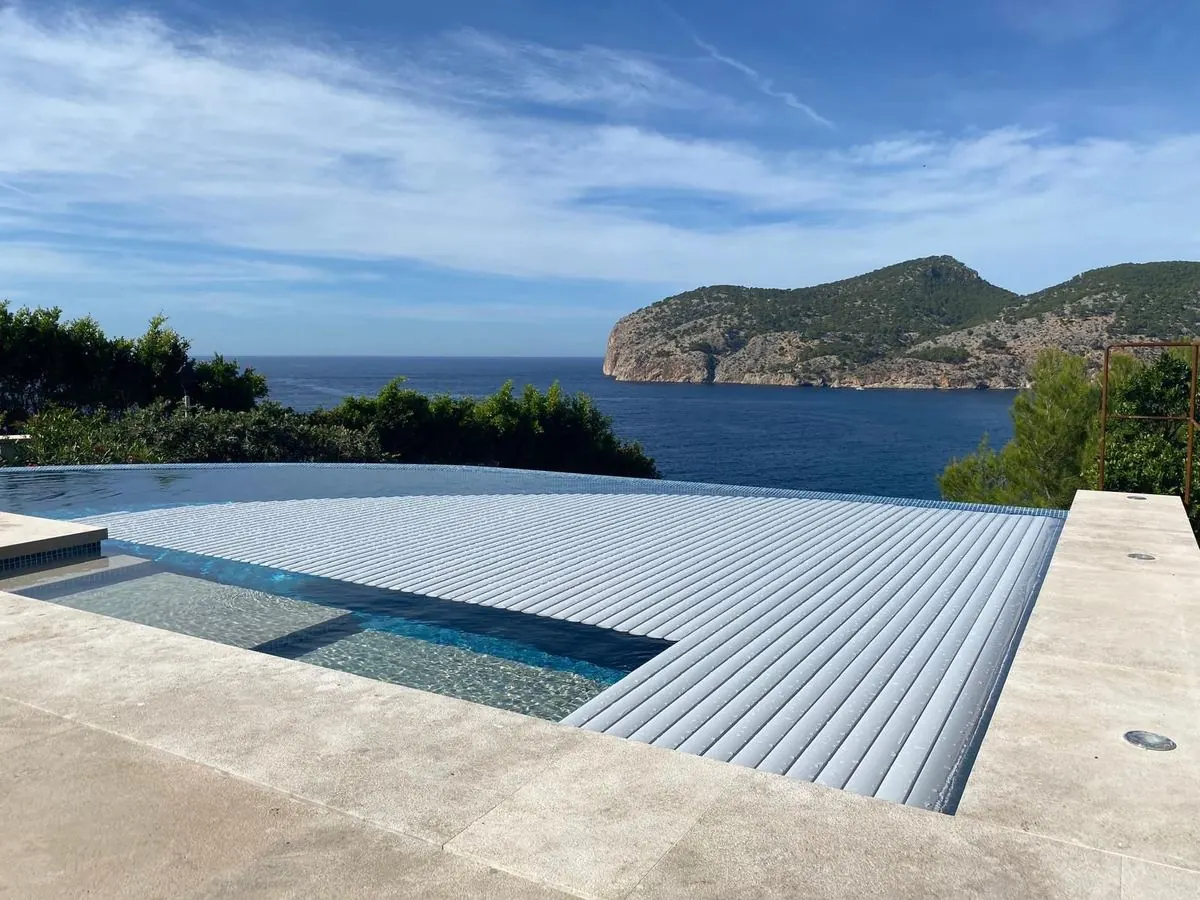
Automatic slatted pool cover closing over a villa pool
Made in our own factory · Quote within 24 hours

What does an automatic pool cover cost?

It depends on your pool, not on a price list. Length, width, the slats you choose and where the roller sits all move the figure. Here is how each one works — and how to get a written quote within 24 hours.

Why there is no price list

No two pools are the same, so a headline figure would be misleading before we have seen yours. A 10-metre lap pool with a Roman end and a submerged roller is a different piece of engineering from a rectangular 8 by 4 with the roller sitting on the coping stone. We have been making these covers since 2005 and we build every one to measure in our own factory in Torrijos, near Toledo, then install it ourselves — there is no dealer or intermediary between the factory and your garden. What we can do is be completely transparent about what moves the number. Five things account for almost all of it: the dimensions and shape of the pool, the slat material, the roller system, access to the poolside, and whether the pool already exists or is still being built. Send us those details and you will have a written, itemised quote within 24 hours, with no obligation.

20+
years in the trade
5,000+
covers installed
100%
made in our own Spanish workshop
NF
P90-308 safety standard

Start with the pool: size, shape and steps

Dimensions are the biggest single factor. The width of the pool sets the length of every slat; the length sets how many slats there are and how much torque the motor must produce to move them. Scaling up is not linear — a longer pool needs a heavier-duty roller and a larger motor, not simply more slats.

Shape comes next. A rectangle is the simplest case: the slats travel in one plane from end to end. Kidney shapes, Roman ends, curved corners and steps built into the shell each need a solution designed around them — shaping the slat pack to the outline, or placing the roller on the straightest run of water. After 5,000-plus installations we have seen nearly all of them.

Every cover we make is motorised at 230 V — there is no manual version — and every one is built to comply with NF P90-308, the standard governing slatted safety covers in Europe. That is part of the product, not an upgrade: the slat locking and the safety performance of the closed cover are in the specification you are quoted for.

The slats: PVC or polycarbonate

The slats are the visible half of the cover and the second lever on the budget. PVC is the most economical and by far the most common: solid, opaque, available in several colours, and very effective at stopping evaporation and keeping leaves out of the water. For a family pool it does everything that is asked of it.

Solar polycarbonate slats are hollow and translucent. They let sunlight through to the water and hold the warmth under the closed cover, which lifts the temperature by several degrees over a season and stretches your swimming year at both ends. They sit above PVC on the quote, but if you heat the pool the heat pump gives that difference back.

Transparent polycarbonate is the premium slat. Closed, the cover all but disappears and the pool still reads as water from the terrace or the house — which is why architects specify it on villas where the view matters. Whichever slat you choose, the roller, motor and fixings underneath are the same 316L stainless steel in every cover we build.

The roller: over the water or hidden below it

The roller can sit above the water on the coping stone at one end of the pool, or hidden beneath the waterline. The over-water system is the more economical and much the quicker to fit: its supports are anchored to the coping stone, nothing is done to the shell, and a straightforward installation is finished in a day. The roller can be boxed in or left open.

A submerged roller lives inside the pool, in a bench built across the entrance end or into the floor of the shell, and vanishes from sight. It is the better-looking answer, but the bench has to be built, waterproofed and tiled — which is why a submerged system sits above an over-water one on the quote, and why it suits a pool still under construction.

So the first thing we ask is whether the pool already exists. On a finished pool we work entirely from the coping stone: no draining, no drilling into the shell, no retiling, no builder. If the villa is still going up, tell us before the shell is poured — designing the bench in from the outset is far simpler than retrofitting one later.

Access, distance and getting a firm figure

Two practical things close the list. Access: the slats and the roller arrive in full lengths and must reach the poolside, so a garden served only by a narrow passage or steps takes longer than one a van can park beside. And distance: we manufacture in Torrijos, near Toledo, with a second base in San Pedro de Alcántara, Marbella, so journeys within the centre and the Costa del Sol are short; further afield, the team's travel is costed into the quote.

It is worth reading the quote against what the cover gives back. On a typical 8 by 4 metre pool a closed cover prevents 15,000 to 25,000 litres of evaporation a year; with a heat pump it cuts seasonal consumption by roughly 50 to 60 per cent; and chemical use falls by about a third. Most owners reckon on five to ten years to pay it back. The figures behind that are broken down in what a pool costs to run each year and in heating a pool in Spain.

To quote properly we need the internal length and width at water level, the shape, whether there are steps inside the shell, two or three photos of the poolside and the name of the town. Send that to info@ingerclima.com or ring +34 91 631 59 40 and the itemised quote comes back within 24 hours. Finance through BBVA is available if you would rather spread the payment.

Common questions

Why don't you publish a price per square metre?

Because a slatted cover is not sold by area. Two pools of identical surface can need different slats, a different roller position and completely different installation work — one over the coping stone in a day, the other around a bench built into the shell. Quoting per square metre would mean either overcharging half our customers or under-specifying the cover. We measure, then we quote.

Which works out cheaper, an over-water roller or a submerged one?

The over-water system, consistently. Its supports are anchored to the coping stone, so there is no building work, no draining and no tiling — the whole installation is normally done in a day. A submerged roller has to sit in a bench built inside the shell, and that construction is what lifts the figure. It looks better, which is why it is worth it on a new build.

Are polycarbonate slats worth paying more for than PVC?

It depends on how you use the pool. If you swim mainly in July and August, PVC is the sensible choice and does the job. If you want a longer season, or you already run a heat pump, solar polycarbonate earns its place: it passes sunlight into the water and holds the warmth in, so the pump works fewer hours. Transparent polycarbonate is chosen mostly for the way it looks.

Can a cover be fitted to a pool that is already built?

Yes, and it is most of what we do. The roller sits on the coping stone at one end, the supports are anchored there, and nothing happens inside the shell — no draining, no drilling, no retiling. The cover is motorised at 230 V and built to NF P90-308, so it also functions as a safety cover once closed. A typical installation takes a single day.

I'm only in Spain part of the year. How does the process work?

Most of our British, Dutch and Belgian customers are. Send measurements and photos by email and we will quote within 24 hours; we then survey on site, manufacture in Torrijos and install with your key holder, property manager or builder present. You get photographs and a handover on completion, and we run you through the controls whenever you are next over. Call +34 91 631 59 40.

Talk to the people who make and fit your cover

Tell us about your pool in Mijas and we'll recommend the right slat, then give you a clear price and timeline. Call +34 916 315 940, message us on WhatsApp at +34 675 651 156, or ask us to arrange a site visit from our San Pedro de Alcántara base.

Tell us about your pool

Send the measurements, the shape and a photo or two, and we will come back within 24 hours with an itemised quote for your pool — no obligation. Call +34 91 631 59 40 or write to info@ingerclima.com.

Chat with us on WhatsApp