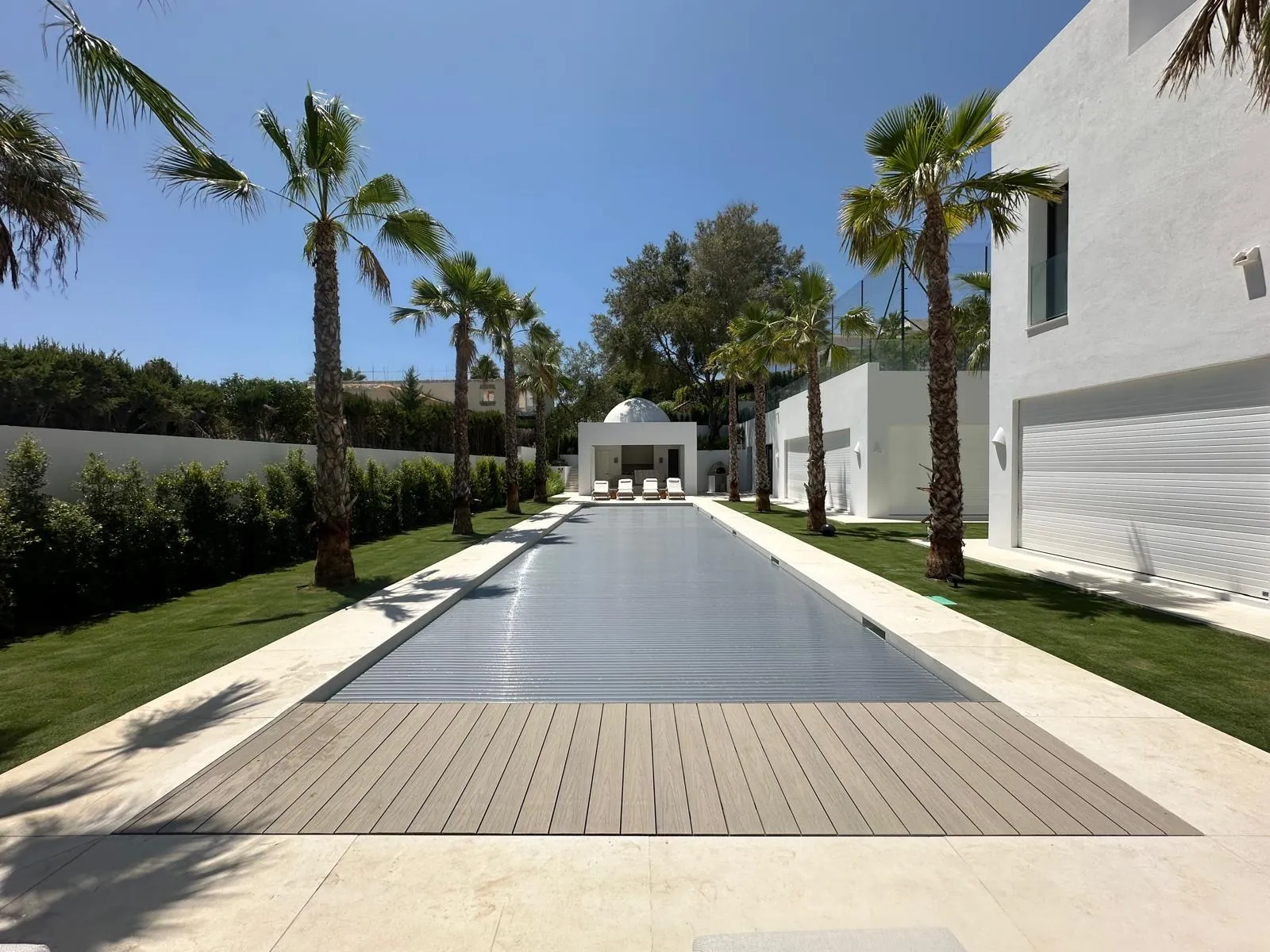
We make and fit automatic slatted covers across the whole municipality: the town centre, Sierra Gorda, Los Llanos, El Albaicín and the urbanisations along the Monda and Mijas roads. Our own crew, out of the San Pedro de Alcántara branch, with no building work in the pool shell.
The Catastro counts 2,697 pools in the municipality of Coín, enough to put it ninth of the 103 in the province of Málaga. It is a figure that cuts against the idea that pools in Málaga are on the coast: Coín has no beach, it sits in the Guadalhorce valley, and even so it is ahead of neighbours in the valley itself such as Cártama, with 1,882. We have made automatic slatted covers since 2005, with more than 5,000 installations and our own factory in Torrijos (Toledo) — but whoever measures, fits and comes back to Coín to adjust a limit switch sets off from our branch in San Pedro de Alcántara.
A pool in Coín is almost never a shell tucked behind a block of flats. It is a plot pool: a single-family house, land around it, trees nearby and, very often, a foreign owner who spends a good part of the year here. That changes the brief. The cover is not asked for only because of the water it saves; it is asked for because the pool goes weeks with nobody swimming, and because uncovered it fills with leaves and soil as soon as the wind gets up in the valley.
Every cover we make is motorised at 230 V, and there is no hand-cranked version. As standard it is operated beside the pool with a key switch, hold-to-run: the slats move only while the switch is held, with the water in view. A remote and operation from a phone through a receiver are optional extras in the quote. The structure and fittings are AISI 316L stainless steel, never aluminium, and the cover is built to the French standard NF P90-308. Manufacturing takes 4-5 weeks, because each cover is made to the size of your pool, and the warranty is three years on the whole assembly.
A country plot: leaves, soil and the filter. In Coín the pool is usually surrounded by ground rather than paving. Uncovered, every gust off the valley puts leaves, dust and fine soil into the water, and all of it ends up on the bottom and in the filter. With the cover closed the dirt stays on top of the slats and comes off with a hose. Chemical use drops by around 35 % and the plant needs fewer hours to leave the water just as clear.
Inland, the water goes at night. Coín is in the valley, not on the beach front, and before dawn the water loses what it gained during the day. The main route of that loss is evaporation, and a closed slatted cover reduces it by 70-80 %: in an 8 × 4 metre pool, 15,000 to 25,000 litres a year, whether anyone swims or not. With solar polycarbonate slats the water also gains 6-7 °C during the day at no running cost, and if there is a heat pump its consumption falls by 50-60 %.
The pool a long way from the house. On the plots along the Monda and Mijas roads the pool is often tens of metres from the house and unfenced. Closed, the slats form a continuous surface that holds 100 kg to NF P90-308, the French anti-drowning standard: that does not make it walkable or trafficable, but it does keep anyone out of the water. It is operated with a key switch beside the pool, hold-to-run, and you watch the pool while the slats move.
We cover the whole municipality, from the town centre to the urbanisations on both roads, and carry on up the valley to Monda, Guaro and Tolox. Alhaurín el Grande, Alhaurín de la Torre, Mijas and Marbella each have their own page, with the models and lead times for that area.
Here, measuring on site is not a formality. Many plots are entered along an unmade lane, a lorry does not always reach the edge of the pool, and the shaft is made to measure in one piece — so we work out how it gets in and how it is unloaded before we give a fitting date.
If access means a barrier, a gate code or a key held by a neighbour, tell us when we book the visit.
Thirty minutes from Marbella by the A-355, and yet the pool behaves nothing like a seafront one. The valley heats hard by day and drops at night, so the water never settles at a temperature on its own: in spring it is slow to start and in autumn it fades early. The cover closed overnight is what keeps the day's heat in the water.
The slat is 60 mm wide, weighs 8.1-9.6 kg/m², floats on the water and is rated for Hail Class 4. PVC is the usual choice for family use and the most common here. Solar polycarbonate lets the sun through and raises the water by 6-7 °C at no running cost, which on an inland plot is what separates swimming in May from waiting for late June. Clear polycarbonate is chosen for how it looks.
The slat lasts 10-15 years and is replaced without touching the structure, which being 316L goes beyond 15. There are no rails or guides to clean or grease: what you rinse with fresh water are the slats and their own profiles, the shaft, the supports and the bolts.
Coín has two opposite access problems and both have to be anticipated. In the town centre and El Albaicín there is a road to the door, but the plots are narrow and the material goes in by hand. On the plots of Sierra Gorda and Los Llanos, and on the Monda and Mijas roads, there is plenty of room around the pool, but you get there along an unmade lane and sometimes up a slope that a vehicle will not take.
Neither of those stops anything; both change the fitting day. The cover is carried up in pieces and assembled beside the pool when it has to be, and that is something we establish when we measure, not on the morning of the installation. On an existing pool the work is normally finished in a day, using the 230 V supply the filtration plant already has.
A large share of the plot pools in Coín belong to owners who are not here all year, many of them foreign residents who came for the countryside rather than the seafront. The pool does not stop evaporating while they are away, and it does not stop collecting what the wind brings in. That is the case where a cover earns its keep fastest.
Closed, the cover seals the water surface completely for the months you are not here: no leaves, no fine soil, evaporation down by 70-80 % and the chemistry holding far longer. Coming back means opening the cover and checking the water, rather than recovering a pool from scratch.
What it will not do is look after itself. There is no alarm, no sensors, no notification and no timer: opening and closing is always a deliberate action by an adult standing beside the pool with the water in view.
The explanation for Coín's 2,697 pools is not beach tourism, it is the kind of housing. The Guadalhorce valley has filled with single-family houses on plots, much of it bought by foreign residents who wanted countryside rather than the seafront, and in that kind of house the pool is private and its own: one per house. Hence ninth place of 103 in the province of Málaga, ahead of Cártama with 1,882 and a little over five hundred short of Alhaurín el Grande, which has 3,226.
The figure that says most about Coín is not the total but the growth: 96 new pools since 2022. This is an established stock, not one under construction. Over the same period Mijas added 727, Marbella 843 and Alhaurín de la Torre 415. That difference has a very concrete consequence: in Coín almost all the work is on existing pools, finished years ago with nothing allowed for a cover. So here the normal answer is the shaft above the water, resting on the coping, and the submerged shaft is left for the new builds that reach us in time.
It is worth saying where these numbers come from and what they cannot be asked to do. They are the Catastro pool census for the municipality, compared against the 2022 count to see how many have been added since, and the Catastro under-records: it is a floor, not a ceiling. There are undeclared pools and shells that never reached the register, so the real figure for Coín is the same or higher, never lower. Nor does it distinguish what kind of pool it is describing: those 2,697 lump together the private plot pool, the communal one in an urbanisation, a hotel's and a sports club's. And it does not go below municipality level: there is no official breakdown for Sierra Gorda, Los Llanos or El Albaicín. What we say about each area comes from what we see when we go out to measure, not from the census.
The first, and in Coín the great majority, is the existing pool. In the town centre and El Albaicín the shell is a courtyard pool on a small plot; on the plots along both roads it sits in open ground. In either case the shaft goes above the water on the coping, visible or in a housing, and the job is normally one day's work.
The second is the new build, which arrives mostly from the urbanisations on the Monda and Mijas roads. There the pit is left in the shell and the shaft stays submerged, with nothing showing. Every cover is cut and assembled to size in Torrijos, and with more than 5,000 behind us few pool geometries here are new to us.
With an automatic cover closed overnight, the swimming season in Coín runs from May to November. Without one the pool is down to the short summer: the water is slow to warm up and loses that heat as soon as the sun eases off.
The cover does two things at once: it stops evaporation, which is where most of the heat goes, and if you choose solar polycarbonate slats it lets the sun through and warms the water underneath at no running cost. And to hold the same temperature right through the season, a heat pump with a cover in place uses 50-60 % less energy.
Santiago R.
“As my wife rightly says — how lucky we were to find this company. They have done a flawless job because they genuinely know their trade. They know covers, which is what they make and sell, and on top of that they are good people. Thoroughly recommended.”
Google review · translated from SpanishJulia C.
“The cover is made from excellent materials and the finish is flawless. From the very first contact the service was outstanding and highly professional. They delivered everything they promised and the result exceeded my expectations. I would recommend them without hesitation.”
Google review · translated from SpanishTeresa
“From the first phone call with the office through to the fitters on the last day, everything was spot on: professional, punctual and tidy. It is a pleasure to find companies that still work like this.”
Google review · translated from SpanishGiuliana R.
“Excellent pool cover. Everything was good, from the advice to the installation. The cover is very well made, works beautifully and keeps the pool clean and protected. We are delighted with it and would certainly recommend them.”
Google Local Guide · translated from SpanishEva V.
“Thoroughly recommended. We are delighted with the cover they fitted for us. The service has been excellent from the very first moment, advising us at every step of the process.”
Google review · translated from SpanishYes, and it is the most common case in Coín. On a finished pool the shaft is fitted above the water, resting on the coping, visible or inside a housing. The shell is not broken into, the filtration system is not changed, and we use the 230 V supply that is already there. We measure on site, make the cover to size in Torrijos in 4-5 weeks, and the installation usually takes a day.
It can, with a receiver, but two things are worth knowing first. The remote and the phone are optional extras in the quote: as standard it is a key switch beside the pool, hold-to-run, meaning the slats move only while the switch is held. And even operated from a phone, there are two separate requirements: you have to be close to the pool for a technical reason, the receiver's range, and you have to watch the water while the slats move because that is a safety rule, always, whether the pool is at the end of the plot or next to the house. This is not internet control, and it is not operating the cover from a distance.
The cover is built to the French standard NF P90-308, which requires it to hold 100 kg without anyone being trapped underneath. We say "built to", never "certified", because no certification document exists. And holding that weight does not make it walkable or trafficable: closed it is a barrier that keeps anyone out of the water, not a floor you can walk on.
The submerged shaft. A pit is left in the floor at the far end of the pool and the shaft sits hidden under the water, with no volume above the coping. It has to be decided before the concrete goes in, so the best thing is for us to talk to your builder now. If the cover only comes up at the end of the build, the normal answer is a visible shaft above the water.
To measure and to fit we come from the branch in San Pedro de Alcántara, Marbella, with our own crew and no subcontractors. Torrijos is the factory, where your cover is cut and assembled. Coín connects to the coast by the A-355, so a visit to adjust a limit switch or check the supports is not an extraordinary trip, whether you are in the town centre or in Los Llanos.
We manufacture in our own workshop in Torrijos (Toledo), with the structure and all fittings in 316L stainless steel, and we fit with our own crew out of San Pedro de Alcántara. If you are designing a house with a pool in Coín, there is one decision worth taking early: the shaft. A submerged shaft needs a pit allowed for in the shell before any concrete is poured; if the cover comes in at the end of the build it is resolved with a visible shaft above the water. We give you the dimensions, the electrical supply and the support detail for the drawings, and manufacturing is planned at 4-5 weeks from confirmed measurements. If the client is yours, the relationship stays with you.
Tell us where the pool is, what size it is and how the plot is reached, and we will put together a no-obligation quote. Made in our own factory in Torrijos, fitted by our own crew from San Pedro de Alcántara, with after-sales service and original spare parts. Call +34 91 631 59 40 or write in English to our Costa del Sol branch: C. Jorge Guillén 6, edificio norte, local 4, 29670 San Pedro de Alcántara (Málaga).
