
Two questions come before everything else here
The first is who actually turns up. We are the manufacturer: your cover is built to your pool's own measurements in our workshop in Torrijos, Toledo, where we have been making slatted covers since 2005 — more than five thousand of them. What matters in Benahavís is that you never wait on a van from Toledo. Our Costa del Sol base and crew sit in San Pedro de Alcántara, on C. Jorge Guillén, ten to thirteen minutes below the hillsides. The same people survey, fit and come back afterwards, and access to La Zagaleta, El Madroñal or Los Flamingos is cleared with the gatehouse in advance.
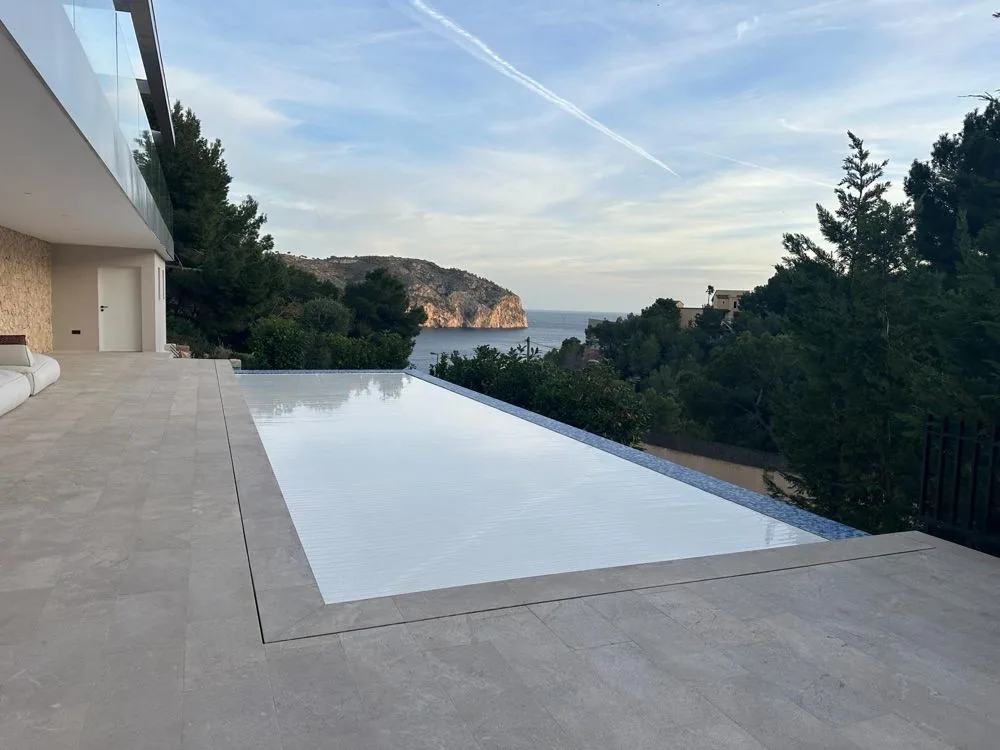
The second is whether your pool can be covered, and the answer turns on one thing: when the shaft can go in. On a pool that is already finished and tiled it rests above the water on the coping, on 316L supports, and nothing is broken into — that is the usual answer on these hillside plots, whatever shape the architect drew. A submerged shaft, in a pit under the water, has to be allowed for before the shell is concreted, so it belongs to a new build or a full refurbishment. Every cover is motorised — there is no hand-cranked version — and the slats move only while the button is held.
Both answers end at running costs, which are larger than people expect. A closed cover cuts evaporation by 70 to 80 per cent, chemicals by roughly 35 per cent and a heat pump's energy by 50 to 60 per cent. An 8 by 4 metre pool loses 15,000 to 25,000 litres a year to evaporation, and pools on these plots are rarely that small: left open through a Costa del Sol July, one can want topping up almost daily, and water allowed to go past rescuing ends up drained and refilled. We publish no prices, but on the saving alone a cover of this kind generally pays for itself in four to seven years.

