Ingerclima — automatic slatted pool covers
+34 91 631 59 40 Get a Quote
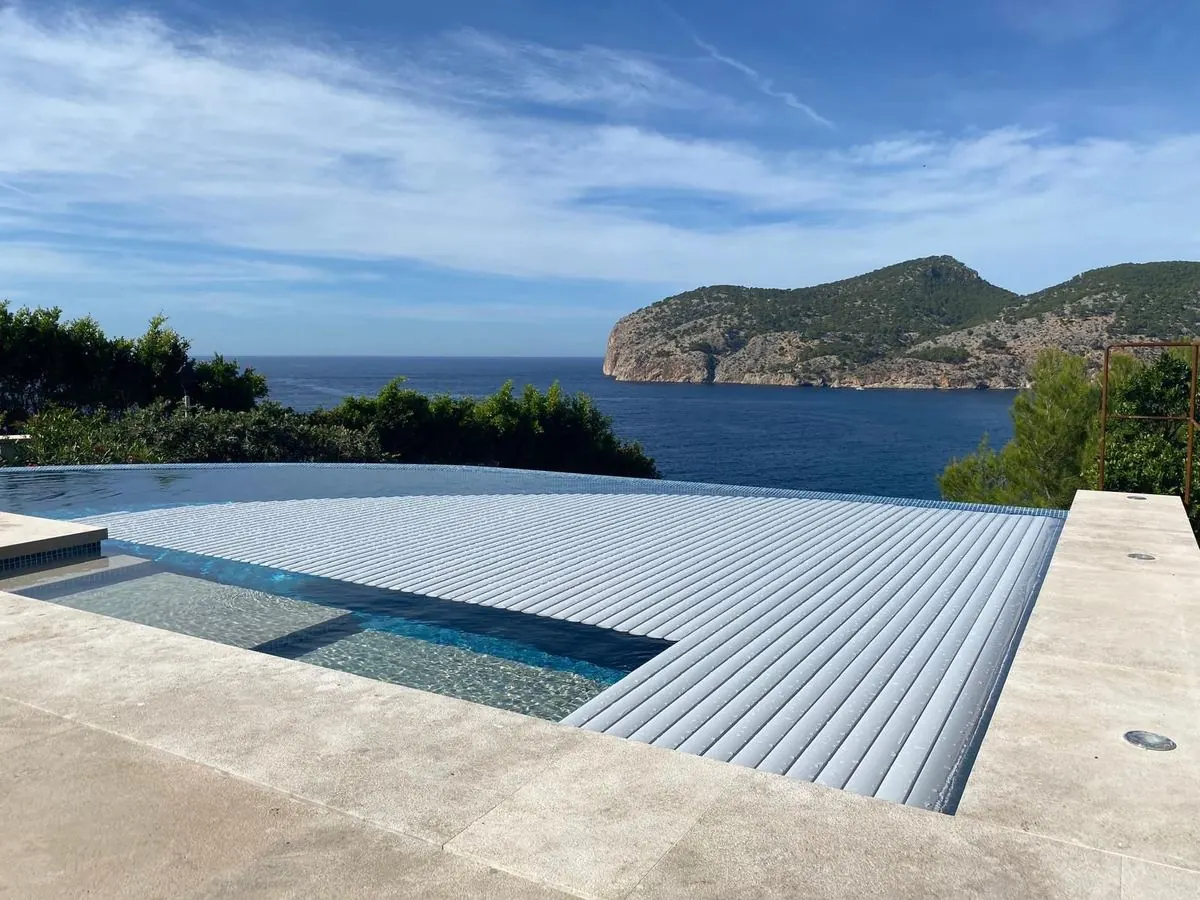
Automatic slatted pool cover closing over a villa pool
All 17 autonomous communities · Reviewed 21 September 2026

Private swimming pool regulations in Spain

Owners buying in Spain are told constantly that a pool has to be covered or fenced by law. We went to the regulation of every autonomous community and read the article that says who it applies to. Here is what we found, and which standard actually governs a cover.

Is there a Spanish law that makes you cover a private pool?

No. Not nationally, and not in any of the seventeen autonomous communities. We read the scope article of every regional pool regulation and of the state decree behind them, and the answer came back the same everywhere: no Spanish pool regulation obliges the owner of a private family pool to cover it, fence it or enclose it. What they regulate is the pool in collective use — the pool of a residents' association above a certain size, a hotel, a campsite, a municipal pool. This is a description of the rules as they are published, not legal advice; check with your town hall before you build.

20+
years in the trade
5,000+
covers installed
100%
made in our own Spanish workshop
NF
P90-308 safety standard

What Real Decreto 742/2013 covers, and what it leaves alone

The state framework is Real Decreto 742/2013, of 27 September, which sets the technical and public-health criteria for swimming pools and was published in the BOE of 11 October 2013. Read it and you find a public-health instrument: water quality, treatment, sampling, records, the information a bather is entitled to see. It was written for pools that groups of people use, and nearly all of it applies only to those.

A single-family pool at a private house is left outside most of it. The one article that reaches the private owner is article 13, which requires health incidents to be reported to the health authority. That is the whole of the duty. There is nothing in the decree about barriers, fences, alarms or covers, because protecting a child from the water is simply not the subject the text is dealing with.

This is worth holding on to when somebody tells you that a cover is required by Real Decreto 742/2013. The decree is real and the reference sounds solid, but the conclusion does not follow from the text. Beyond that single reporting duty, nothing in the decree classifies a cover as a compulsory safety device, and nothing in it obliges you to put anything at all over the water.

Region by region: what each autonomous community asks for

Health powers over swimming pools sit with the autonomous communities, which is why the detail lives in seventeen regional regulations rather than in one national text. We opened each of them, alongside the state decree, and read the article that defines who the regulation applies to. The table below is the result, reviewed on 21 September 2026, with every regulation linked to the official gazette that published it so you can read the wording yourself instead of taking ours for it.

Two answers appear in the column that matters. No means the regulation is written for pools in public and communal use and never reaches a private family pool. Only article 13 means the text does mention the private pool, but the single duty it brings with it is the one in article 13 of Real Decreto 742/2013: reporting a health incident. It is not an obligation to cover, fence or enclose anything. Four rows carry that second answer — Castilla-La Mancha, Comunidad Foral de Navarra, Comunidad de Madrid and Galicia — alongside the state framework itself.

Regulations also move, and one row shows how fast. The Murcia entry, Decreto 58/1992, was repealed almost in its entirety by Decreto-ley 1/2025 on administrative simplification, which left only its article 37.1 in force. That does not change the answer in the column, because the decree was written for pools in public use either way, but it is a reminder to open the official link on your row and read the text as it stands today.

One limit on the table, and it matters. It sets out the public-health pool regulation of each community and the state framework, and nothing else. It does not reach Ceuta and Melilla, municipal by-laws, the statutes of a community of owners, or the conditions an insurer may set, and any of those can add requirements of their own. It is a starting point, not the last word.

Regional pool health regulations in Spain. Each regulation links to its official gazette. Updated 21 September 2026.
RegionDoes the regulation reach a private family pool?RegulationApplies to
España (marco estatal)Only article 13 (report incidents)Real Decreto 742/2013, de 27 de septiembre, por el que se establecen los criterios técnico-sanitarios de las piscinas (BOE núm. 244, de 11 de octubre de 2013). Texto consolidadoCommunal and private
AndalucíaNoDecreto 485/2019, de 4 de junio, por el que se aprueba el Reglamento Técnico-Sanitario de las Piscinas en AndalucíaPublic and communal pools only
AragónNoDecreto 50/1993, de 19 de mayo, de la Diputación General de Aragón, por el que se regulan las condiciones higiénico-sanitarias de las piscinas de uso público (BOA núm. 60, de 31 de mayo de 1993). Artículo 2 en la redacción dada por el artículo único del Decreto 119/2006, de 9 de mayoPublic and communal pools only
Asturias (Principado de Asturias)NoDecreto 140/2009, de 11 de noviembre, por el que se aprueba el Reglamento Técnico-Sanitario de las Piscinas de Uso Colectivo (BOPA núm. 277, de 30 de noviembre de 2009)Public and communal pools only
CanariasNoDecreto 212/2005, de 15 de noviembre, por el que se aprueba el Reglamento sanitario de piscinas de uso colectivo de la Comunidad Autónoma de Canarias (BOC núm. 236, de 2 de diciembre de 2005), modificado parcialmente por el Decreto 119/2010, de 2 de septiembre (BOC núm. 182, de 15 de septiembre de 2010)Public and communal pools only
CantabriaNoDecreto 72/2008, de 24 de julio, por el que se aprueba el Reglamento Sanitario de Piscinas de Uso Colectivo de la Comunidad Autónoma de Cantabria (BOC núm. 199, de 15 de octubre de 2008). Artículo 21 en la redacción dada por el artículo 6 del Decreto 56/2009, de 2 de julio (BOC de 10 de julio de 2009, vigente desde el 11 de julio de 2009)Public and communal pools only
Castilla y LeónNoDecreto 177/1992, de 22 de octubre, por el que se aprueba la normativa higiénico-sanitaria para piscinas de uso público (BOCyL núm. 103, de 2 de junio de 1993). Artículo 3.º en la redacción dada por el artículo único del Decreto 106/1997, de 15 de mayo (BOCyL núm. 93, de 19 de mayo de 1997)Public and communal pools only
Castilla-La ManchaOnly article 13 (report incidents)Decreto 72/2017, de 10 de octubre, por el que se establecen las condiciones higiénico-sanitarias de las piscinas en Castilla-La Mancha (DOCM núm. 205, de 23 de octubre de 2017)Communal and private
CataluñaNoDecret 95/2000, de 22 de febrer, pel qual s'estableixen les normes sanitàries aplicables a les piscines d'ús públic (DOGC núm. 3092, de 6 de març de 2000)Public and communal pools only
Comunidad Foral de NavarraOnly article 13 (report incidents)Decreto Foral 86/2018, de 24 de octubre, por el que se establecen las condiciones higiénico-sanitarias y de seguridad de las piscinas de la Comunidad Foral de Navarra (BON núm. 221, de 16 de noviembre de 2018)Communal and private
Comunidad ValencianaNoDecreto 85/2018, de 22 de junio, del Consell, por el que se establecen los criterios higiénico-sanitarios aplicables a las piscinas de uso público (DOGV núm. 8331, de 4 de julio de 2018)Public and communal pools only
Comunidad de MadridOnly article 13 (report incidents)Decreto 99/2024, de 30 de octubre, del Consejo de Gobierno, por el que se establecen los criterios técnicos e higiénico-sanitarios de las piscinas y parques acuáticos de la Comunidad de Madrid (BOCM núm. 260, de 31 de octubre de 2024; en vigor el 1 de noviembre de 2024). Deroga el Decreto 80/1998 y el Decreto 128/1989Communal and private
ExtremaduraNoDecreto 102/2012, de 8 de junio, por el que se regulan las condiciones técnico-sanitarias de las piscinas de uso colectivo de la Comunidad Autónoma de Extremadura (DOE núm. 112, de 12 de junio de 2012)Public and communal pools only
GaliciaOnly article 13 (report incidents)Decreto 119/2019, de 19 de septiembre, por el que se regulan los criterios higiénico-sanitarios de las piscinas de Galicia (códigos de procedimiento SA431D, SA431C y SA431E) (DOG núm. 191, de 8 de octubre de 2019). Deroga el Decreto 103/2005, de 6 de mayoCommunal and private
Illes BalearsNoDecret 53/1995, de 18 de maig, pel qual s'aproven les condicions higienicosanitàries de les piscines dels establiments d'allotjaments turístics i de les d'ús col·lectiu en general (BOCAIB núm. 80, de 24 de juny de 1995)Public and communal pools only
La RiojaNoDecreto 2/2005, de 28 de enero, por el que se aprueba el Reglamento Técnico Sanitario de Piscinas e Instalaciones Acuáticas de la Comunidad Autónoma de La Rioja (BOR núm. 17, de 1 de febrero de 2005; en vigor desde el 2 de febrero de 2005), modificado por el Decreto 37/2008, de 30 de mayo (BOR 78) y por el Decreto 25/2010, de 30 de abril (BOR 55)Public and communal pools only
País VascoNoDecreto 32/2003, de 18 de febrero, por el que se aprueba el Reglamento sanitario de piscinas de uso colectivo (BOPV núm. 88, de 8 de mayo de 2003)Public and communal pools only
Región de MurciaNoDecreto n.º 58/1992, de 28 de mayo, por el que se aprueba el Reglamento sobre condiciones higiénico-sanitarias de las piscinas de uso público de la Región de Murcia — DEROGADO casi por completo por el Decreto-ley n.º 1/2025, de 5 de junio, de Simplificación Administrativa de la Región de Murcia (BORM núm. 130, de 7 de junio de 2025), que solo mantiene vigente su artículo 37.1Public and communal pools only

Which technical standard actually applies to a cover

If no law obliges you to fit a cover, one question still deserves a precise answer: when a cover is sold as a safety cover, what does that actually mean? The reference is NF P90-308, a French standard written for covers on private pools. It asks three things of the closed cover: that it keeps a child under five out of the water and carries a 100 kg adult applied at any point without breaking, sinking, taking permanent deformation or pulling out of its anchors; that it opens only by a deliberate adult action, from a remote control, a push button or a key, and never by accident; and that it covers the whole water surface, with no gap and no corner left open. It is an anti-drowning standard, and that is all it claims to be.

What it is not — and this is where most English-language advice goes wrong — is a certificate that the cover can be walked on. Deliberately standing on a closed cover, treating it as a terrace, is a structural question of a different order, and it belongs to the Eurocode: EN 1991-1-1, category A, the loading rules for domestic floors. A cover built to NF P90-308 will hold someone who steps or falls onto it. It is not a floor, and it should never be used as one.

The other reference you may see quoted in cover paperwork is the UNE-EN 13451 series. It does not apply. That series covers equipment for public-use pools classified under EN 15288: part 2 deals with ladders, step ladders and handrails, part 11 with movable floors and bulkheads. Covers for private pools are outside its scope, so a document offering UNE-EN 13451 as proof that a cover is compliant is quoting the wrong book.

So what is a French standard worth in Spain? Spanish law does not name it, and no Spanish pool regulation asks for it. What it changes is the conversation with the installer, because it turns a vague promise into a specification: a cover has either been built to NF P90-308 as a barrier or it has not. Every cover we build in our own workshop in Torrijos, near Toledo, where we have made them since 2005, is made to it.

Private pool or shared pool: the line that decides everything

Everything above turns on one distinction, so it is worth knowing which side of it you are on. A private family pool is the one in the garden of a single house, used by the household and its guests. On the other side is the pool in shared use, which is what the regulations were written for: a residents' association above a certain size, a hotel, a campsite, a municipal pool. The rules that sound strict are the rules for that second group.

If your pool is shared you are reading two layers at once — what your community's regulation asks of the installation, in supervision, bather load and control of the water, and whatever the residents' association has agreed among itself. We work with property administrators and residents' committees in Madrid and in Andalusia, and we hand over the technical documentation that is normally asked for before an installation is authorised.

If nothing is compulsory, why do owners fit a cover?

Because the legal obligation and the real reason for fitting one are different things. A regulation can say what has to be measured, recorded and reported; it cannot say who will be in the garden on a Tuesday afternoon. What a private pool carries is not the risk of an inspection but the risk of an unattended minute, and none of the regulations in the table was written with that minute in mind. Closing that gap is what an owner is buying.

A closed cover also earns its place in ways no regulation has an opinion about. Across a season it cuts evaporation by roughly 70 to 80 per cent, which is water you never have to put back. Chemical use falls by about a third, because far less sunlight and debris reach the water. Where the pool has a heat pump, keeping the surface closed cuts seasonal consumption by roughly 50 to 60 per cent. Nothing requires any of it; it is simply what a cover does once it is there.

If it is the safety argument you want in detail — what the 100 kg test actually involves, how a closed cover compares with a perimeter fence or an immersion alarm, why opening it has to be a deliberate adult action, what happens when a pet wanders onto it — that is set out on our page on child safety and NF P90-308. This page stops where the law stops.

What to check before you build, buy or renovate

Three things are worth checking before a pool is built or reworked, and none of them is about covers. The first is the regulation of your own autonomous community, on the row of the table above: if the pool will be shared rather than private, the answer changes completely. The second is your town hall, since building, licensing and local by-laws are municipal. The third, if you are buying into a development, is the statutes of the community of owners.

What you will not find in any of them is a rule telling a private household to cover its pool. That decision belongs to you, and it is better made on how the pool is used and who can walk into the garden than on a requirement nobody has written down. If you want a second opinion on your own pool, we are happy to look at its shape, its coping and the way people reach it, and say what we would fit.

Common questions

Is it compulsory to cover a private pool in Spain?

No. Neither the state framework nor any of the seventeen autonomous communities obliges the owner of a private family pool to cover it, fence it or enclose it. The regional regulations are written for pools in collective use: residents' associations above a certain size, hotels, campsites and municipal pools. The only duty Real Decreto 742/2013 places on a single-family pool is its article 13, which requires health incidents to be reported to the health authority. This is general information, not legal advice.

Do I still need a fence if the pool has a cover?

No Spanish pool regulation requires either one on a private family pool, so this is not a compliance question but a decision about the protection you want. A fence works around the water and depends on a gate being closed by somebody; a closed automatic cover sits on the water itself and needs a deliberate adult action to open. The two are compared in detail on our page about child safety and the NF P90-308 standard, at ingerclima.com/en/child-safety-pool-covers.html.

Which Spanish regions regulate a private family pool at all?

Four regional regulations mention the private pool in the article that sets out their scope: Castilla-La Mancha, Comunidad Foral de Navarra, Comunidad de Madrid and Galicia, alongside the state framework itself. What that brings with it is the duty under article 13 of Real Decreto 742/2013 to report a health incident to the health authority. None of the four obliges the owner to cover, fence or enclose the pool. The remaining regional regulations are written for pools in public and communal use and do not reach a private family pool at all.

Is UNE-EN 13451 the standard for pool covers?

No. The UNE-EN 13451 series covers equipment for public-use pools classified under EN 15288. Its part 2 deals with ladders, step ladders and handrails, and part 11 with movable floors and bulkheads. Covers for private pools fall outside its scope altogether, so it cannot show that one complies with anything. The reference for a cover on a private pool is NF P90-308.

Can I walk on a cover built to NF P90-308?

No. NF P90-308 is an anti-drowning standard: it means a person who steps or falls onto the closed cover is held on the surface rather than going into the water. Certifying a cover to be walked on deliberately is a structural question governed by Eurocode EN 1991-1-1, category A, which is a different and far higher requirement. A slatted cover is a barrier over the water, not a floor above it.

The pool belongs to a community of owners. Is it different?

A pool shared by a residents' association is the case the regulations were written for. It comes under the public-health pool regulation of its autonomous community, which sets requirements on supervision, bather load and control of the water, and the community is also bound by whatever it has agreed among itself. We work with property administrators and residents' committees in Madrid and Andalusia, and we hand over the technical documentation usually asked for before an installation is authorised.

Talk to the people who make and fit your cover

Tell us about your pool in Mijas and we'll recommend the right slat, then give you a clear price and timeline. Call +34 916 315 940, message us on WhatsApp at +34 675 651 156, or ask us to arrange a site visit from our San Pedro de Alcántara base.

Chat with us on WhatsApp