Ingerclima — automatic slatted pool covers
+34 91 631 59 40 Get a Quote
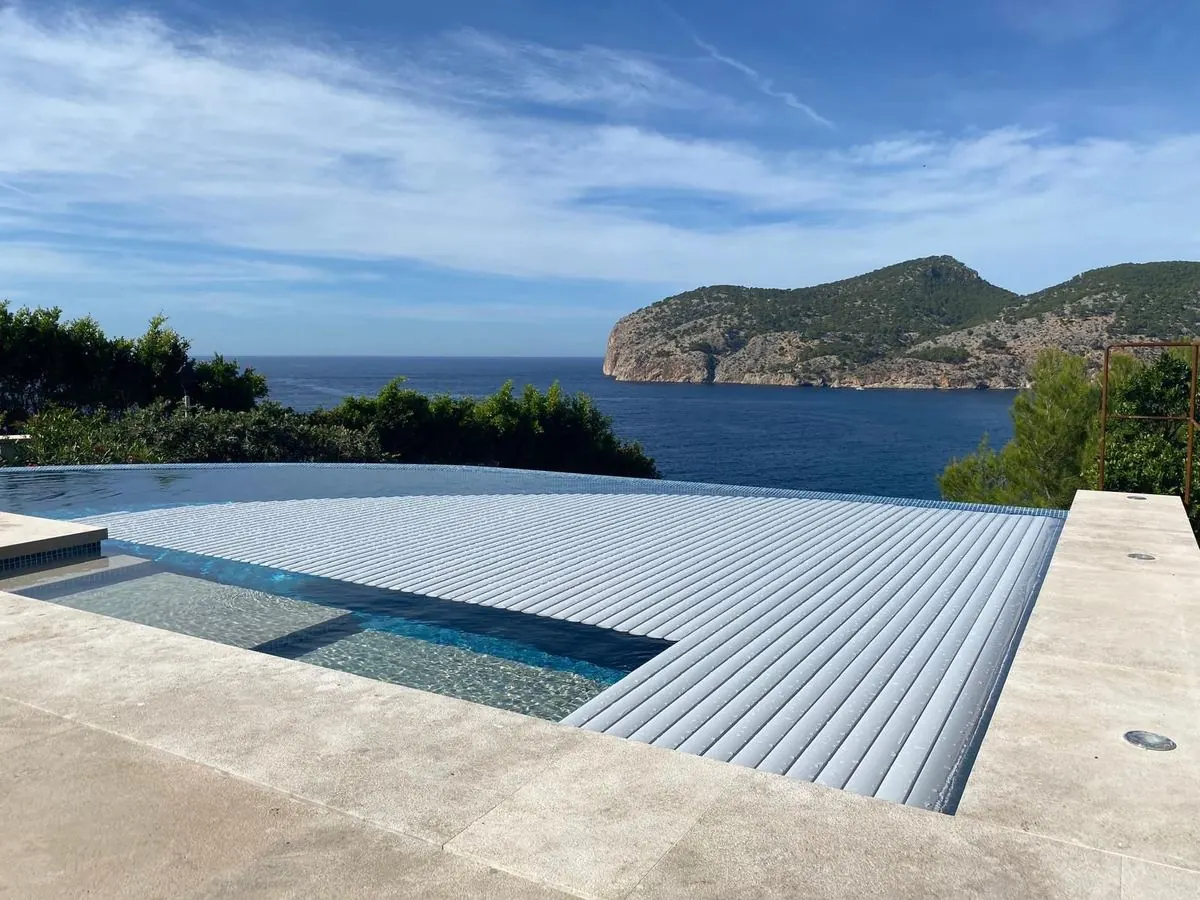
Automatic slatted pool cover closing over a villa pool
Made in Spain since 2005 · 5,000+ pools covered

What a slatted pool cover is and how it works

Automatic slatted covers are what we build, and the only thing we build. Rigid slats float on the water, wind onto a stainless steel roller and close the pool at the touch of a button. Here is how the system actually works.

A cover made of rigid slats

If you have started looking into pool covers in Spain you will have met several names for the same product: slatted cover, automatic slat cover, or persiana de piscina in Spanish. They all describe one thing. A run of rigid, buoyant slats is joined edge to edge, rather like the slats of a window shutter, and wound onto a roller at one end of the pool. Press a button and the roller turns: the slats unwind and travel across the surface until the water is completely covered. Press again and they wind back on. The slats float rather than span the pool, which is why the system seals the surface so completely, and every part that meets water or weather is built to live outdoors permanently.

20+
years in the trade
5,000+
covers installed
100%
made in our own Spanish workshop
NF
P90-308 safety standard

How it opens and closes

Every cover we make is motorised. A 230 V motor drives the roller, and you operate it from a remote handset or a key switch mounted beside the pool. Closing an ordinary domestic pool takes a couple of minutes, and you stand where you can see the water while it happens. There is no hand-cranked version: the motor is not an upgrade, it is the product.

The slats are linked along their long edges, so the whole sheet behaves as one flexible surface. As the roller turns, that sheet unwinds and travels out across the water until it meets the opposite wall, where it stops. Nothing has to be lifted, folded, dragged or stored, and one person handles the whole operation from the side of the pool.

On longer pools we fit end stops or lateral guides so the sheet travels straight and lands square against the far wall. The roller, the supports and the fixings are all made from 316L stainless steel, the grade specified for marine and swimming pool use, because those components spend their entire working lives in or just above chlorinated water.

Where the roller goes: above the water or submerged

The decision that changes the look of your pool most is where the roller sits when the cover is open. There are two answers, they are not interchangeable once the pool has been finished, and which one is right for you usually comes down to a single question: does the pool already exist, or is it still to be built?

An above-water roller sits at one end of the pool on the coping stone, carried on two side supports or enclosed in a casing. It is visible, and that is the trade-off. In exchange, nothing is built into the pool shell: no draining, no excavation, no disturbance to your coping or tiling. Installation is normally a single day's work, which is why it is the usual answer for a pool already in use.

A submerged roller is hidden below the water line in a bench built across one end of the pool. Open the cover and the pool is completely clear, with no roller, no casing and nothing to look at. It is the more discreet system and the one most owners choose for a new pool or a full refurbishment, because the bench forms part of the pool structure.

The two slat materials

Slats come in two materials, and the choice is really about what you want the closed cover to do. PVC slats are opaque, hollow and extremely hard-wearing, and they are what most pools end up with. They hold in the heat the water has gathered during the day, they stop evaporation, and they shrug off chlorine, salt and strong sunlight season after season.

Polycarbonate comes in two versions. Solar polycarbonate is the one people usually mean: the cells inside each slat act as a small solar collector and can lift the water temperature by as much as 8°C at no running cost, which often adds several weeks at either end of the season. Transparent polycarbonate keeps the water visible through the closed cover, which is what indoor pools and view-facing terraces need. Both versions float and close the same way.

What a closed cover actually does

Safety comes first, and it is measurable. Our covers are built to NF P90-308, the French standard that European pool professionals treat as the benchmark for automatic covers, and a closed sheet takes the weight of an adult. That does not make it a floor to walk on. It means a child or a dog reaching the water's edge does not go through, which is why many owners start looking in the first place. What Spanish law itself asks of a private pool — and what it does not — is set out region by region in private pool regulations in Spain.

The rest is economy. A closed cover cuts evaporation by roughly 70 to 80 per cent: on an ordinary 8 by 4 metre pool that is somewhere between 15,000 and 25,000 litres of water a year you do not have to replace. Less evaporation also means less heat lost overnight, so a heat pump works far less to hold the same temperature, and around 35 per cent less chlorine, because the water is no longer open to leaves, dust and sun.

And it stays covered between visits, which matters if you are not in Spain every week. Slatted covers are the whole of what we make. We do not supply winter debris sheets, bubble blankets, telescopic enclosures, high enclosures, awnings or pergolas, so what you hear from us is advice about your pool rather than a tour of a catalogue.

Common questions

Can a slatted cover be fitted to a pool that is already built?

Yes, and that is what most of our customers need. An above-water roller is carried on side supports or in a casing on the coping stone at one end of the pool, so nothing is built into the shell and your tiling stays untouched. The pool does not need draining, and installation is usually finished in a day. A submerged roller is the exception: it needs a bench built into the pool, so it suits new builds and full refurbishments.

Is there a manual version, or does it always need power?

It is always motorised. A 230 V mains supply near the pool drives the roller, and you operate it with a remote handset or a key switch. There is no hand-operated model. A full sheet of slats is heavy, and motorising it is not a luxury but the only sensible way to build the thing. If you are covering an older pool, an electrician brings the supply to the point we agree with you before installation day.

Will the slats really hold a person's weight?

The cover is manufactured to NF P90-308, the standard that sets out how an automatic cover must behave under load, and a closed sheet supports the weight of an adult. It is a safety barrier, not a terrace: it exists to stop someone falling in, not to be walked across, sat on or dived from. Keep it fully closed whenever the pool is unattended and it does exactly the job it was designed for.

PVC or polycarbonate: how do I choose?

Ask what you want from the cover when it is closed. PVC is opaque and very hard-wearing, it retains the day's heat and it hides the water, which suits most gardens perfectly well. Solar polycarbonate warms the water actively, by up to 8°C, and usually earns its place by stretching the swimming season at both ends. Transparent polycarbonate is for owners who want to keep seeing the water, typically indoor pools or terraces where the pool is the view.

What about the months when nobody is at the house?

Leave it closed. With the slats across the surface, leaves, dust and wind-blown dirt stay out, evaporation almost stops and the water needs considerably less treatment while you are away. The pool still wants its filtration running on a timer and someone to check the chemistry now and then, because a cover reduces the work rather than removing it. Owners who spend only part of the year in Spain tend to notice the difference most.

Talk to the people who make and fit your cover

Tell us about your pool in Mijas and we'll recommend the right slat, then give you a clear price and timeline. Call +34 916 315 940, message us on WhatsApp at +34 675 651 156, or ask us to arrange a site visit from our San Pedro de Alcántara base.

Tell us about your pool

Send us the internal measurements, a photograph or two and whether the pool is already built or still on the drawing board, and we will tell you which roller and which slat suit it. Call +34 91 631 59 40 or write to info@ingerclima.com.

Chat with us on WhatsApp