
What an inland pool in Sant Cugat actually needs
The local station says two opposite things at once
Sant Cugat does not borrow figures from the coast or the county: Meteocat measures inside the municipality. The 2014-2025 record gives 61.2 days a year with a maximum above 30 °C — four times as many as Cabrils, on the Maresme coast, which gets 15.2 — and at the same time 10.4 frost days, with an absolute low of −4.4 °C. Tropical nights number only 31.3: no sea is close enough to hold the heat in. Meteocat puts the frost calendar the other way round — it does not freeze between June and October, so it can freeze in the other seven months.
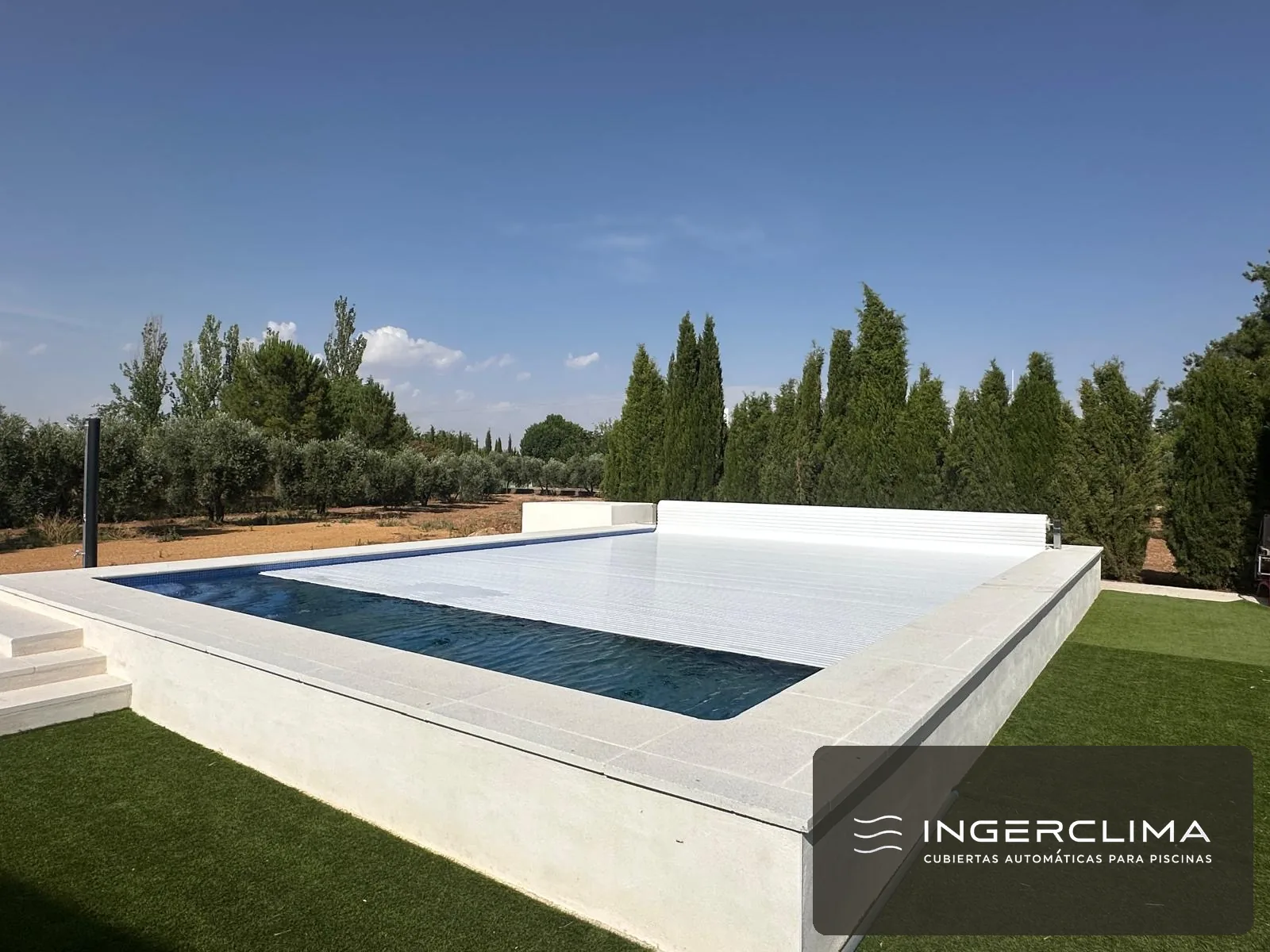
For a pool that is exactly the problem. The afternoon sun lifts the water temperature and a clear inland night takes it straight back out through evaporation and radiation. A closed slatted cover stops both: it cuts evaporation by 15,000 to 25,000 litres a year in an 8 × 4 m pool, and it holds overnight the heat the water gained during the day. That is why a cover buys more season here than on the coast, where the nights are mild anyway: it decides whether May, September and October are swimming months. With a heat pump it cuts 50 to 60 % of the heating consumption, and the water needs roughly 35 % less chemical treatment.
Which slat to ask for
With hot days and cool nights, the slat that usually fits a Sant Cugat garden is solar polycarbonate: it lets the sun through to the water instead of shutting it out, which is worth most in the shoulder months where the Vallès falls short. PVC slats stay the most robust option for a pool used daily and under trees, and transparent polycarbonate keeps the water visible. All three run on the same 316L structure and motor: every cover is motorised, 230 V / 50 Hz, on a remote or wall switch, and there is no manual version. The shaft sits above the water, with or without a housing, or submerged and out of sight.
Water: the town wrote Spain’s first saving ordinance
Sant Cugat approved a water-saving ordinance before any other town in Spain — the consolidated text dates from July 2018 — and it requires new pools with more than 20 m² of water surface to collect their surplus in a tank. The council also helped draft the Diputació de Barcelona’s model ordinance of March 2025, which ties a new pool’s licence to measures that minimise evaporation losses — a model, binding only where a town adopts it.
Right now there are no restrictions at all: the 18 water units of Catalonia are in normalitat and the Ter-Llobregat system stood at 77.51 % on 24 September 2026. The honest argument is not fear, it is arriving prepared for the next drought. Under the Catalan drought plan (Acord GOV/1/2020), an alerta scenario limits top-up to replacing what evaporates; in excepcionalitat the first filling of a new single-family pool is banned outright; in emergència even partial top-up is banned, private well included. The Catalan Water Agency itself recommends covering the pool, because a cover cuts evaporation by up to 70 %, prevents freezing and keeps organic matter out. Our systems are in cover models, the materials in slat types.


