
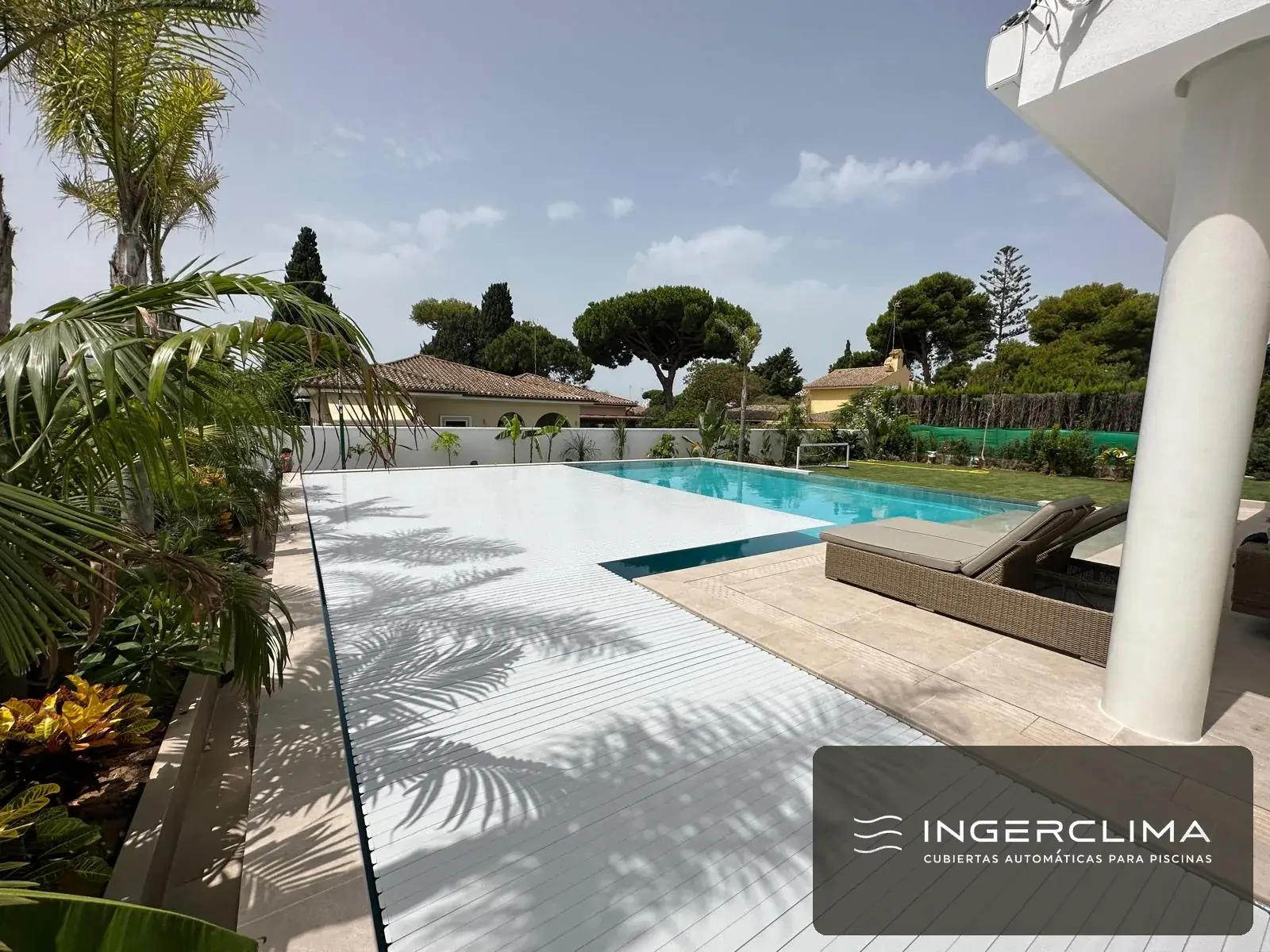
Salt, pine needles and a house that is empty midweek: what a Maresme pool is up against
The Maresme is built in pairs, and the local names say so: Premià de Mar down on the shore and Premià de Dalt above it, Vilassar de Mar and Vilassar de Dalt, Arenys de Mar and Arenys de Munt. The flats and the railway are down at sea level; the houses with a garden and a pool are up on the slope, on terraces cut into the hill, looking down at the water. Alella, Cabrils, Teià and Argentona sit entirely in that upper half and never reach the sea at all; Cabrera de Mar touches it only with the narrow strip at Costamar and Bonamar, and its houses with land are up at Agell. What a pool up there is up against is nothing like what a pool 30 km inland faces, and it decides almost every choice on the cover.
Frost is not the problem here. Salt is
The Meteocat station at Cabrils is the reference for this stretch of the Maresme. Its 2010-2025 averages: 1.0 frost day a year, an absolute minimum of −2.6 °C, 47.4 tropical nights above 20 °C and only 15.2 days above 30 °C. Inland, at Sant Cugat del Vallès, the same Meteocat series gives 10.4 frost days a year and 61.2 days above 30 °C. So the inland argument — a pool losing at night what it gained by day — is weak here: Maresme nights are already mild.
What this coast has instead is the sea two or three kilometres downhill and a salt-laden breeze over every terrace on the slope. Hence AISI 316L stainless steel in the structure, the axle, the brackets and every fitting: it is the marine grade.
The hard wind comes off the land, not the sea
The damage does not come off the water. The strongest gust ever recorded at Cabrils came from 355° — due north, the tramuntana — at 116.6 km/h, on 20 January 2020 during storm Glòria. The garbí, the sea breeze, is the gentle afternoon one. Rain is violent in the same way: 131.2 mm in a single hour and 220.9 mm in 24 hours at Cabrils on 12 October 2016. After an hour like that, a closed cover is the difference between skimming leaves and emptying a pool full of what washed off the slope above it. And these hills are pine and holm oak: the needle is what fouls Maresme water. The Catalan Water Agency puts a cover in its own household saving guide, under the heading cobreix la piscina, for that reason — a cobertor cuts evaporation by up to 70 %, prevents frost and keeps organic matter out. Less organic matter means about 35 % less chemical product.
A third of these houses are not somebody's main home
This is the argument that matters most here. 34.5 % of the dwellings in Sant Vicenç de Montalt are not a main residence, and the same 34.5 % in Caldes d'Estrac, 26.8 % in Cabrils, 25.7 % in Sant Andreu de Llavaneres and 24.9 % in Cabrera de Mar (2021 Census, Consell Comarcal del Maresme). A pool nobody looks at from Monday to Friday, under pines, on a coast that can take 131 mm of rain in an hour, is a pool you spend Saturday cleaning instead of using; closed, it is clean when you arrive. In an 8×4 m pool a cover stops 15,000 to 25,000 litres of evaporation a year, and with a heat pump it cuts heating consumption by 50-60 %.
Which slat, which axle
With nights this mild the heating argument is thinner than inland, so the choice follows how the pool is used. PVC slats are the usual pick under trees; solar polycarbonate earns its place if you want to stretch May and October, because it warms the water using the sun. Every cover is motorised, 230 V / 50 Hz, on a remote or a wall switch. The axle sits above the water, or submerged and out of sight — that one belongs to a pool still on the drawing board. More in cover models and slat types.


