Comprehensive climate-control solutions to manage temperature, environment and humidity in any type of installation.
Ingerclima has specialised in pool climate control since 2005. We offer complete solutions to manage water temperature, environment and humidity in any type of installation, from private pools to hotel and sports facilities.
Efficient water heating to extend the swimming season. High energy efficiency.
Humidity control for indoor pools. They prevent condensation and ensure a healthy environment.
Water cooling for warm-climate areas or sports pools that require a controlled temperature.
Space heating for indoor and covered pools. Thermal comfort for users all year round.

Official Calorex distributor — Europe's leading manufacturer of pool climate-control equipment. Full range: heat pumps, chillers and specialised dehumidifiers. Official warranty and technical service.
Heating the water lets you swim comfortably from spring until well into autumn in an outdoor pool, or all twelve months if the pool is covered or indoors. What decides the result is choosing the right equipment and, above all, cutting heat losses to a minimum.
An air-source heat pump is the efficient answer today: it takes heat from the outside air and moves it into the water, so for every kW it draws it can deliver around 5 kW of heat. That ratio is why it is the usual choice for private pools.
In covered or indoor pools, dehumidification goes alongside the heat pump: it keeps the air from condensing on walls and ceilings, protects the building and makes the room pleasant to be in all year. As official Calorex distributors we size heat pumps, dehumidifiers and chillers against the volume of your pool and the climate where it sits.
Pool water loses heat four ways: evaporation, radiation to the night sky, convection with the air, and conduction through the shell. Evaporation is by far the largest. Every litre that evaporates carries away the heat it took to evaporate it, and it happens mostly at night, when the air is colder and drier than the water.
Which is why the order of decisions is not the obvious one. The cover first, the equipment after.
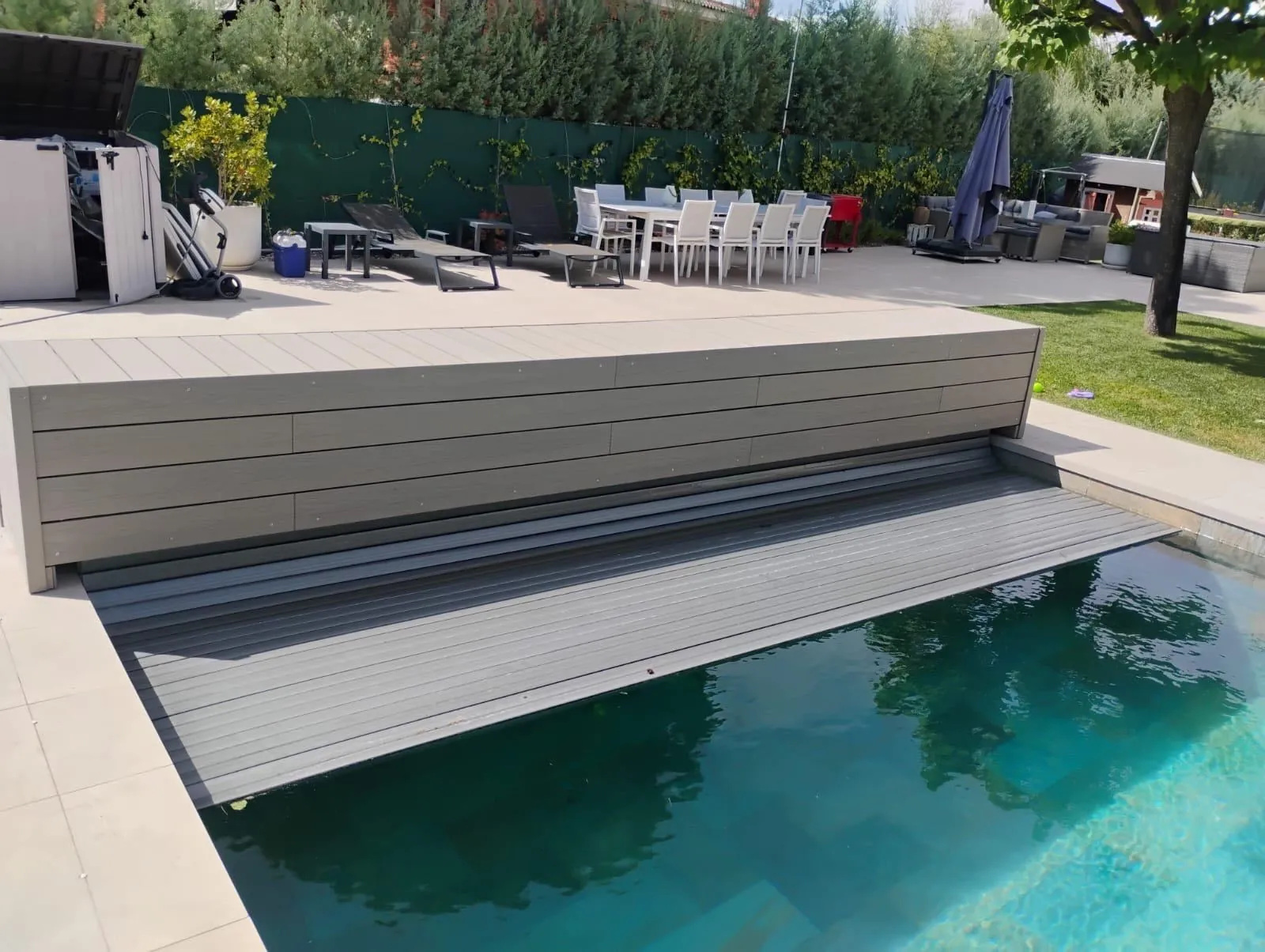
An automatic slatted cover closes the water surface completely and cuts evaporation by 70–80 %. On the running cost of the heating system, the saving lands between 50 % and 60 %, depending on the slat and the local climate. Put the other way round: a heated pool with no cover costs roughly twice as much to run as the same pool with the cover closed overnight.
It changes the size of the equipment too. Sizing a heat pump for an uncovered pool means paying for losses you need not have had. With a cover, the same temperature rise is reached with a smaller unit that cycles less and works fewer hours.
And there is one gain only the cover gives you: a solar polycarbonate slat lets radiation through and traps the heat underneath, so the pool warms during the day with no energy at all — up to 6-7 °C above the same pool left uncovered. The heat pump starts from higher up and has less left to do.
There is no standard heat pump. The unit that suits you depends on five things, and all five have to be measured before anything is decided:
The volume of the pool. Not the surface: the volume. An 8 × 4 m pool averaging 1.50 m deep holds roughly 48 m³ of water to bring up to temperature and, more to the point, to hold there.
The temperature rise. The gap between the water you have and the water you want. Three degrees in May is not ten degrees in March.
The months you want to use it. Adding a month at each end of the season does not call for the same unit as swimming in January.
Your climate. An air-source heat pump takes its heat from the air, so its real output is set by the night-time air temperature: the colder it is, the less it delivers. The same pool calls for different equipment on the coast and inland.
Whether there is a cover. This is the variable that moves the answer most, for the reason above.
With those five figures we work out the power needed and how long the first heat-up will take. For an indoor or covered pool, dehumidification is added to the calculation: the air in a room with an open water surface saturates easily and the moisture condenses on cold surfaces. A correctly sized dehumidifier protects the building and makes the room usable; an undersized one does neither.
If the pool is being built or refurbished, five things are cheap now and expensive later:
Room for the unit. An air-source heat pump takes heat from the air, so it needs air: clear space around it and in front of the fan, with no enclosed corner where it ends up recirculating its own cold exhaust.
Its own electrical supply, with protection at the board, sized for the unit that is actually going in.
A bypass connection after the filter. The bypass lets the flow through the unit be regulated and lets it be isolated for servicing without stopping filtration.
A drain for the condensate. A heat pump produces condensation water and it has to go somewhere.
A short pipe run. The further the unit sits from the pool, the more heat is lost on the way.
Every unit has its own clearances and dimensions. We put them in writing before you pour concrete, together with the cover’s if you are fitting both.
A pool heat pump warms the water efficiently by taking energy from the air, drawing far less electricity than a resistive heater. It extends the swimming season by several months, in private pools as much as in sports and hotel installations.
A pool dehumidifier controls air humidity in indoor or covered pools. It is essential to prevent condensation on walls, ceilings and structures, to stop mould forming and to keep the air healthy for swimmers. It is recommended in any covered or indoor pool.
The first heat-up of the season takes longest: you start from cold water and have to climb several degrees, which can take days depending on the output of the unit and the volume of the pool. After that the work is maintenance and comes down to a few hours a day. With the cover closed overnight that maintenance is much smaller, because the water reaches the morning close to the temperature it was left at.
Yes. The heating equipment connects to the existing filtration circuit and needs no work inside the pool shell. If you also want a cover, the above-ground models are designed precisely for existing pools and do not require touching the shell either.
It works, but it is worth knowing the cost: without a cover the heating system uses roughly twice as much, because all night it is replacing the heat lost to evaporation. If the budget forces a choice, the cover comes first — it cuts the running cost, lengthens the season on its own and is a safety barrier as well.
An air-source heat pump extracts heat from the outside air, so its output falls as that air gets colder. On the Mediterranean coast and in the south, where winter nights are mild, it stays efficient for much of the year. Inland, where there are frosts, winter use makes most sense in covered or indoor pools, where the room protects both the water and the unit.
A solar polycarbonate slat has a cellular structure and lets radiation through: it traps the sun's heat under the cover and passes it to the water, so the pool can gain up to 6-7 °C with no energy used. A PVC slat does not transmit light, but it holds the heat gathered during the day very well and stops evaporation just as effectively. Which suits you depends on how your pool is oriented and how many hours of sun it gets.
Yes. We work on private pools and on sports, municipal, hotel and spa installations, sizing the equipment for intensive use and for precise control of water temperature, air temperature and humidity.


