Ingerclima — automatic slatted pool covers
+34 91 631 59 40 Get a Quote
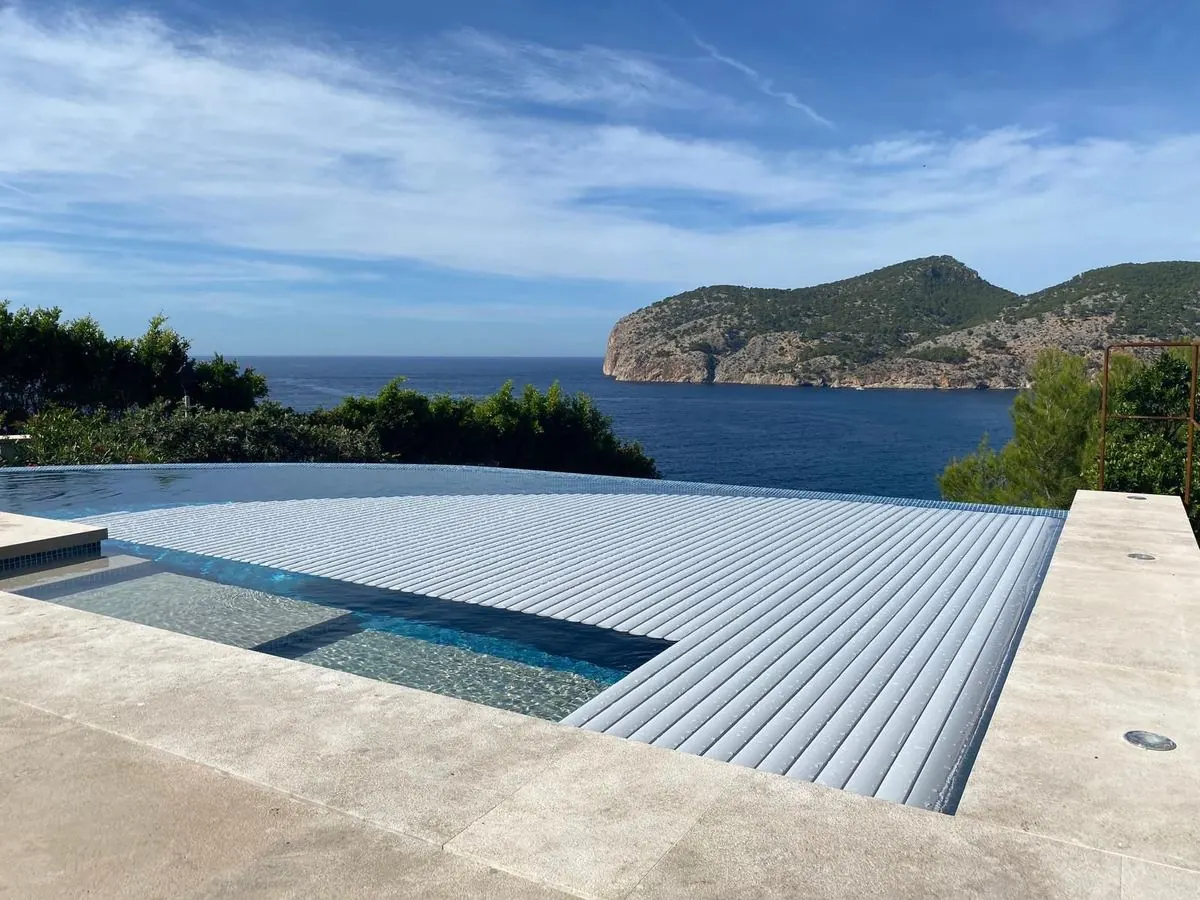
Automatic slatted pool cover closing over a villa pool
Five bills a year · Third-party Spanish market figures

What a swimming pool costs to run in Spain each year

Water, chemicals, electricity, the pool technician and the things that break. Here is what each one costs a private pool in Spain over a year, and how much of each a closed automatic cover takes away.

The bill nobody adds up before they buy the villa

Hardly anyone costs the pool before buying the house. You are walked onto the terrace, you picture August, and the pool enters the decision as a feature rather than a line in a budget. The first full year corrects that: it arrives carrying five separate bills — the water the pool loses, the chemicals that keep it clear, the electricity that moves and heats it, the technician who looks after it, and the things that break. Every euro on this page is a third-party cost at indicative Spanish market prices, published here in September 2026. None is a price of ours: we manufacture covers, and we publish no figure for one.

20+
years in the trade
5,000+
covers installed
100%
made in our own Spanish workshop
NF
P90-308 safety standard

1. Water: what evaporation quietly costs

Evaporation is how a pool in Spain loses most of its water, and it runs fastest in the conditions you moved here for: long sun, warm nights and a little wind across the surface. It is invisible because it is gradual — nobody watches the level drop, they notice the automatic filler running.

At Spanish mains prices — roughly €1.50 to €3 a cubic metre, depending on the municipality — a standard 8 by 4 metre pool spends something like €22 to €75 a year on replacement water. That is the smallest of the five bills and on its own would justify nothing. A closed automatic cover cuts evaporation by roughly 70 to 80 per cent, so most of it disappears.

What has changed lately is not the price but the permission. Several Spanish municipalities now restrict filling and topping up during drought episodes, so the real constraint is no longer only what water costs but whether you are allowed to buy it in the month you need it. A pool that barely loses water never has to ask.

2. Chemicals: chlorine, pH and the Spanish sun

The chemical bill is the most variable of the five, because it is driven by sunlight and by how much dirt reaches the water. Ultraviolet light breaks chlorine down, which is why an open pool in Andalusia in July never seems to hold the dose you set. Pollen and Saharan dust finish the job.

On an unheated pool in a warm part of Spain the market ranges run roughly like this over a year: €150 to €350 on chlorine, whether in tablets, liquid or salt for a chlorinator; €40 to €80 on pH correction; €30 to €60 on algaecide and preventive treatments; and €50 to €100 on the occasional shock dose or flocculant. Call it €270 to €590 a year for a medium-sized pool with nothing over it.

This is where a closed cover does its most visible work. A sealed surface shades the water and keeps debris out at the same time, so ultraviolet stops eating the chlorine and nothing new arrives to consume it. The dose you set stays where you put it, and across a season chemical use falls by about a third. The water then reaches the end of the year worth keeping.

3. Electricity: filtration, heat pump and robot

Two motors dominate the electricity bill, and they are nothing like the same size. The filtration pump is the steady one: a 0.75 kW pump on a 32 cubic metre pool, running eight hours a day for seven months, uses around 1,260 kWh a year, or €190 to €250 at €0.15 to €0.20 a kilowatt-hour. A robot cleaner adds perhaps €30 to €50. Neither is dramatic.

The heat pump is what changes the arithmetic. A 10 kW unit running six hours a day over four months draws roughly 7,200 kWh, which at the same tariff is €1,080 to €1,440 in a single season — on its own, more than the water, the chemicals, the filtration and the robot put together. If you heat the pool at all, this is the number the whole budget turns on.

It is also the number a cover moves most. A pool sheds its heat through the surface, overnight, into the air above it, which is why an uncovered pool spends each morning asking the heat pump to re-win what went out in the dark. Seal the surface and most of that nightly loss never happens. With a closed cover, seasonal consumption falls by roughly 50 to 60 per cent.

4. The pool technician, and what the service costs while you are away

Most owners of a villa in Spain do not clean their own pool. A weekly or fortnightly visit with products included runs somewhere between €80 and €150 a month in season, and opening and closing the pool for the year adds €200 to €400. Across a full year that is the second-biggest line in the budget: only the electricity the pool burns, heat pump included, comes to more.

What owners who are here for part of the year discover is that the service does not pause when the house does. The pool still needs visiting through the months when nobody swims, so that €80 to €150 a month either keeps running on the standing order or is saved now and spent later, when the first visit of the season turns into several. Our page on leaving the pool covered over winter sets out what those months actually look like.

A pool that spends them sealed gives the technician far less to do. The chemistry stays close to where you left it, and the spring opening is a short job rather than a recovery operation. The visits do not disappear, but each one is shorter.

5. Repairs and the things nobody budgets for

The fifth bill never makes it into anyone's spreadsheet, because it is different every year. LED lamps fail, a union starts weeping, a filtration module gives up, a valve seizes after a winter of standing still. On a pool with nothing seriously wrong with it, budget in the region of €100 to €300 a year and you will be about right.

Covering the water does not make equipment immortal, and a cover is itself a mechanism that lives outdoors. What it changes is exposure: less debris through the filter, less ultraviolet on the lining, and a pool that is not standing open and unattended for half the year. Everything structural we build is 316L stainless steel, and our warranty covers the whole cover — structure, motor, slats and installation — not only the frame. Our page on repairs and original spare parts explains how that works.

The same pool, covered and uncovered

Set the recurring bills side by side for one medium-sized pool with a heat pump and the uncovered year comes to between €2,300 and €3,800: €22 to €75 of water, €270 to €590 of chemicals, €220 to €300 of filtration and robot, €1,080 to €1,440 of heating and €700 to €1,400 of an independent pool service. The same pool under a closed automatic cover lands between €1,100 and €2,300, the heating line doing most of the moving. Repairs sit outside both totals because they differ every year — add the €100 to €300 above for the whole picture.

The difference — very roughly €800 to €1,500 a year — is not a discount and not a payment plan. It is what is left when you add up five separate movements: the water you no longer replace, the chemicals the sun no longer destroys, the filtration hours that cleaner water no longer needs, the heat that no longer leaves through the surface overnight, and the technician time a sealed pool saves. It repeats every year.

Every euro in those two totals is a third-party cost, not our price for anything. We publish no figure for a cover, because a cover is built to one specific pool: the size and shape of the water it must cross, the slat you pick, and whether the roller sits over the water on the coping stone or disappears below it. The page on what an automatic cover costs works through those factors and puts the payback at five to ten years. Send the measurements and the quote, itemised, is back with you within 24 hours.

Coast or inland: the same five bills, different sizes

These are Spanish averages, and Spain is not one climate. On the Costa del Sol the season is long, the heat pump works at both ends of the year and evaporation never entirely stops, so heating and water dominate. What attacks the hardware there is salt-laden air, which goes for the fixings first, and is why the metal under our covers is specified for a marine environment rather than for cost.

Inland, in Madrid, Toledo and Castilla-La Mancha, the shape of the bill changes. The water is harder, dust and pollen hang in the air much of the year, and frost means the pool must be put to bed properly in autumn. The heating line is shorter because the season is, but opening and closing the year costs more.

Then there is the case that fits neither: inland Málaga — the Axarquía, Rincón de la Victoria, the hills behind Alhaurín and Coín. The season is very long, so the accumulated running cost is high, while winters are mild enough that winterising is minimal. In all three a closed cover brings the bill down; what changes is only which line it brings down most.

Common questions

How much does it cost to maintain a swimming pool in Spain each year?

For a medium-sized private pool with a heat pump, the recurring annual costs come to roughly €2,300 to €3,800: replacement water, chemicals, filtration electricity, heating and an independent pool service. Repairs are on top of that, typically €100 to €300 a year. The same pool under a closed automatic slatted cover runs at roughly €1,100 to €2,300, because heating, chemicals and water all fall. A pool with no heat pump sits well below both figures, since heating is the largest single item. These are indicative Spanish market figures for third-party costs, not a quotation.

What does evaporation cost a swimming pool in Spain each year?

Evaporation is the main way a pool loses water in Spain, and it runs all season: long sun, warm nights and wind across the surface all drive it. At Spanish mains prices of roughly €1.50 to €3 a cubic metre, replacing what a standard 8 by 4 metre pool evaporates costs something like €22 to €75 a year. A closed automatic cover cuts evaporation by roughly 70 to 80 per cent. The larger issue is availability rather than cost: several Spanish municipalities now restrict filling and topping up during drought episodes, so the water may not be on offer in the month you need it.

Does an automatic cover really cut the chemical bill?

Yes, for a straightforward reason: ultraviolet light destroys free chlorine, and a closed cover stops sunlight reaching the water. It also keeps out the leaves, pollen and dust that create demand in the first place. Across a season that takes about a third off the chemical bill. On a medium-sized Spanish pool, where chlorine, pH correction, algaecide and the occasional shock treatment together run €270 to €590 a year uncovered, that is a real part of the bill rather than a rounding error.

Which is the biggest item in a pool's annual running cost?

Heating, by a distance, if the pool has a heat pump. A 10 kW unit running six hours a day for four months uses around 7,200 kWh, which is roughly €1,080 to €1,440 a season at €0.15 to €0.20 a kilowatt-hour — more than water, chemicals, filtration and the robot cleaner put together. It is also the item a cover changes most, because a pool loses its heat at the surface: sealing the surface takes roughly 50 to 60 per cent off seasonal consumption.

What does the pool cost while the house is empty for months?

More than most owners expect, because the pool does not stop working when the house shuts. In the Spanish market a pool technician's visits run around €80 to €150 a month in season, plus €200 to €400 to open and close the year — third-party market figures, not an Ingerclima service: we manufacture and install covers, we do not sell pool maintenance. Left open through the closed months, a pool takes in debris and drifts out of balance, so either someone keeps visiting or the work reappears in spring. A closed cover keeps light and debris off the water, so very little changes between the last swim of one season and the first of the next.

Are these running costs the same everywhere in Spain?

No. On the Costa del Sol the season is long and the heat pump runs at both ends of the year, so heating and evaporation dominate, and salt-laden air is what wears the hardware. Inland, in Madrid, Toledo and Castilla-La Mancha, the season is shorter but the water is harder, dust and pollen are constant, and frost makes opening and closing the year the bigger line. Inland Málaga sits between the two: a very long season and a high accumulated cost, but mild winters and minimal winterising.

Talk to the people who make and fit your cover

Tell us about your pool in Mijas and we'll recommend the right slat, then give you a clear price and timeline. Call +34 916 315 940, message us on WhatsApp at +34 675 651 156, or ask us to arrange a site visit from our San Pedro de Alcántara base.

Chat with us on WhatsApp