Ingerclima — automatic slatted pool covers
+34 91 631 59 40 Get a Quote
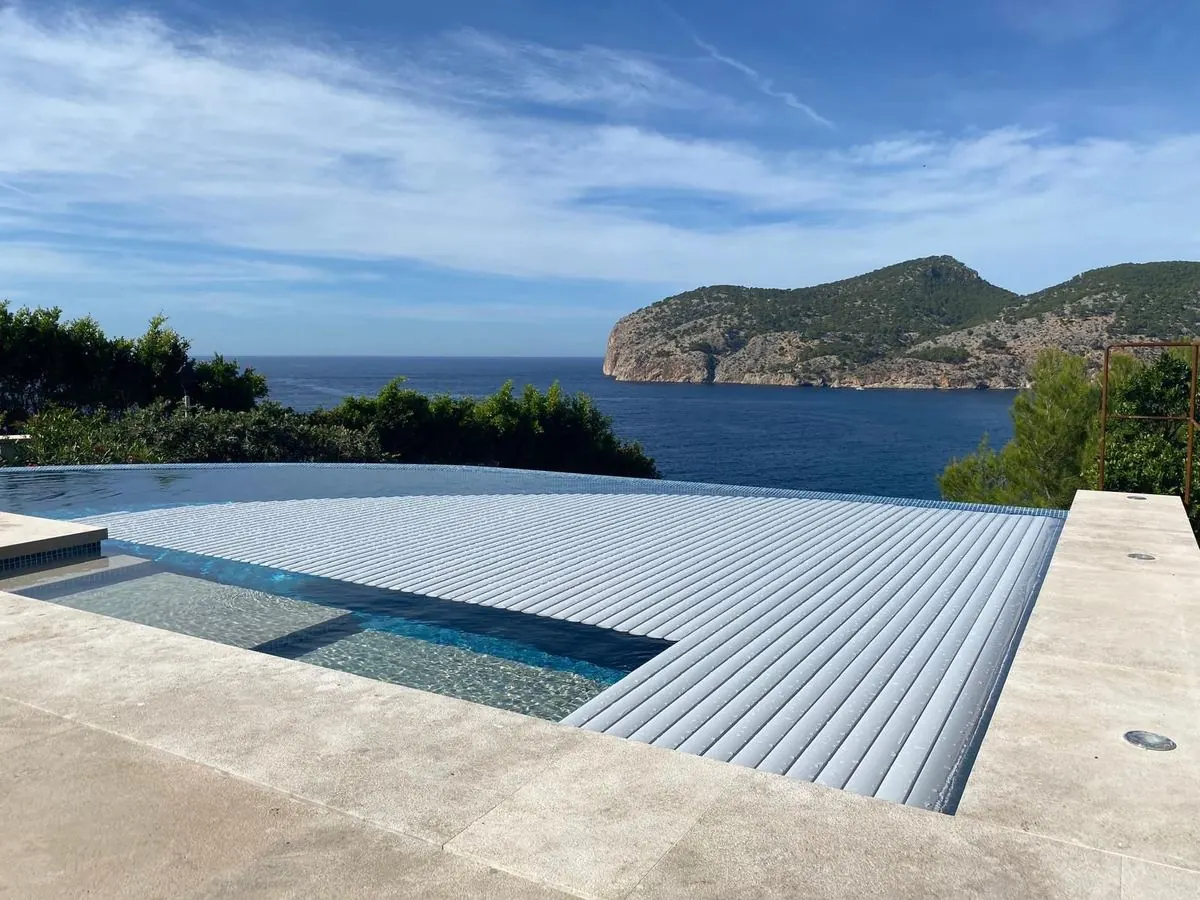
Automatic slatted pool cover closing over a villa pool
Protected October to May · Ready by the first swim

Leaving the pool covered over winter

Most owners here are away from October to May. An automatic slatted cover means the pool looks after itself while the house is shut: no leaves, no algae, no shock treatments in April. You come back and swim.

The six months nobody is watching the pool

If you spend the winter in Surrey, Utrecht or Hamburg and the villa sits empty from half term until Easter, the pool goes roughly seven months without anyone looking at it. Nobody notices the first green bloom in November, or the pine needles that sink and stain. The bill arrives in spring, and it is paid mostly in time: a partial drain, shock dosing, scrubbing the shell, and a couple of weeks of chasing the chemistry back into balance before anyone can swim. An automatic slatted cover changes that arithmetic. Closed, it seals the surface: leaves stay on top of the slats instead of on the floor of the pool, and the light algae need never reaches the water. In April you press a button and the season starts that afternoon.

20+
years in the trade
5,000+
covers installed
100%
made in our own Spanish workshop
NF
P90-308 safety standard

What happens to an uncovered pool between October and May

An open pool does not go dormant just because you have. Through the autumn it takes in leaves, dust, whatever the calima brings across from Africa, and the sediment that rain washes off the terrace. Cold water slows algae rather than stopping them, and a bright fortnight in February on the coast is enough to turn the walls green while the shutters are still closed.

That is why the first week of the season is so often a write-off. Organic matter that has been sitting on the floor since November stains the lining, the filter clogs, and the water needs shock dosing before it will hold a reading. Owners who arrive at Easter expecting to swim end up watching a technician instead.

A closed slatted cover removes the cause rather than treating the symptom. The slats sit edge to edge across the whole surface, so debris never reaches the water and the light that algae depend on never gets through. Evaporation almost stops, the chemistry stays where you left it, and the pool you uncover in spring is the pool you covered in October.

Emptying the pool for winter is the mistake to avoid

It is a stubborn piece of folklore that a pool should be drained before it is left for the winter. The opposite is true. An empty shell has nothing pushing back against the ground around it, so groundwater and swelling soil can lift or crack it. Frost gets into a dry structure, and winter sun works on a bare liner or mosaic finish.

Refilling is the other half of the problem. A typical private pool holds somewhere between 40,000 and 80,000 litres, and in a growing number of Spanish municipalities drought rules mean you may simply not be allowed to put that water back when you want it. A pool that spends the winter full and sealed under a cover sidesteps the whole question.

There is a safety argument too, and for an empty house it is the strongest one. Our covers are built to NF P90-308, the French child-safety standard, so a closed cover is a barrier a small child cannot get through and carries the weight of a 100 kg adult who walks onto it by mistake. Between October and May, when nobody is in the garden and the gate gets left open by a gardener or a pool technician, that matters.

Water level, filtration and the last hour before you fly

Leave the water at its normal operating level, roughly halfway up the skimmer mouth. The slats float, so they need the surface to be where it always is; drop the level and the cover loses its support while the skimmer starts drawing air. If a wet autumn pushes the level above the skimmer, ask whoever holds your keys to take it back down.

Filtration can drop right back, but do not switch it off. A short daily cycle on the timer keeps the water moving and the equipment healthy, and under a closed cover the pump has very little work to do because almost nothing is falling in. Inland, where nights go below zero, set the cycle to run through the coldest hours so nothing sits still in the pipework.

Balance the pH and the disinfectant before you go, then close the cover. With the surface sealed, sunlight is not burning the chlorine off, so what you leave behind lasts far longer than it would in July. One last thing: the cover is motorised at 230 V, so if you shut the power off at the consumer unit on your way out, close it first.

PVC or polycarbonate: choose for your winter, not your August

Winter in Spain is not one climate. Inland — Madrid, Toledo, the whole of Castilla-La Mancha — nights fall below freezing and the water gets genuinely cold. There, PVC slats are the sensible choice. They are completely opaque, so photosynthesis has nothing to work with, and they give the best insulation of the two, holding the water in a stable condition until spring.

On the coast the calculation changes. In Andalusia and along the Mediterranean, solar polycarbonate slats keep collecting heat on the bright days that a Costa del Sol winter hands out for free, which in a mild year can stretch swimming into November or December — more still if you have a heat pump, because the closed cover keeps the heat you have paid to put in. Transparent polycarbonate is the third option. If you are weighing a heat pump alongside the cover, both are compared in heating a pool in Spain.

Underneath either slat, the structure is 316L stainless steel throughout, which is what lets it live in chlorinated and salt-treated water without corroding. The roller sits either above the water on the coping stone, visible or inside a box, or submerged and out of sight in its own compartment. We have been building them in Torrijos since 2005, more than 5,000 installations so far, with a delegation in San Pedro de Alcántara for the Costa del Sol.

Common questions

Should the cover stay closed for the whole winter?

Yes — closed is its normal position from the last swim of the season until you come back. The one thing worth doing is having someone open and close it once or twice over the winter, which takes a minute and keeps the motor and the slats moving. If you cannot arrange that, leaving it shut for the full six months does no harm.

Do I need to lower the water level before I leave?

No, and please do not empty the pool either. The slats float on the surface, so the water is what holds the cover up; drop the level and you take that support away and leave the skimmer sucking air. Keep it at the normal mark, roughly mid-skimmer, and if heavy autumn rain pushes it higher, have it brought back down to that line.

Can I turn the filtration off completely while the house is empty?

It is better to leave a short daily cycle running on the timer. Under a closed cover there is barely any load on the system, so a couple of hours is usually plenty, and inland it should fall during the coldest part of the night. Ask a neighbour, keyholder or your usual pool technician to look in monthly: a tripped breaker in December is otherwise found in April.

Will the cover cope with frost, snow and winter storms?

Yes. The structure is 316L stainless steel and the slats are sealed, so ice on the surface, a night of hard frost or a layer of snow are all within what they are designed for. Built to NF P90-308, the closed cover also holds the weight of a 100 kg adult. Clear leaves and grit off the slats before you open it in spring so none of it drops into the water.

My pool is already built. Can a cover still be fitted?

Yes, and most of ours go onto existing pools. The roller sits above the water on the coping stone at one end, with or without a box, so nothing is dug into the shell and the pool is not out of use for long. A submerged, hidden roller belongs to a new build or a full refurbishment. Send us photographs and dimensions and we will tell you which applies.

Talk to the people who make and fit your cover

Tell us about your pool in Mijas and we'll recommend the right slat, then give you a clear price and timeline. Call +34 916 315 940, message us on WhatsApp at +34 675 651 156, or ask us to arrange a site visit from our San Pedro de Alcántara base.

Fly home in October, swim in April

Tell us where the villa is, how big the pool is and when you are next in Spain. We will come out, measure, and put a written quotation in front of you. Call +34 91 631 59 40 or email info@ingerclima.com.

Chat with us on WhatsApp