Ingerclima — automatic slatted pool covers
+34 91 631 59 40 Get a Quote
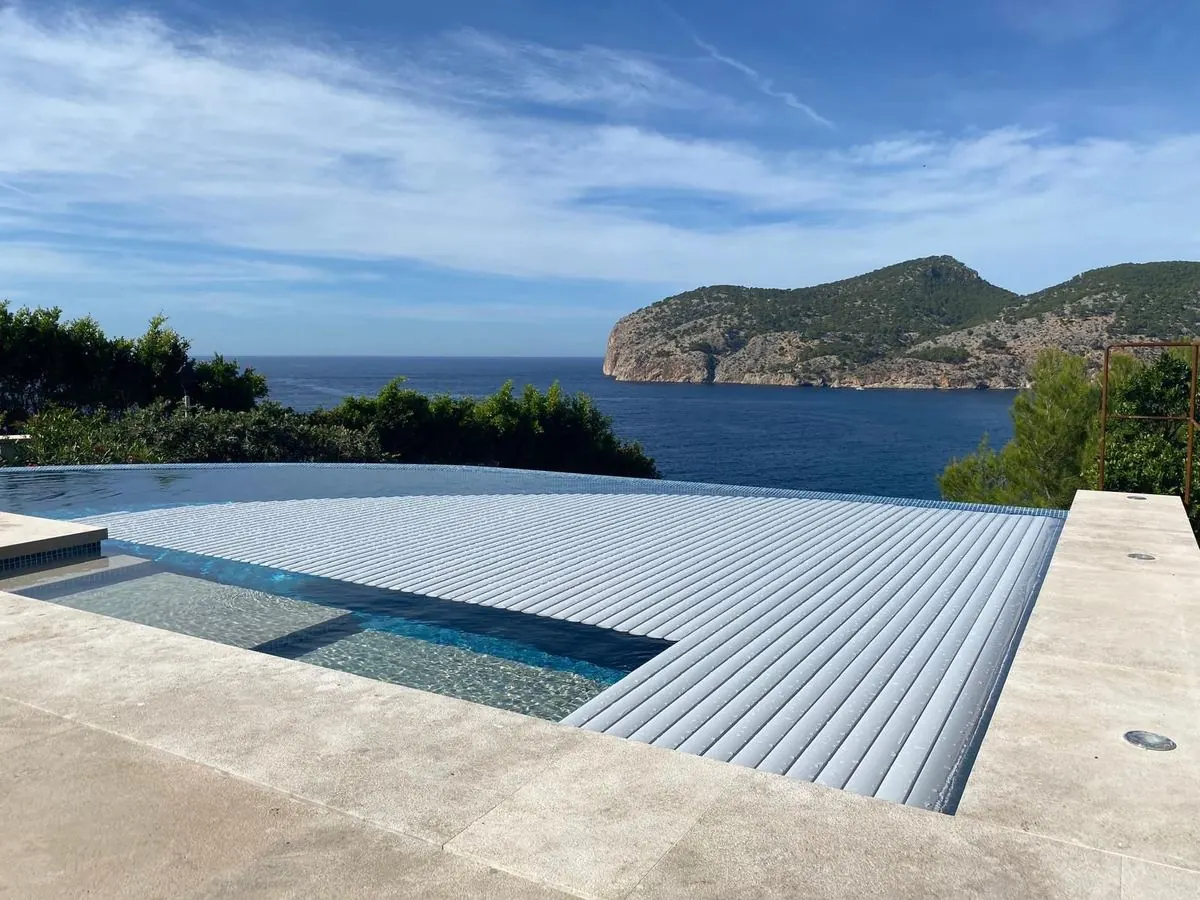
Automatic slatted pool cover closing over a villa pool
Built to NF P90-308 · Holds the weight of an adult

Child safety and the NF P90-308 standard

An automatic slatted cover seals the water surface completely, carries the weight of an adult and opens only when someone deliberately makes it open. For a family villa in Spain, it is the most complete protection available.

Why a French standard matters to a pool in Spain

NF P90-308 is a French norm, which surprises people until they read it. France made safety devices compulsory on private pools in 2003 and gave each accepted family of device its own specification; NF P90-308 is the one written for covers. Two decades of enforcement have turned it into the most quoted safety reference in Europe, which is why buyers from Britain, the Netherlands, Germany and Belgium ask for it by name even when the pool is in Marbella or the sierra outside Madrid. For a house in Spain it does something genuinely useful: it converts the phrase the cover is safe into a list of things that can be measured. Load, opening, coverage, ageing, the gaps at the edges. When you compare two quotations, it is the one line that means the same thing on both.

20+
years in the trade
5,000+
covers installed
100%
made in our own Spanish workshop
NF
P90-308 safety standard

What NF P90-308 actually requires

The headline requirement is structural. To meet the standard, a cover must take the weight of a 100 kg adult applied at any point of its surface, without sinking and without deforming permanently. In practice, a child who walks or falls onto a closed cover stays on top of it: the slats are rigid, they interlock along their full length, and they rest on the coping stone at both sides.

The second requirement is about who can open it. The cover may only be opened by a deliberate adult action: a remote control, a key switch or a switch protected by a code. It cannot drift open, be pushed open from above, or be started by a child pressing something by accident. Every Ingerclima cover is motorised at 230 V, so opening is always a controlled electrical operation rather than something anyone can do by hand.

The third is coverage. The norm asks for the entire water surface to be closed, with no uncovered corner and no gap a small child could slip through. That is why covers are made to measure for each pool, following its real shape rather than a catalogue rectangle. The standard also covers durability: the cover has to keep performing after ageing, exposure and repeated cycles, not just on the day it is installed.

A barrier that works when nobody is watching

Drownings in private pools are the leading cause of accidental death in young children in Spain, and they happen in seconds, in silence, with adults a few metres away. Fences, alarms and supervision all matter, but each has the same weak point: they depend on a person remembering. Somebody has to shut the gate, arm the alarm, keep looking. A closed cover has no such dependency.

Compare the options honestly. A perimeter fence works until the gate is left open, and does nothing once the child is already inside it; it also dominates the garden visually. An immersion alarm reacts after the child is in the water, and the chain of alarm, adult, pool takes time you may not have. A perimeter alarm detects an approach but prevents nothing, and cries wolf at cats, dogs and wind.

A closed slatted cover is the only measure that is passive and continuous. Whenever the pool is not in use, the water is simply not reachable: a child arriving at the edge finds a firm surface underfoot instead of water. It does not replace adult supervision while children are swimming or playing beside an open pool, but it removes the risk entirely for the many hours nobody is out there.

Spanish rules, and a pool you are not standing next to

Spain does not oblige you to cover a private family pool. Real Decreto 742/2013 sets the technical and health criteria for pools in public and communal use, and a single-family pool falls only under its article 13, which asks the owner to report a health incident. None of the seventeen autonomous communities requires the owner of a private family pool to cover it, fence it or enclose it. A cover built to NF P90-308 is therefore a decision you take for your own household rather than a box the law makes you tick, and it is the most complete of the measures on offer, because it takes the water out of reach instead of warning you once a child has already got to it. We set out what each autonomous community's regulation actually says, with a link to the official gazette for every one of them, in our guide to private pool regulations in Spain.

That matters more still if you are not here all year. A villa on the Costa del Sol or in the Madrid sierra spends months with a key-holder, a gardener and a pool cleaner coming and going, and perhaps guests who have never seen the property. You cannot brief all of them, and you cannot check a gate from Amsterdam or Surrey. A cover that needs a deliberate adult action to open behaves the same whether you are in the house or not.

How the cover is built, and what you choose

Ingerclima has manufactured slatted covers in Torrijos, near Toledo, since 2005, with more than 5,000 installations and a branch in San Pedro de Alcántara, Marbella. The structure, the roller and the fixings are 316L stainless steel, the marine grade chosen because a poolside lives in permanently chlorinated, salty, sunlit air. Every cover is motorised at 230 V; there is no hand-wound version, because a safety cover that is tiring to close is a cover that stays open.

You then make two choices. The first is the slat: PVC, the robust everyday option, or polycarbonate, either solar, which lets sunlight through to warm the water, or transparent. The second is the roller. It can sit above the water, visible, with or without a housing, which suits a pool already built because nothing is touched inside the shell. Or it can be submerged and hidden, the choice while a pool is still being designed.

Common questions

Is an NF P90-308 cover legally required in Spain?

No. Spanish law does not name the French norm, and no autonomous community obliges the owner of a private family pool to cover, fence or enclose it. Real Decreto 742/2013 applies to pools in public and communal use; a single-family pool falls only under its article 13, on reporting health incidents. The standard matters for a different reason: NF P90-308 is the one written for private pool covers, so it is how you know what a cover has to do: carry a 100 kg adult applied at any point without tearing or coming away from its anchor points, open only by a deliberate adult action, and close over the whole water surface with no gap a small child could slip through.

Could a child open the cover on their own?

No. The standard requires a deliberate adult action to open, and our covers are driven by a 230 V motor operated from a remote control, a key switch or a coded switch. There is no handle, no crank and no way to slide the slats open from above. Keep the remote out of reach in the same way you would keep car keys out of reach, and the pool stays closed until an adult decides otherwise.

Does it really hold an adult's weight?

The cover is built to withstand 100 kg applied at any point without sinking or taking permanent deformation, which is what makes a child who steps onto it stay on the surface. That is a safety margin, not an invitation: a closed cover is a barrier, not a terrace, and nobody should walk or play on it deliberately. We do not make walk-on decking covers, and no slatted cover should be treated as one.

What about dogs and cats?

Pets are one of the reasons owners call us. The slats carry the weight of a dog or a cat without giving way, so an animal that wanders onto a closed pool in the dark stays on top of the cover, and the textured surface lets it walk off under its own steam. For households with an elderly or excitable dog, that alone is often the argument that settles the decision.

Can it be fitted to a pool that already exists?

Yes, and most of our installations are exactly that. On an existing pool the roller sits above the water, raised on supports at one end, with or without a housing to conceal it; nothing is cut, drained or rebuilt inside the shell, and a typical installation is a matter of a day or two. A submerged, hidden roller needs a compartment built into the structure, so that option belongs to pools still under construction or being fully renovated.

Talk to the people who make and fit your cover

Tell us about your pool in Mijas and we'll recommend the right slat, then give you a clear price and timeline. Call +34 916 315 940, message us on WhatsApp at +34 675 651 156, or ask us to arrange a site visit from our San Pedro de Alcántara base.

Talk to us about your pool

Send us the measurements of your pool and a photograph or two, and we will propose the right slat and roller for it. Made to measure, built to NF P90-308, installed across Spain. Call +34 91 631 59 40 or write to info@ingerclima.com.

Chat with us on WhatsApp