
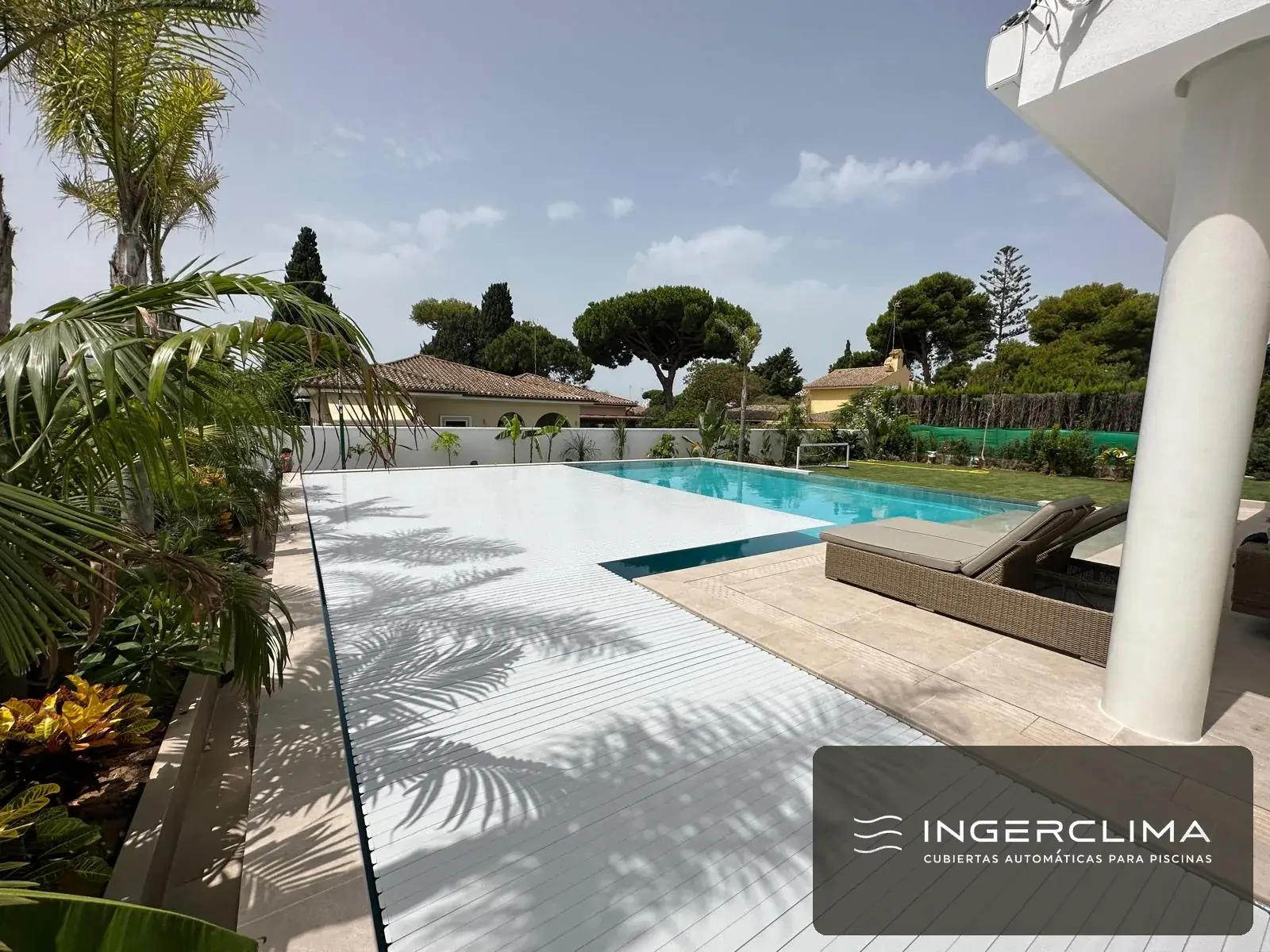
Why a Castelldefels pool has a dirt problem, not a frost problem
At three metres above sea level, the thing working against a pool is not the cold. Meteocat averages for 2010-2025 record 0.0 frost days a year at Barcelona-Raval and 3.3 at Sant Pere de Ribes, on the far side of the Garraf, against 10.4 up in Sant Cugat del Vallès. Winter is not the argument here. What gets into the water is: salt carried in off the beach, sand, and the pine pollen the Garraf puts into the air in April — plus the evaporation nobody sees and the safety question every family with a garden asks.
What the chlorides actually go after
The sea breeze carries chloride inland and it attacks bearings, screws and brackets long before any visible part looks tired. Everything structural in our covers — frame, shaft, supports, fixings — is AISI 316L, the marine grade, and none of it is aluminium. That buys more than 15 years of structure and 10 to 15 years of slats, changed as a part of their own. Upkeep is a hose: run fresh water over the closed cover now and again and there is nothing else to do.
PVC or polycarbonate on a pool used all twelve months
Only 13.6 % of the housing stock here is a second home, so the pool works all year and the slat has to as well. PVC is the tougher of the two and the usual answer. Solar polycarbonate is what to ask for if you want April and October back: it lets the sun through and hands that heat to the water, which is where the temperature loses the argument in the shoulder months. Transparent polycarbonate is for a garden where the pool is meant to be looked at. Every version is motorised, 230 V / 50 Hz, on a remote or a wall switch — there is no hand-operated model. The shaft either stands over the water, boxed or bare, or goes below it and out of sight; the slats themselves are set side by side on slat types.
What water costs on this side of the metropolitan area
Castelldefels is supplied by Aigües de Barcelona, and the domestic tariff rises in five monthly blocks. A garden with a pool goes past 18 m³ a month in July, and above that line supply alone is 4.2674 €/m³ (2026 tariffs, provincial gazette); the Catalan water levy adds up to 4.8208 €/m³ in its own top band, and with sewerage and VAT the marginal cubic metre of the metropolitan bill comes to 10.31 €/m³. Pool water is not bought at the average price on the bill: it is the last water of the month, so it is bought near the top. A cover stops 15 to 25 m³ of evaporation a year on an 8 × 4 m pool, and the Agència Catalana de l’Aigua recommends covering the pool in its own saving guide: a cobertor de piscina cuts evaporation by up to 70 %, keeps frost off the water and keeps organic matter out. Alongside that come roughly 35 % less chemical consumption and, if the pool runs on a heat pump, 50 to 60 % less energy.
The restrictions are gone, and that is the reason to fit it now
Nothing is restricted today. Every supply unit in Catalonia is in normalitat, the Ter-Llobregat system was at 77.51 % on 24 September 2026, and the Barcelona area has been out of restrictions since 16 May 2025. But anyone living here remembers 2024, when the area reached the emergency scenario, and the drought plan has not changed a word since: in alert, topping up is limited to replacing evaporation losses; in an exceptional scenario that allowance disappears; in emergency even partial topping up is banned, whatever the origin of the water, a private well included. Water that does not evaporate does not have to be replaced: that is the case for fitting the cover now, while nobody is telling you that you must.


