Ingerclima — automatic slatted pool covers
+34 91 631 59 40 Get a Quote
Automatic pool cover in summer — Ingerclima
70–80% less evaporation · Real savings on water and chlorine

Pool covers for the summer

Summer is when a pool needs the most water, the most chlorine and the most maintenance. An automatic slatted cover closes over the pool in seconds whenever it is not in use, cutting evaporation by between 70% and 80% and keeping the water in perfect condition with no effort. Three-year warranty covering structure, motor, slats and installation.

Summer is the season when your pool loses the most

Paradoxically, summer — when the pool is used most — is also when the water deteriorates most. High temperatures and the sun's UV radiation break chlorine down quickly, evaporation carries water and chemicals off into the air, and the constant coming and going of bathers adds a continuous organic load. The result: a pool that constantly needs chemicals, water that has to be topped up every week and a robotic cleaner that works every day.

An automatic slatted cover solves all of these problems while the pool is not in use — at night, through the middle of the day or on days when nobody swims. Closing the cover cuts evaporation, blocks the UV rays that destroy chlorine and keeps the water cleaner. The result is less spent on chemicals, less water added and far less time spent on maintenance.

What changes when you close the cover

Water

An 8×4 m pool can lose between 120 and 190 litres a day to evaporation at the height of summer, depending on the area (you can work out the litres for your own pool (in Spanish)). With a cover, evaporation falls by 70–80%: 15,000–25,000 litres less a year. Less topping up, less spent on mains water.

Chlorine and chemicals

UV rays break down free chlorine within hours. Covering the pool at night and whenever it is not in use can reduce consumption of chlorine and other chemicals by around 35% in summer.

Dirt and maintenance

With the cover closed, no leaves, dust or insects get in. The robotic cleaner has far less work to do, the filtration system can run for fewer hours and the water stays visibly cleaner.

Convenience

Opening or closing the cover takes less than 60 seconds with the key switch or the optional remote control. No manual effort, no tarpaulins to roll up, no anchors to deal with. The pool is ready whenever you want it.

Why a pool loses so much water in heat and wind

Evaporation is not a slow drip: it is the entire surface of the pool working as an evaporator. Water turns to vapour when the air above it is dry and the water is warmer than that air, and in summer all of those conditions come together: low humidity, high temperatures and long hours of sun heating the water surface. Wind adds the factor that is most underestimated: over still water a layer of already humid air forms and slows the process down, and every gust sweeps it away and replaces it with dry air. That is why a pool sheltered between hedges and one on an open plot do not lose anything like the same amount.

And there is a detail that tends to be overlooked: at night the pool goes on losing water to evaporation, and a lot of it. During the day the water stores heat; as evening falls the air cools sooner than the water does, so the water is left warmer than its surroundings and evaporation carries on all night, just when nobody is keeping an eye on the pool. It is the part of the day when the cover can stay closed without getting in anyone's way.

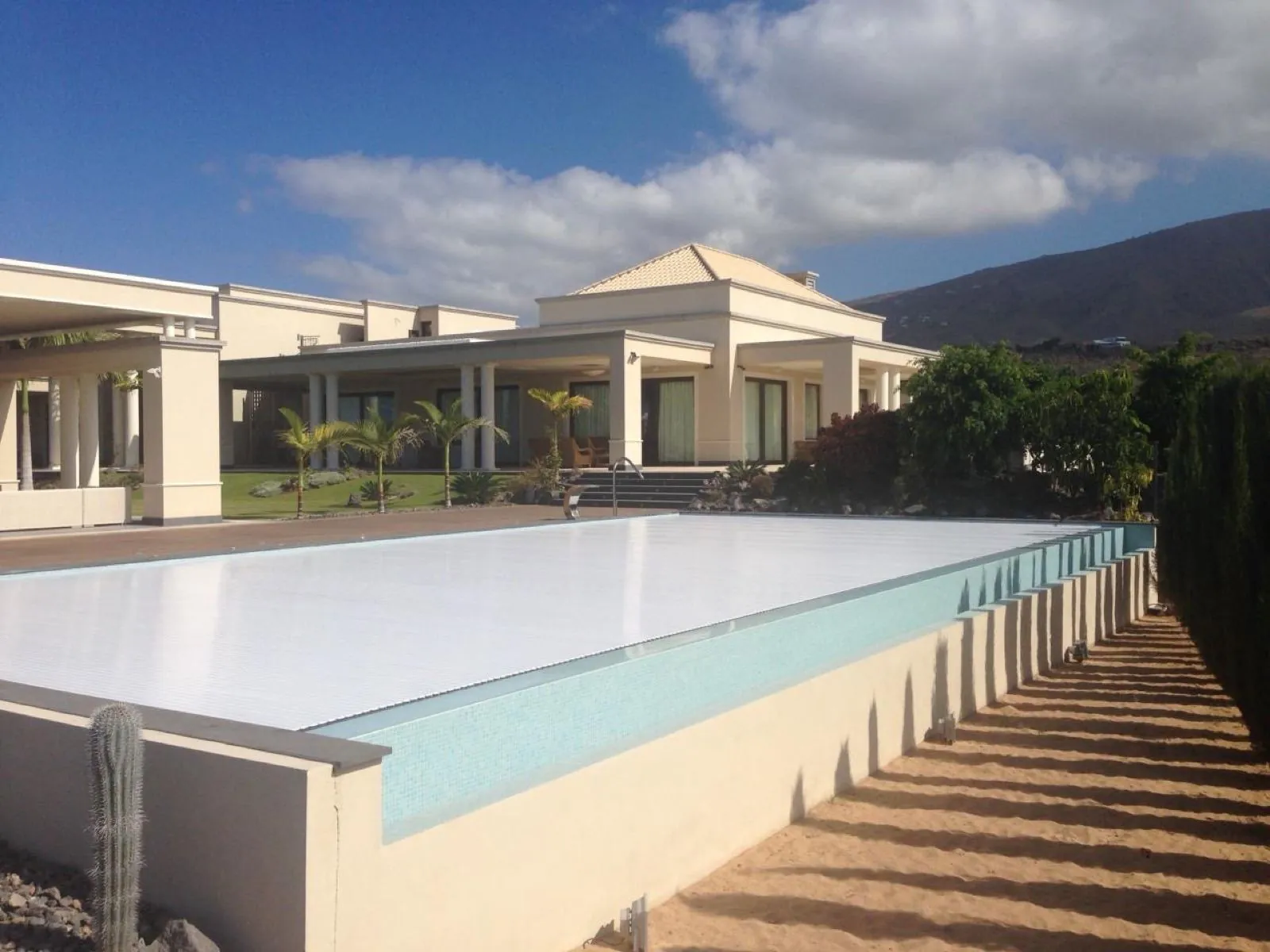
With the cover closed, the slats float on the water and cover the whole surface, from edge to edge. Once contact between the water and the dry air is cut off, evaporation falls by between 70% and 80%. Over the season that translates into something concrete: the level stops dropping visibly from one day to the next and topping up comes into play far less often.

Because every top-up is more than just water. Mains water goes in cold and untreated: it lowers the temperature of the pool and dilutes the disinfectant you had only just adjusted. Every time you refill, you have to correct the chemistry again. That is why the saving on water and the saving on chemicals, of around 35% (in Spanish), always go together. And where there are watering restrictions or water is billed in consumption bands, that constant topping up is exactly what you want to be without.

With a cover vs without a cover in summer

The same pool and the same month of August, with the cover closed during the hours when nobody is swimming, and without it.

In summer Without a cover With an automatic slatted cover
WaterEvaporation at its full rate, day and night. The level has to be topped up again and again.Between 70% and 80% less evaporation while it is closed.
ChemicalsUV radiation breaks down free chlorine in a matter of hours. Constant dosing.Around 35% less chemical consumption.
Water temperatureAt night the water gives up the heat it had gained during the day.Keeps the heat the water has gained during the day; with solar polycarbonate slats, up to 6–7 °C more (which is what you want in May and September, not at the height of August).
CleanlinessLeaves, dust, insects, pollen and sand in the pool every day.Water surface covered from edge to edge: no dirt gets in.
MaintenanceRobotic cleaner and filtration system working every day.Fewer hours of robotic cleaning and fewer hours of filtration.
SafetyThe water is left uncovered the whole time nobody is watching.Rigid surface built to NF P90-308: it holds the weight of a 100 kg adult.

None of these advantages means changing your habits: the cover opens and closes in less than 60 seconds with the key switch or the optional remote, and it is the same cover that will later see the pool through the winter. You buy it once and it works all twelve months.

Covering at night or covering by day? What each one is for

In summer the cover is used for two aims that look like opposites, and it is worth being clear about which one is yours before you choose the slat.

Closing it at night is what almost everyone does and what almost always pays off. Water loses heat mainly through its surface, and a good part of that loss goes precisely with the water that evaporates. If you cover the water surface when the air cools down, by morning the water is a good deal closer to the temperature it had the evening before. It is also the reason a cover and a heat pump get on so well: with the cover closed during the hours the pool is not in use, the saving on pool heating is between 50% and 60%.

Closing it during the day makes sense in the opposite case: when the water is already too warm. In the middle of a heatwave, and above all in small or shallow pools, the water can end up lukewarm and not very pleasant. Closing through the middle of the day cuts the direct radiation on the water and also cuts evaporation during the sunniest, windiest hours. And on any day when nobody is going to swim, the most cost-effective thing is to leave it closed all day.

The slat decides which way the temperature goes. Opaque PVC slats do not collect solar energy: they hold in the heat the water already has and add no more, which is what you want if you like cool water in August. Solar polycarbonate slats work the other way round: their triple-extrusion cellular structure acts as a collector and they can raise the water by up to 6–7 °C without using a single watt, which is very useful for stretching the season through May and September. Clear polycarbonate slats let the light through and allow you to go on seeing the water with the cover closed: they are chosen for looks, not for temperature. In cover models you can see how each system looks, and what affects the price sets out the factors that drive the quote.

This should not be confused with a bubble blanket, which is a different category of product: we make automatic covers with rigid slats, with a 316L stainless steel structure and an electric motor, and all of them are motorised — there is no manual version.

In summer the cover is also a safety barrier

Summer is the season when people are in and out of the water all day, and it is also the one with the most risk: children at home for the holidays, cousins and friends who do not know the pool, the garden gate left open and long lunches at which everyone assumes somebody is watching. The risky moments are almost never the ones when people are swimming: they are the idle spells in between.

That is where an automatic slatted cover does something no other summer accessory does: it covers 100% of the water surface passively and continuously, without relying on anyone remembering to switch anything on. Our covers are built to the French standard NF P90-308, the benchmark anti-drowning standard for pool covers, and the closed cover carries the weight of a 100 kg adult applied at any point: a child who falls onto it stays on top of the slats and cannot sink. Carrying that weight does not make it a walk-on cover: it is a safety requirement so that anyone who falls onto it does not go under, not permission to walk across it. Because it is made to measure for the pool shell, no gaps are left at the sides or the corners, whatever the shape of the pool.

And it opens only when an adult wants it to: operation is always motorised, with a key switch as standard and a remote control as an option. It does not open by itself, it does not open with a push and it does not open by accident. That sets it apart from any cover that has to be spread out and taken off by hand: what takes no effort gets used; what takes effort ends up unused on exactly the days when the garden is busiest.

To be honest about it: the cover does not replace adult supervision while children are near the water. What it removes is the risk during the hours when the pool is not in use, which in summer are most of them. We set it all out in full, with the comparison against fences and alarms, on the pool covers and child safety page.

‘There is no need to cover it in summer’: why that is not true

Some people think there is no point in covering the pool in summer because ‘it is already warm’. But in summer the cover is not used to heat the water — it is used for everything else: cutting evaporation overnight, protecting the chlorine from UV rays, keeping the pool clean between swims and providing safety when there are children or older people in the house.

The cover does not get in the way of using the pool at all: it opens in seconds when someone wants to swim and closes just as quickly afterwards. The balance of time and money always comes out in the owner's favour.

And if what is holding you back is not knowing which slat to choose, that is settled further up: opaque PVC if you want cool water in August, solar polycarbonate if what you are after is extra warmth.

Start this summer with lower costs and more convenience

Ask us for a quote for your automatic cover. Manufacture and installation throughout Spain, with short lead times so that you have the cover before the season.

Common questions

Can the cover be used in summer even when it is very hot?

Yes. The cover is used mainly when the pool is not in use: at night, through the middle of the day and on days when nobody swims. Opening or closing it takes less than 60 seconds with the key switch or the optional remote control. The slat materials are designed to withstand extreme summer temperatures without deteriorating.

Does the cover make the water too warm in summer?

Opaque PVC slats do not collect solar energy, so they do not heat the water. Solar polycarbonate slats do have a warming effect. In intense summer heat, if you would rather keep the water cool, PVC slats are the most suitable option. In warm-climate areas where the aim is to extend the season, solar polycarbonate is still useful because it heats the water in autumn and spring.

How much does the cover save on pool chemicals in summer?

Summer is when the greatest loss of chlorine and other disinfectants to the sun's UV radiation occurs. A slatted cover can reduce chemical consumption by around 35%, because it protects the water from UV rays when the pool is not in use and keeps up the concentration of the active chemicals for longer.

Do you have to cover the pool in summer?

It is not compulsory, but it is the time of year when it makes the most difference. In summer, peak evaporation, peak breakdown of chlorine by UV rays and peak use of the pool all coincide. Covering it during the hours when nobody is swimming — at night, through the middle of the day in a heatwave and on days when it is not used — cuts evaporation by between 70% and 80%, reduces chemical consumption by around 35% and keeps the water clean between swims. And it involves no work at all: opening or closing it takes less than 60 seconds with the key switch or the optional remote.

Is it better to close the cover by day or by night in summer?

At night, almost always: that is when the water is warmer than the air, when evaporation carries on without anyone keeping an eye on it and when the pool is not in use. Closing it at night keeps the heat built up during the day and cuts the water lost during those hours. By day it makes sense to close it through the middle of the day in a heatwave and on any day when nobody is going to swim. If you want warmer water, solar polycarbonate slats heat the water while the cover is closed; if you want the water not to get any warmer, opaque PVC slats do not collect solar energy.

How much water does the cover stop evaporating in summer?

In summer, with high temperatures and wind, an 8×4 metre pool can lose between 120 and 190 litres of water a day to evaporation, depending on the area. With the cover closed during the hours the pool is not in use (especially at night), evaporation is reduced by between 70% and 80%, which can amount to between 15,000 and 25,000 litres less water a year.

Chat with us on WhatsApp