Cambrils has 1,837 pools on the Land Registry
According to the Land Registry there are 1,837 uncovered pools registered in Cambrils, 220 more than in 2022, when there were 1,617: 13.6% growth in four years, three times the provincial rate. That makes the town the fifth of the 184 municipalities in the province of Tarragona, behind El Vendrell (2,807), Calafell (2,802), Mont-roig del Camp (2,614) and L’Ametlla de Mar (2,342), and ahead of Tortosa (1,718), Cunit (1,582), the city of Tarragona itself (1,533), Roda de Berà (1,321), El Catllar (1,270) and Reus (1,125). The province of Tarragona has 41,968 pools and has gained 1,825 since 2022, 4.5% more. Across Catalonia there are 204,648 pools spread over 936 municipalities: Barcelona leads with 108,322, Girona is second with 46,007, Tarragona third and Lleida has 8,351.
For context: Madrid is the leading province in Spain with 147,555 pools, Alicante the second with 132,495, and Málaga records 83,789. Tarragona is not in that league by volume, but Cambrils does stand out for concentration: 1,837 pools in a municipality of some 35 km² is more than eight times the provincial average per municipality, and of the order of 52 pools per square kilometre.
There is a town-planning explanation for why a municipality this size holds so many pools. Cambrils did not grow as a wall of apartment blocks: it grew as two compact centres plus a patchwork of plot-by-plot estates in the eastern and western sectors. The INE’s 2021 Population and Housing Census counts 31,733 conventional family dwellings here, of which 14,146 are main residences and 17,587 are not: 55.4%, where the INE puts the Spanish average at 8.1 million non-main dwellings, 30.4% of the total. And the registered population is not small either: 37,068 inhabitants at 1 January 2025 according to Idescat, using the official INE figures, of whom 7,595 are foreign nationals, 20.49% of the town.
One necessary warning about these numbers, so that nobody reads more into them than is there. The Land Registry census under-records: it is a floor, not a ceiling. Some pools are never declared and others are entered late, so the real figure is higher than the published one. The Land Registry also does not tell a private pool from a communal one or from a campsite pool: the 1,837 are every body of water in the municipality, not 1,837 houses with a pool. And the data does not go below municipal level: there is no breakdown by district or by estate, so there is no way of saying how many are in Vilafortuny and how many in la Vila. When we break the area down we do it by geography and by our own work, never by pinning numbers on a neighbourhood.
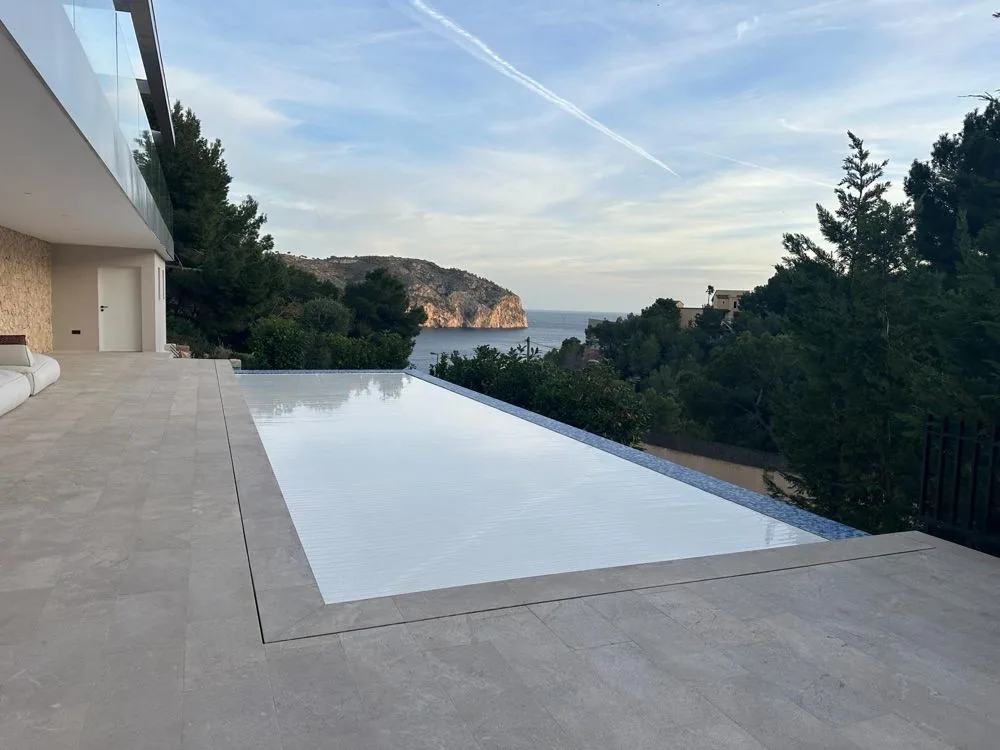
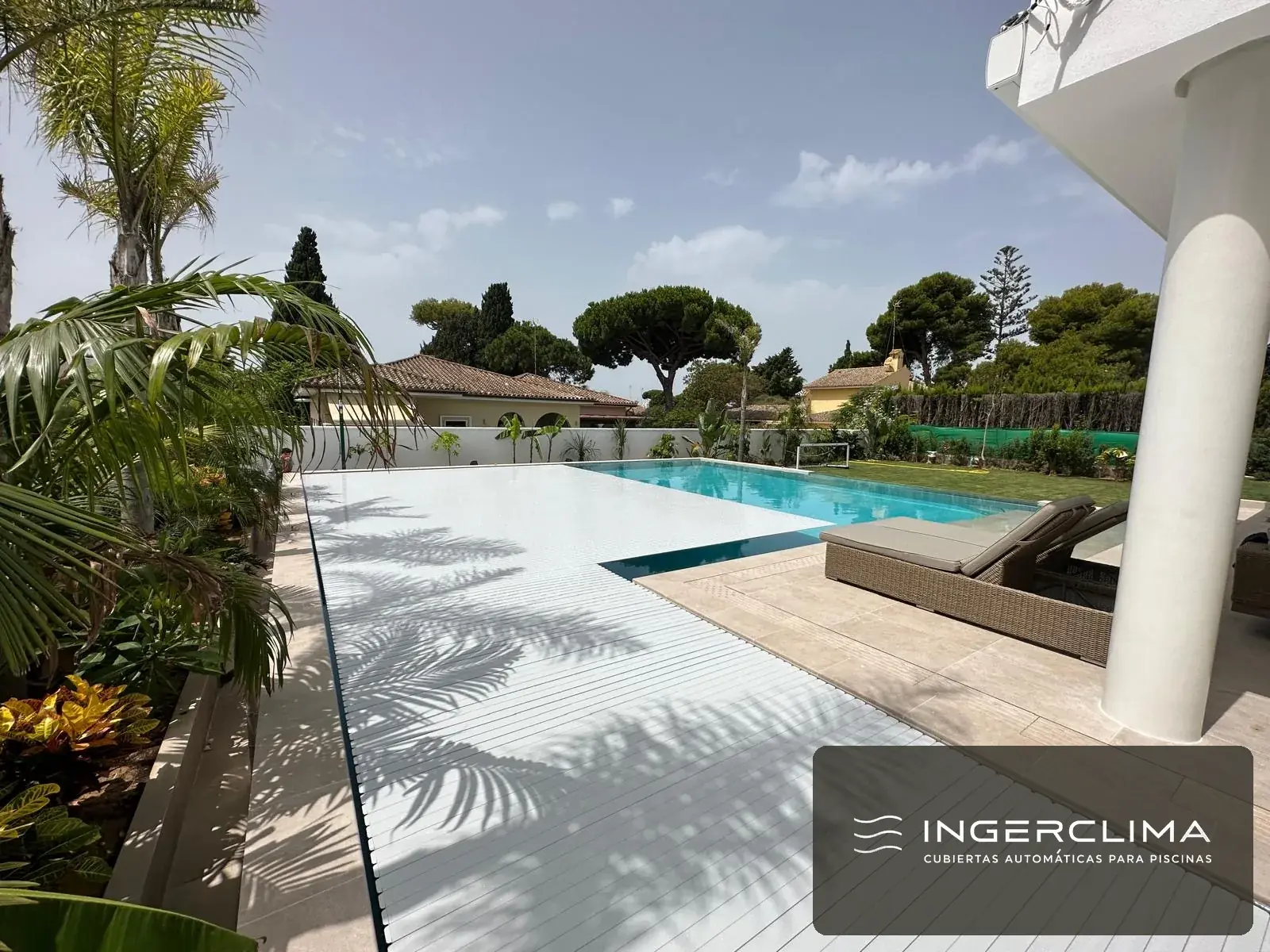
In practice, that profile — a family pool on its own plot — is the one where a cover pays for itself fastest. Closed, it cuts evaporation by 70% to 80%: in an 8×4 metre pool, 15,000 to 25,000 litres a year you do not have to replace. If there is a heat pump, consumption drops by 50% to 60%, and with solar polycarbonate slats the water gains 6 or 7 °C during the day at no running cost. The other reason people call us is safety: closed, the slats form a continuous surface that keeps anyone out of the water and holds 100 kg, built to the NF P90-308 standard, a French one rather than a European one. That does not make it a walk-on or step-on surface, and nobody should walk on it. You can see the whole province on pool covers in Tarragona and the region as a whole on pool covers in Catalonia.