Ingerclima — automatic slatted pool covers
+34 91 631 59 40 Get a Quote
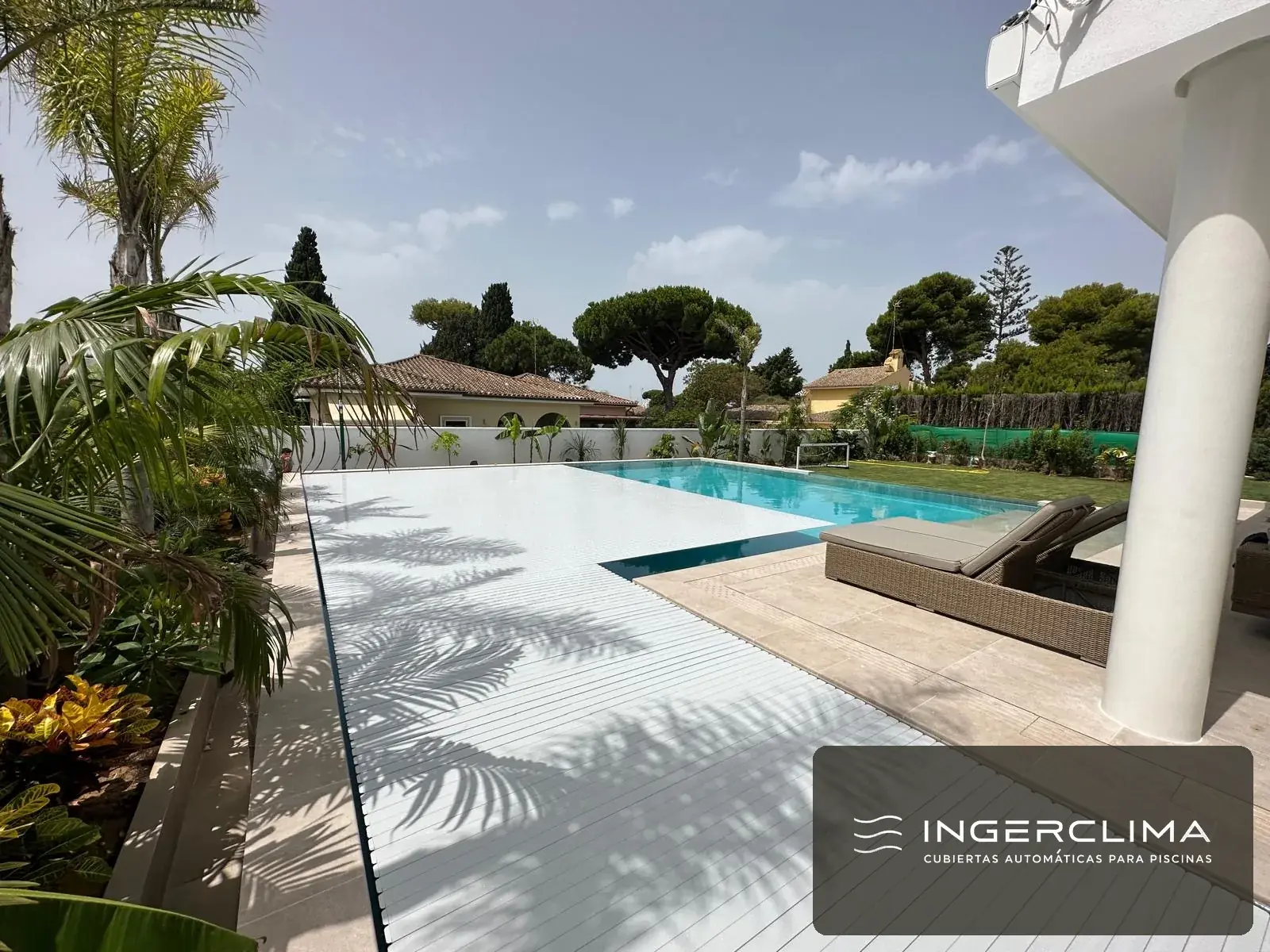
Automatic cover with white slats closed over the pool of a villa, with hedging and palm trees
Province of Girona · Manufacturer since 2005

Automatic pool covers in Girona and on the Costa Brava

We build your slatted cover to size at our own factory in Torrijos (Toledo) and our Barcelona team fits it, covering the whole of Catalonia: all 221 municipalities in the province, from the coast of the Alt and Baix Empordà to inland la Selva, el Gironès and the mountain comarques. Three-year warranty on structure, motor, slats and fitting.

A cover we build ourselves and our Barcelona team fits

At Ingerclima we have been building automatic slatted pool covers since 2005, at our own premises in Torrijos (Toledo). We do not resell them: we design them, we build them, we set the price and we answer for them afterwards. We have over 5,000 installations across Spain, with our own service engineers and spare parts, and we also heat the pool with heat pumps, chillers and dehumidifiers as an official Calorex distributor. In Catalonia the house call, the measuring and the fitting are done by our Barcelona team, which covers all four provinces: we say so in the first line because it is the first thing people ask.

The province of Girona has a great many pools and, above all, a great many new ones. The Land Registry records 46,007 uncovered pools across the 221 municipalities of the province, 3,840 more than in 2022: 9.1% in four years, the sharpest growth of the four Catalan provinces. Girona is second in Catalonia by number of pools, behind Barcelona (108,322) and ahead of Tarragona (41,968) and Lleida (8,351), within a Catalan total of 204,648 pools in 936 municipalities on the 2026 count. The table covering all four provinces and the legal side are on the Barcelona and Catalonia page; here we get to what is different about Girona.

It is worth saying exactly what we build, because the words “pool cover” are used for very different things. In covers we do one thing only: automatic slatted covers. Every one of them is motorised, and there is no manual or crank version. As standard they are operated with a key switch and in hold-to-run mode — that is, the slats only move while you keep the switch pressed and with the pool in view; the remote control and the phone are options on the quote. The frame, the shaft, the brackets and the fittings are always AISI 316L stainless steel, the molybdenum-bearing grade meant for marine air, and no other material. The slats float on the water: there is nothing along the sides to clean or grease, and what rests on the surround are the legs and, where fitted, the housing, which is not a bench and is not meant to be sat on. The cover has no alarm and no obstacle sensors: it detects nothing and it does not stop on its own, so you have to operate it with the pool in view and nothing on top of it, and never pull the slats by hand. Built to size in 4 to 5 weeks, plus one or two days of fitting, with a three-year warranty on the whole assembly and built to the French NF P90-308 standard.

46,007
pools recorded in the province of Girona
+9.1%
since 2022, the sharpest growth in Catalonia
5,000+
covers installed since 2005
3 years
warranty on structure, motor, slats and fitting

The 46,007 pools in the province of Girona, municipality by municipality

This is the real order across the province, with nobody left out. Top of the list is Castelló d’Empúries with 3,066 pools on record, the municipality with more pools than anywhere else in Girona. Second comes Lloret de Mar with 2,862, third Calonge i Sant Antoni with 2,623, fourth L’Escala with 2,159 and fifth Begur with 2,039. Behind them come Roses with 1,850, Platja d’Aro with 1,517, Palafrugell with 1,466, Santa Cristina d’Aro with 1,439 and Maçanet de la Selva with 1,218. Closing the upper table are Caldes de Malavella with 1,152, the city of Girona itself with 1,143, Vidreres with 1,059, Pals with 879, Blanes with 794, Torroella de Montgrí with 761, Sils with 731 and Sant Feliu de Guíxols with 643.

Three things come out of that table, and together they explain what kind of province this is. The first: the capital is not in charge. The city of Girona comes twelfth, with 1,143 pools, less than half of Castelló d’Empúries. That is not a statistical oddity, it is town planning: the city is compact and built in blocks, and pools appear where there are plots.

The second: here the pool is, to a large extent, a coastal second home. The top five municipalities are on the coast or a step from it, and not in a single comarca: Castelló d’Empúries and L’Escala in the Alt Empordà, Calonge i Sant Antoni and Begur in the Baix Empordà, and Lloret de Mar on the coast of la Selva. There are small municipalities, Begur among them, that pass the two thousand mark. That changes the priorities: the cover is not bought only to warm the water, it is bought so that the pool stays clean and closed through the months when nobody is looking at it.

The third: inland la Selva counts too. Maçanet de la Selva, Caldes de Malavella, Vidreres and Sils add up to more than 4,100 recorded pools between the four of them: villa estates with proper plots, well away from the sea, with colder winters and more vegetation around them. These are two different markets, and the same order sheet does not answer both.

A necessary word of warning about these figures. The Land Registry count under-records: it is a floor, not a ceiling. Some pools are never declared, others are entered late, and some never appear at all, so the real figure is higher than the published one. Nor does it distinguish a private pool from a communal one, or from a hotel or campsite pool: the 3,066 pools in Castelló d’Empúries are every body of water on record in the municipality, not 3,066 houses with a pool. And the data does not go below municipality level: there is no official breakdown by neighbourhood or by estate. When we divide the province into comarques here we do it by geography and by where we work, never by pinning figures on a neighbourhood.

And that is where a slatted cover earns its place on arguments that have nothing to do with looks. Closed, it cuts evaporation by 70% to 80%, which is where most of the water goes and most of the heat with it. Chemical consumption falls by around 35%, because the water stops taking direct sun, leaves and dust. With a heat pump and the cover in place, the system uses 50% to 60% less. And with solar polycarbonate slats the water gains 6 or 7 °C during the day at no running cost. The other reason people call us is safety: closed, the slats form a continuous surface that keeps anyone out of the water and carries 100 kg to the NF P90-308 standard, which is French and not European. That does not make it a walkable or step-on surface: you must not walk on it, and it does not replace adult supervision.

Tramuntana and salt air: what really decides the cover here

On the Costa Brava, and in the Alt Empordà above all, the figure that shapes a cover most is not the temperature: it is the wind. The tramuntana comes down from the north, dry and gusty, and it can blow for several days together without easing off at night. Between Roses, L’Escala and Cap de Creus it is the wind that sets the household calendar.

A slatted cover copes well with that for one specific reason: the slats float on the water. The closed cover rests on the body of water itself, and there is no sheet stretched above it for the wind to lift like a sail. It is not a tarpaulin you have to roll up and tie down every time the wind picks up.

What the tramuntana does demand is that the fittings and the anchoring be taken seriously. The legs, the brackets and the fixings are AISI 316L stainless steel, and the anchor points into the coping stone are set out on site one by one, not from a catalogue. On exposed plots the first thing we ask is not the size of the pool: it is where the wind comes from.

The second factor is salt. The Costa Brava is genuine coast — cliff, cove and houses looking straight out to sea, from Blanes to Portbou — and that means salt-laden air for much of the year, not just in summer. With the tramuntana the salt travels inland, so you do not have to be on the front row to feel it. The answer is the material, and it is the same in Begur as in Vidreres: all our steel is AISI 316L, the molybdenum-bearing marine grade. We do not change material by area, and there is no downgraded version for inland sites.

A Girona winter is not a Levante winter

This is the difference most often overlooked. The Costa Brava is Mediterranean, but it sits at the far northern end of Spain’s Mediterranean coast and the winter shows itself differently from the south: the nights are colder, the season starts later and finishes earlier, and the water takes longer to warm up in spring. Inland, in la Selva and el Gironès, the gap between day and night is wider still.

For a cover that changes two things. The first is the slat: here solar polycarbonate carries more weight, because it adds 6 or 7 °C during the day at no energy cost, which is exactly what you need in May and in September, when the water is nearly there but not quite. The second is the habit: close it at dusk, because a cover left open overnight lets evaporation take away almost everything the sun has put in during the day.

And it is worth saying what we do not make, so that nobody is caught out: we do not build enclosures, domes, telescopic covers or walk-on covers, and we do not do winter tarpaulins or thermal blankets either. Our cover will keep the pool closed through the winter as well, but it is none of those things.

The house shut half the year, and what ends up in the pool

In this province a great many pools belong to houses that are used in summer and at weekends and stand closed the rest of the year. It is the case we hear about most often on the phone: the pool does not get dirty because it is used, it gets dirty because nobody is standing there when it does.

What falls into the water here has specific names. In the Baix Empordà and in la Selva the pines and the holm oaks come right up to the edge of the plot, and with a bit of wind the needles and the cones end up inside. In the Alt Empordà the tramuntana carries dust, sand and dead leaves in from a long way off and drops the lot in the same corner of the garden. And the autumn storms put soil and grit into the water within hours, with the hillside plots taking the worst of it.

With the cover closed that dirt stays on top, gets hosed off and never reaches the water: the bottom stays clean, the filter pump works less and chemical consumption falls by around 35%. For a house that opens up in spring, it is the difference between arriving and swimming and spending a week getting the water back.

Which slat to choose in the province of Girona

We work with three slats, and the choice is not a catalogue decision: it depends on the pool, which way it faces and how many months you want to swim.

The PVC slat is the most popular and the best balanced: robust, resistant to the sun and to salt air, and it holds on to the heat the water has built up during the day. It is the natural choice on the most exposed stretches of coast —Roses, L’Escala, Begur, Palafrugell, Lloret de Mar, Blanes— and in any house that wants something durable and would rather not think about it.

Solar polycarbonate is the strongest card for swimming more months of the year, and in Girona that counts for more than it does in the south: its slats capture the sunlight and add 6 or 7 °C by day at no running cost, which is exactly what it takes to stretch May out and win September back. It is the one we recommend most inland, in la Selva and el Gironès —Caldes de Malavella, Maçanet de la Selva, Vidreres, Sils, Cassà de la Selva or Llagostera—, where the nights cool down earlier, and on hillside plots where the sun comes in full on for much of the day.

Transparent polycarbonate puts looks first: it lets you see the water and sits discreetly in its setting. It is what the cove villas of the Baix Empordà ask for, where the view is the whole argument of the house. All three slats float on the water and all three go on a motorised cover. The detail on each one is in Slat types.

Shaft visible above the water or submerged shaft: when each one fits

The other decision, every bit as important as the slat, is the roller unit, and here taste does not come into it: it depends on what stage the building work is at.

If the pool already exists —the commonest case in this province, where the coast is full of shells from the seventies, eighties and nineties— it is solved with the shaft visible above the water, its AISI 316L stainless steel legs resting on the coping stone, left open or with a housing. The shell is not broken into, the tiling is not touched and the filtration plant is not changed; the cover runs off the power supply the pool already has. The measuring is done by our Barcelona team, at your house: those older shells rarely come in a catalogue size.

If the pool is still on the drawing board or under construction, there is room for the submerged shaft in its own recess, out of sight from the terrace. But it has to be allowed for before the concrete is poured: it is not a decision you can leave to the end. If the cover comes along once the shell is already built, the sensible answer is the visible shaft. For architects’ practices, builders and developers we supply dimensions, power requirements and bracket details for the drawings. Every model is set out in Cover models.

And there is a third thing that in Girona decides as much as the other two: access. The slats travel in long pieces and the shaft in a single one. A lorry will not get down many of the estate lanes on the Costa Brava: the ramps of the Baix Empordà and the narrow streets of the old village centres mean working out where the unloading happens before the quote is signed off. If the only way in is by hand, we say so and we plan for it; we do not find it out on fitting day.

Who comes to your house in Girona and who fits the cover

Here is the part that rarely gets put in writing, because it is the first thing people ask. We are the manufacturer: your cover is built to size at our factory in Torrijos (Toledo), and the people who come to your house to measure and who fit it are our Barcelona team, who cover all four Catalan provinces, Girona city, the Alt and the Baix Empordà, la Selva and el Gironès included.

We say it plainly because it is the advantage, not a shortcoming: the visit and the fitting are done by people from here, not by someone passing through. Our Barcelona team comes to your house, takes the measurements, fits the cover and is still there afterwards, for servicing or an end-of-season adjustment. We set the price ourselves and the three-year warranty is Ingerclima’s, covering structure, motor, slats and fitting. Spare parts —a slat, a motor, a control box— come out of our own factory in Spain, and in a province with this many second homes that continuity is worth more than it sounds. To get the quote out quickly we ask for three things before anything else: the dimensions of the pool, visible or submerged shaft, and where the vehicle can get in as far as the coping stone. With those, fitting day holds no surprises. Write to us from contact.

Comarcas and towns where we install in Girona

We cover all 221 municipalities in the province, on the coast and inland. These are the areas we work in most; if yours is not listed, just ask us.

Alt Empordà

Baix Empordà

  • Calonge i Sant Antoni
  • Begur
  • Platja d’Aro
  • Palafrugell
  • Santa Cristina d’Aro
  • Pals and Torroella de Montgrí
  • Sant Feliu de Guíxols

La Selva

  • Lloret de Mar
  • Blanes
  • Maçanet de la Selva
  • Caldes de Malavella
  • Vidreres
  • Sils

Gironès and the rest

A reminder: our Barcelona team covers the whole of Catalonia, Girona and the Costa Brava included. The cover is built in Torrijos (Toledo) and they are the ones who fit it, with Ingerclima’s three-year warranty. If your town is not on the list, ask us for a quote and we will confirm it for you.

How many months can you swim on the Costa Brava?

Without a cover, the season in Girona comes down to a short summer: the water is slow to warm up in spring and loses it again as soon as the September sun eases off. With a cover closed at night it stretches at both ends, and with solar polycarbonate slats further still.

The cover does two things at once. It cuts evaporation by 70% to 80%, which is where most of the heat in an uncovered pool goes, and if you choose solar polycarbonate it lets the sun through and warms the water underneath, 6 or 7 °C by day, at no running cost. The difference between the coast and inland is mostly at night: on the coast the sea softens it, while in la Selva and el Gironès the temperature swing is wider, so closing the cover at dusk is what stops you starting from scratch every morning. If you want a steady temperature right through the season, the missing piece is the heat pump, which we supply as an official Calorex distributor: it is quoted alongside the cover and sized at the same time.

One local note that is worth making: the water-saving by-law of Caldes de Malavella, in la Selva, recommends in its article 10 that pools, public and private, be fitted with a mechanical system that makes it easy to cover the whole water surface, so as to prevent evaporation when they are not in use. It recommends, it does not require: there is no legal obligation to cover the private pool of a family home. The detail on Catalan regulations and on water is in the Barcelona and Catalonia page.

What owners in Girona and on the Costa Brava ask us

Do you install in Girona if your factory is in Toledo?

Yes. We build the cover to size in Torrijos (Toledo), with a lead time of 4 to 5 weeks plus one or two days of fitting, and the people who fit it are our Barcelona team, which covers the whole of Catalonia: from Blanes to Portbou and right across la Selva and el Gironès. That is how the job splits, and it is worth knowing before you ring: we build the cover, we set the price and we give the three-year warranty; the visit, the measuring, the fitting and the after-sales are done by our Barcelona team. The visit and the fitting are done by people from here, not by someone passing through.

My pool dates from the 1980s and it is in the Baix Empordà. Can it be covered without building work?

Yes, and it is the case we are asked about most here, because there is a huge amount of pool shell that was built decades ago. On an existing pool we fit the shaft above the water, with its AISI 316L stainless steel brackets resting on the coping stone, either visible or with a housing. The shell is not cut into, the tiling is left alone and the filtration plant is not changed; we use the power supply the pool already has. The measuring is done by our Barcelona team, because those shells rarely come in a catalogue size. If you would rather see nothing on top of the coping, then we are talking about a submerged shaft, and that only fits if the pool is still at the design stage: it has to be allowed for before the concrete is poured.

Does it hold up in the tramuntana? Do you have to roll it away when there is a wind warning?

It holds up, and there is no need to roll it away: a slatted cover is not a tarpaulin. The slats float on the water and form a rigid mat that rests on the surface itself, so there is no sheet stretched above the pool for the wind to get under. What we do do is set out the fixings to the coping stone one by one on exposed plots, and that is why we ask which way the wind comes from before quoting. All the steel is AISI 316L. And the rule for using it does not change in the wind, it only matters more: look at the pool before you operate it, clear anything that has fallen on top, and never pull the slats by hand.

Is there a crank-handle cover, without a motor? And does it have an alarm if somebody comes near?

No to both, and it is worth knowing before you ask for a quote. All our covers are motorised, and we do not build a manual or crank-handle version; what you choose is two things, the roller unit (above the water, with or without a housing, or submerged) and the slat (PVC, solar polycarbonate or transparent). And the cover has no alarm and no obstacle sensors: it detects nothing and it does not stop on its own, so whoever operates it has to look at the pool and check there is nothing on top. As standard it comes with a key switch and hold-to-run, that is, it only moves while the button is held down; the remote control and phone operation are options on the quote. Nor do we make walk-on covers, telescopic covers, enclosures, domes, winter tarpaulins or thermal blankets: only automatic slatted covers, and since 2005.

What maintenance does it need, and who looks after it if the house is shut up for half the year?

Maintenance is minimal: rinse the slats, the shaft and the brackets with fresh water now and then — above all after several days of sea air or tramuntana — and check the motor. There is nothing at the sides to clean or grease, because the slat floats on the water. As manufacturers, any spare part (a slat, a motor, a control unit) comes out of our own factory in Spain, and the after-sales is handled by our Barcelona team, the same one that fitted it. That is what reassures owners who have the house shut up for half the season most: the pool stays clean and, if something does go wrong, you ring the same place you bought it from. The warranty is three years and covers the whole thing: structure, motor, slats and fitting.

Shall we put together the quote for your pool in Girona?

Tell us the dimensions of the pool, the area and whether the pool is already built or still under construction, and we will put together a quote with no obligation. Call us on +34 916 315 940 or message us on WhatsApp on +34 675 651 156: we will advise you on the slat that best suits your pool and the months you want to swim.

Chat with us on WhatsApp