Calafell has 2,802 pools on the Land Registry
According to the Land Registry there are 2,802 uncovered pools registered in Calafell, 74 more than in 2022, when there were 2,728: growth of 2.7% in four years. That figure makes the town the second of the 184 municipalities in the province of Tarragona, five pools behind El Vendrell (2,807) and ahead of Mont-roig del Camp (2,614), L’Ametlla de Mar (2,342), Cambrils (1,837), Tortosa (1,718), Cunit (1,582) and the provincial capital itself, Tarragona (1,533). The province adds up to 41,968 pools and has gained 1,825 since 2022, 4.5% more in four years. Catalonia as a whole has 204,648 pools spread across 936 municipalities: Barcelona leads with 108,322, Girona has 46,007, Tarragona 41,968 and Lleida 8,351.
To put that in context: Madrid is the first province in Spain with 147,555 pools, Alicante the second with 132,495 and Málaga records 83,789. Tarragona does not play in that league by volume, but Calafell does by concentration: one in every fifteen pools in the province sits inside this municipal boundary, around 137 per square kilometre, and close to nine for every 100 of its roughly 32,500 registered residents in 2025.
There is a historical reason why such a small municipality holds so many pools, and it is Segur de Calafell: it was founded in 1947 as a summer garden city on the Quinta de Sant Miquel de Segur estate, went on to become the largest and most populated urbanisation in Catalonia and today, turned into a permanent residential district, accounts for around half the town’s population. Almost thirty more estates grew up around it, with detached houses on their own plots dominating the hillside and the inland strip, and mid-rise blocks along the seafront. Growth over the last four years, 2.7%, falls short of the 4.5% across the province: that is what you would expect of a municipality that is already heavily built up.
A necessary word of warning about these numbers, so that nobody reads more into them than is there. The Land Registry census under-records: it is a floor, not a ceiling. There are pools that were never declared and others that appear late, so the real figure is higher than the published one. Nor does it distinguish a private pool from a communal one or from a campsite pool: those 2,802 are every body of water in the municipality, not 2,802 houses with a pool. And the data does not break down below municipal level: there is no split by district or by estate, so there is no saying how many are in Segur and how many in Platja de Calafell. When we divide up the area we do it by geography, never by pinning figures on a neighbourhood.
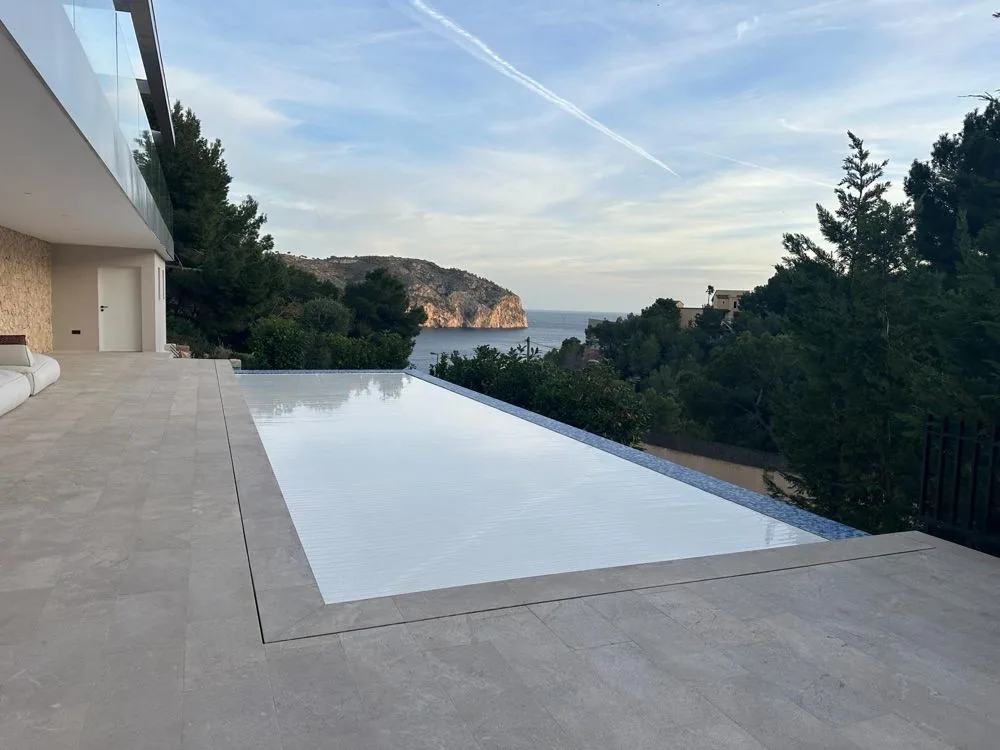
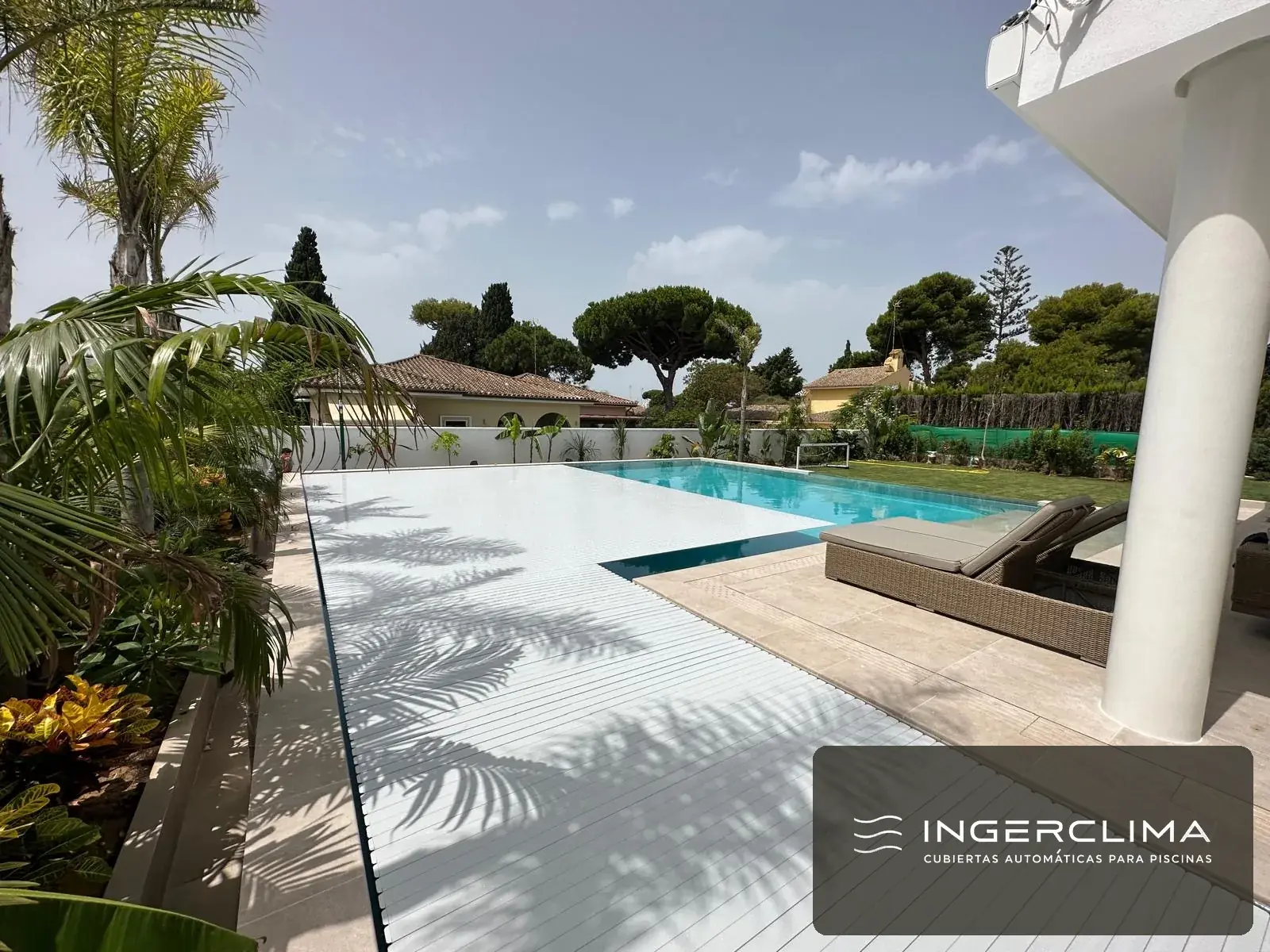
In practice, that profile — a family pool on its own plot — is the one a cover pays back fastest on. Closed, it cuts evaporation by between 70% and 80%: in an 8×4 metre pool, between 15,000 and 25,000 litres a year you do not have to replace. If there is a heat pump, consumption drops by between 50% and 60%, and with solar polycarbonate slats the water gains 6 or 7 °C during the day at no running cost. The other reason people call us is safety: closed, the slats form a continuous surface that keeps anyone out of the water and withstands a 100 kg adult applied at any point, without breaking or coming away from its anchorings, built to the NF P90-308 standard, which is a French standard, not a European one. That does not make it a walkable surface or something to stand on, and nobody should walk on it. You can see the whole province on pool covers in Tarragona and the wider picture on pool covers in Catalonia.