Ingerclima — automatic slatted pool covers
+34 91 631 59 40 Get a Quote
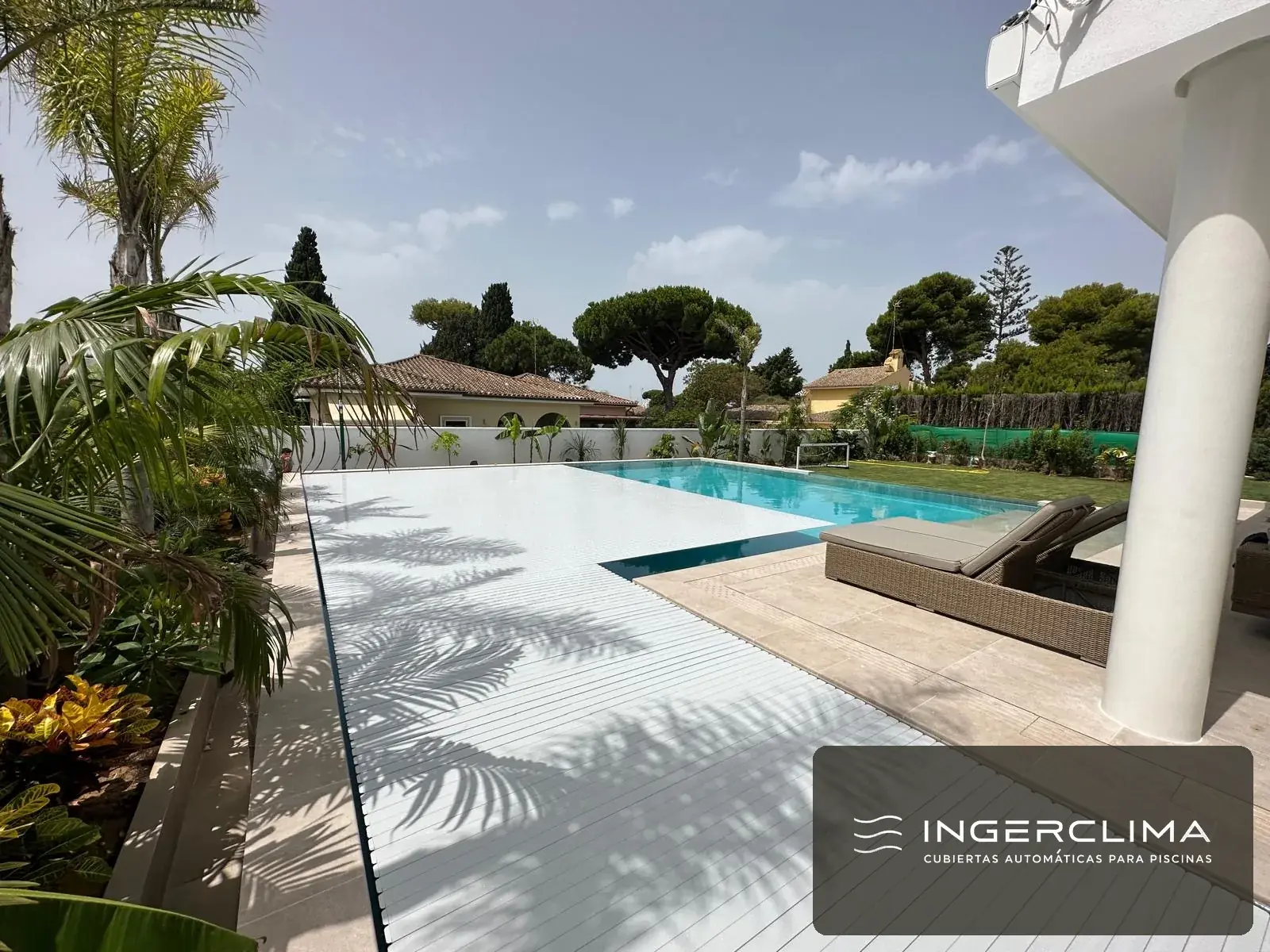
Automatic slatted cover over the pool of a villa with its own plot on the Mediterranean coast
Cunit · Baix Penedès, Costa Dorada

Automatic Pool Covers in Cunit

We build and fit automatic slatted covers right across the municipality: the old town and the seafront promenade, Can Nicolau, Les Sorres, Valparaíso and Cal Cego, and the estates of Costa Cunit, Els Jardins and Els Rosers. We are the manufacturer: your cover is built to size at our own factory in Torrijos (Toledo) and fitted by our Barcelona team, with Ingerclima’s three-year warranty.

More than 20 estates, 9.74 km² and 1,582 pools

Cunit has an old town and a seafront promenade, but the municipality is above all estates: more than 20 of them, and the names give away where the plots came from, because many still carry the name of the farmhouse that stood there before. Can Nicolau is an estate today, with Les Sorres and Valparaíso beside it; Cal Cego, Can Molas, El Rectoret, Els Ametllers, Montcunit and Procunit share out the inland side, and Costa Cunit, Els Jardins and Els Rosers make up the best-known residential block in the municipality. All of that fits into 9.74 km², at a density of around 1,682 inhabitants per square kilometre, one of the highest in the comarca.

That is where the pool comes from. The Land Registry records 1,582 uncovered pools in Cunit, 67 more than in 2022, and that puts the municipality 7th of the 184 in the province of Tarragona. The explanation is plot-by-plot development, the same thing that explains the other figure that defines Cunit: of the 13,027 family dwellings in the municipality, 7,230 are not a main residence according to the 2021 Census, 55.5% of the stock.

It is worth being clear about what we build. All our covers are motorised: there is no manual or crank version. As standard they are operated beside the pool with a key switch and hold-to-run, which means the slats only move while you keep the button pressed and with the pool in view; the remote control and phone control are options on the quote. The structure, the shaft, the brackets and the fixings are always AISI 316L stainless steel, never aluminium. The slats float on the water: there are no rails and no side profiles. What rests on the coping stone are the legs of the roller unit and, where fitted, the housing, which is not a bench to sit on. And the warning we always repeat: there is no alarm and no obstacle sensors, and it does not stop on its own, so you operate it watching the pool and with nothing on top, and you never pull the slats across by hand.

We work just as readily on the pool that already exists in Cal Cego as on the shell still under construction in Costa Cunit. On a finished pool we fit the roller unit above the water, resting on the coping stone, either on view or with a housing, without cutting into the shell. In a new build there is room for a submerged shaft in its own recess, which is invisible from the terrace but has to be allowed for before the concrete is poured. Manufacture is made to measure and takes 4 to 5 weeks, plus the fitting, which is one or two days; the warranty is three years on structure, motor, slats and fitting, and the cover is built to the French NF P90-308 standard.

And now how we work here, which is the question we are asked most. We are the manufacturer: your cover is built to size at our factory in Torrijos (Toledo), and we set the price and the lead time ourselves. The people who come to your house to measure and who fit it are our Barcelona team, who cover the whole of Catalonia — Barcelona, Girona, Tarragona and Lleida — Cunit and the rest of the Baix Penedès included. The visit, the measuring, the fitting and the after-sales are done by people from here, not by someone passing through, and the three-year warranty is Ingerclima’s: over 5,000 installations since 2005.

20+
years of experience
5,000+
covers installed
100%
built in our own factory in Spain
NF
P90-308 safety standard

What changes on a pool in Cunit

From the seafront to the inland plots

The municipality is flat beside the sea and gains height as you go inland, and the C-32 motorway crosses it behind the built-up front, with estates on either side. From the promenade to the furthest plots in the municipality is a couple of kilometres, and a pool a hundred metres from the sand is not the same pool as one up the hill: the wind it takes is different and so is the access. That is why the visit and the measuring are done by our Barcelona team before anything is cut.

Mestral, garbí and salt: 316L and no aluminium

Cunit has 2.5 kilometres of sandy coast wide open to the sea and a wind regime documented by its own council: a light average, around 6 km/h, with northerlies dominant from the land breeze and the garbí, the south-westerly sea breeze, through the hours of sun. But it is the mestral that gets up and passes 80 km/h, and the highest gust recorded in the municipality is 116 km/h, on 24 January 2009. Sea wind and salt, season after season, are what ordinary fixings never forgive: our structure, the shaft, the brackets and the fittings are AISI 316L stainless steel, never aluminium.

Houses that spend half the season shut up

Here the second home is not a slice of the housing stock: it is the majority. The 2021 Census counts 7,230 dwellings that are not a main residence out of 13,027 family dwellings, 55.5%. These are pools that go months with nobody in front of them. With the cover closed, leaves and dust stay on top of the slats and come off with a hose: the floor of the pool stays clean and chemical use drops by around 35%.

Where we install in Cunit

We cover the whole municipality: the town centre and the seafront, the inland estates and the Costa Cunit, Els Jardins and Els Rosers block. And we carry on through the rest of the Baix Penedès.

Town centre and seafront

  • Cunit (old town)
  • Seafront promenade
  • Cunit Ponent seafront
  • Cunit Llevant seafront
  • El Prat de Cunit

Costa Cunit, Els Jardins and Els Rosers

  • Costa Cunit
  • Els Jardins
  • Els Rosers
  • El Rectoret
  • Montcunit

Inland estates

  • Can Nicolau
  • Cal Cego
  • Les Sorres
  • Valparaíso
  • Can Molas, Cunidor and Procunit

Comarca and neighbouring towns

An honest word about access, which in Cunit counts for as much as the pool itself: the slats and the shaft travel in long pieces, and a lorry cannot get down many of the streets on these estates. There are narrow lanes with tight bends in Can Nicolau, Cal Cego and Les Sorres. We check where the material can be unloaded and how it gets from there up to the pool. If your pool is on an estate you cannot see in the list, ask for a quote and we will confirm it for you.

Cunit has 1,582 pools on the Land Registry

According to the Land Registry there are 1,582 uncovered pools registered in Cunit, 67 more than in 2022, when there were 1,515: a rise of 4.4% in four years. That puts the town seventh of the 184 municipalities in the province of Tarragona, behind El Vendrell (2,807), Calafell (2,802), Mont-roig del Camp (2,614), L’Ametlla de Mar (2,342), Cambrils (1,837) and Tortosa (1,718), and ahead of the city of Tarragona itself (1,533), Roda de Berà (1,321), El Catllar (1,270), Reus (1,125) and La Bisbal del Penedès (1,013), which is also in the Baix Penedès.

The province of Tarragona adds up to 41,968 pools across those 184 municipalities and has gained 1,825 since 2022, 4.5% in four years: Cunit is growing at the same rate as its province. Catalonia as a whole has 204,648 pools in 936 municipalities, with Barcelona in front (108,322), Girona second (46,007), Tarragona third and Lleida behind (8,351). Madrid is the leading province in Spain with 147,555 pools, Alicante the second with 132,495, and Málaga records 83,789.

What is interesting about Cunit is not the volume but the density: 9.74 km² with 1,582 pools works out at around 162 per square kilometre, almost ten for every hundred of its 16,385 residents on the 2025 register. There is no mystery to it: the municipality filled up by carving estates into building plots, not by putting up blocks of flats.

A word of caution about these numbers. The Land Registry count under-records: it is a floor, not a ceiling, because some pools are never declared and others appear years late. It also makes no distinction between a private pool, a communal one and a campsite pool: those 1,582 are every body of water in the municipality, not 1,582 houses with a pool. And the figure does not go below municipality level: there is no breakdown by district or by estate, so nobody can say how many there are in Can Nicolau and how many in Costa Cunit.

In practice, that profile — a family pool on its own plot — is the one where a cover pays for itself fastest. Closed, it cuts evaporation by 70% to 80%, which is water you do not have to top up season after season. The other reason people call us is safety: closed, the slats form a continuous surface that keeps the water out of reach, and the cover is built to the NF P90-308 standard, which is French, not European. That does not make it walkable or safe to step on, and you should not walk on it. You can see the whole province on pool covers in Tarragona and the region as a whole on pool covers in Catalonia.
Wind, salt air and a house that sits empty: what Cunit asks of a cover

Cunit has an unusual advantage for a municipality of 9.74 km²: it measures its own weather, with an automatic station on the Servei Meteorològic de Catalunya network (station code WZ) and a municipal weather bulletin. So let us talk about this coast with figures from here.

Start with the wind, which is the first thing to come up in any conversation about a cover. The municipal average is light, around 6 km/h, with northerlies dominant from the night-time land breeze and the garbí, the south-westerly sea breeze, during the hours of sun. And here is the figure that matters: the mestral is the wind that picks up most strength in Cunit, it goes beyond 80 km/h, and the strongest gust recorded in the municipality is 116 km/h, on 24 January 2009. The llevant and the llebeig are the ones that stir up the sea most. All of this is on the town council’s climate page.

For the pool that counts in two ways. Evaporation: after the sun, air moving across the water surface is the great driver of water and heat loss, and a closed cover takes that surface out of the wind. And what the wind brings: with the cover on, leaves and grit stay on top and are rinsed off with a hose. Closed, the slats form a continuous surface sitting on the water, with no loose skirts for the mestral to lift.

The second thing is salt. Cunit’s seafront is 2.5 kilometres of fine sand between Cubelles and Calafell, split into two beaches: Cunit Ponent, about 1,500 metres long with three groynes, and Cunit Llevant, about 1,200 metres with four. Those seven groynes, built between 1977 and 1983 to hold the sand, give the shore a run of semicircular bays and stretch the beach line to some 3.3 kilometres; they are not natural coves, however much they look like it. What counts for the pool is that this breeze leaves salt on everything standing on the terrace. That is why the structure, the shaft, the brackets and the fittings are AISI 316L stainless steel, the molybdenum-bearing grade made for marine air, and we use nothing else. An occasional rinse with fresh water is all it needs, and there is nothing to grease, because the slats float on the water.

The third thing is rain: 555 mm a year on average in the council’s 1989-2012 series, with September the wettest month (89 mm) and July the driest (16 mm). But the average is misleading, because this coast rains in bursts: the monthly record is September 2005, with 292.4 mm in seven days. In July nothing falls and every litre in the pool has to be looked after; in September half a year’s rain can come down in a week, with the watercourses that cross the municipality — the riera de Cunit and the torrent de Cal Cove — carrying soil with them.

And the fourth is the household calendar. With 55.5% of the housing stock not in main use, many pools spend half the season with nobody in front of them, and a cover leaves the pool closed and out of reach. With the usual warning: it has no alarm and no obstacle sensors, and it does not stop on its own.

With all that in mind, the choice of slat is not a matter of taste. PVC does well on sheltered inland pools, and it comes in four shades: white, beige, grey and blue. Solar polycarbonate uses the sun to stretch the season, in seven shades: blue, royal blue, platinum, green, smoke, royal black and royal grey. Transparent, available in transparent, platinum and blue, looks best on pools that face the sea. It is all set out in slat types, and the roller units in cover models. What we do not make is walk-on covers, telescopic covers, enclosures, domes, winter tarpaulins or thermal blankets: automatic slatted covers only, and since 2005.

Installations along this coast

See more photos in the gallery →

How many months can you swim in Cunit?

Here the answer can be given with the town’s own figures: Cunit averages 16.3 °C a year in the council’s 1989-2012 series, with August at 24.8 °C and January at 9.5 °C. It is a coastal climate, with no hard winters. Summer swims without any help, so what is at stake are the months at either end — May, June and September — when an uncovered pool gives back at night what it gained during the day.

That is where the cover works, and it does two things at once: it holds back evaporation, which is where most of the pool’s heat goes, 70% to 80% of it, and if you choose solar polycarbonate slats it lets the sun through and warms the water underneath at no running cost, by 6 or 7 °C over the day. Closed overnight, the water wakes up where you left it.

If you want to go from a season of months to almost the whole year, the next step is a heat pump, which with the cover in place uses 50% to 60% less. The order matters: cover the pool first, then size the equipment, not the other way round.

What owners say once the cover is in

4.7 15 Google reviews See them on Google →
SR

Santiago R.

“As my wife rightly says — how lucky we were to find this company. They have done a flawless job because they genuinely know their trade. They know covers, which is what they make and sell, and on top of that they are good people. Thoroughly recommended.”

Google review · translated from Spanish
JC

Julia C.

“The cover is made from excellent materials and the finish is flawless. From the very first contact the service was outstanding and highly professional. They delivered everything they promised and the result exceeded my expectations. I would recommend them without hesitation.”

Google review · translated from Spanish
T

Teresa

“From the first phone call with the office through to the fitters on the last day, everything was spot on: professional, punctual and tidy. It is a pleasure to find companies that still work like this.”

Google review · translated from Spanish
GR

Giuliana R.

“Excellent pool cover. Everything was good, from the advice to the installation. The cover is very well made, works beautifully and keeps the pool clean and protected. We are delighted with it and would certainly recommend them.”

Google Local Guide · translated from Spanish
EV

Eva V.

“Thoroughly recommended. We are delighted with the cover they fitted for us. The service has been excellent from the very first moment, advising us at every step of the process.”

Google review · translated from Spanish

What owners in Cunit ask us

Our pool in Can Nicolau was built years ago. Can it be covered without building work?

Yes, and it is what we are asked for most in Cunit. On an existing pool we fit the roller unit above the water: the AISI 316L stainless steel legs rest on the coping stone and the shaft sits over the pool, either on show or inside a housing. Nothing is cut into the shell, the filtration plant stays as it is, and we use the power supply the pool already has. That is the usual arrangement on the plot-by-plot estates of Cunit, where the shell is almost never a catalogue size. Our Barcelona team comes out to measure and we build to those measurements: 4 to 5 weeks, plus the fitting, which is one or two days.

Will it stand up to the mestral and the salt air on the Cunit seafront?

That is exactly what AISI 316L is for: a stainless steel alloyed with molybdenum and meant for marine conditions. It is the material of our whole structure, of the shaft, of the brackets and of the fixings, and we never use aluminium. The slats are not affected by salt either. On the wind: the climate page of Cunit town council puts the average at around 6 km/h, but it names the mestral as the strongest wind in the municipality, above 80 km/h, and the highest gust on record is 116 km/h, on 24 January 2009. Closed, the slats form a continuous surface sitting on the water, with no skirts for the wind to lift. All we ask of you is an occasional rinse with fresh water.

We only come to Cunit in summer and the house is shut up the rest of the year. How is that organised?

That is the normal situation in the town: at the 2021 Census, 7,230 of Cunit’s 13,027 family dwellings are not a main residence. Our Barcelona team can measure with the house shut up if a trusted person or whoever looks after the maintenance lets them in; we build in Torrijos in the meantime and leave the fitting for days when you are here. The cover runs on a key switch and hold-to-run control, so whoever looks after the house can open and close it without any difficulty, on one condition: keep the pool in sight, because it has no alarm and no obstacle sensors. And with it closed, the bottom stays clean and chemical use drops by around 35%.

We are building in Costa Cunit and we do not want to see anything on the coping stone. Is there an option?

Yes: the submerged roller unit. The shaft is hidden in a recess inside the pool shell itself and from the terrace you see nothing but water. The condition is the timing: it has to be allowed for in the project, with dimensions and a power supply, before any concrete is poured. If the pool is already built, the answer becomes a visible shaft above the water, on show or with a housing, and that housing is not a bench to sit on. Call us while it is still a drawing and we will talk to your builder.

Who comes to measure and who does the fitting in Cunit? And is there a crank-handle cover, without a motor?

The visit, the measuring and the fitting are done by our Barcelona team, which covers the whole of Catalonia — Barcelona, Girona, Tarragona and Lleida — and therefore Cunit and the Baix Penedès. The cover is built to size at our factory in Torrijos (Toledo), we set the price ourselves and the three-year warranty is Ingerclima’s. Put another way: local people for the visit, the fitting and the after-sales, with the manufacturer behind them. And no, there is no crank-handle version: every cover is motorised. What you choose is the roller unit (above the water, with or without a housing, or submerged) and the slat (PVC, solar polycarbonate or transparent). We do not make winter tarpaulins, thermal blankets, walk-on covers, telescopic covers, domes or pool enclosures either. The warranty is three years: structure, motor, slats and fitting.

Architects, developers and builders in Cunit

If you are an architect, a builder or a developer putting up housing here, what matters is deciding the cover at project stage: the submerged shaft has to be allowed for in the shell before any concrete is poured, and if the decision only arrives at the end of the build it is normally resolved with a visible shaft on the coping stone. On the estates of Cunit, many of them with narrow lanes, two things are worth checking early: the clear width of the coping and the access for bringing the shaft in, since it travels in one piece. We manufacture in Torrijos (Toledo), with the structure and the fittings in AISI 316L stainless steel, and the fitting is done by our Barcelona team, which covers the whole of Catalonia. We give you dimensions, the power supply to allow for and the bearing details for the drawing, and manufacture is planned at 4 to 5 weeks plus the fitting. If the client is yours, the relationship stays with you.

How we work with professionals Download the slat comparison (PDF) →

Cunit: a longer season without the running costs

On this coast the water in an uncovered pool cools overnight for most of the season, and in May or October during the day too, once the mestral comes in. Which is why anyone who wants to stretch the season ends up looking at a heat pump.

Before choosing equipment, this is worth knowing: evaporation is the largest route of heat loss in a pool, and an automatic slatted cover cuts it by between 70% and 80%. Heating consumption falls with it by between 50% and 60%. Without a cover, the heat pump works all night replacing what evaporates, and with wind coming off the land at night that shows up on the bill.

The combination that works best here is a cover with solar polycarbonate slats and equipment sized afterwards, once the losses are under control. We are an official Calorex distributor and we heat the pool with a heat pump, a chiller and a dehumidifier: you can see it in pool heating.

Shall we talk about your pool in Cunit?

Tell us where the pool is — in the town centre, in Les Sorres, in Can Nicolau or on any estate in the municipality — and we will put together a no-obligation quote in under 24 hours. Built in our own factory in Torrijos and fitted by our Barcelona team.

Chat with us on WhatsApp