Calonge i Sant Antoni has 2,623 pools on the Land Registry
According to the Land Registry there are 2,623 uncovered pools registered in Calonge i Sant Antoni, 208 more than in 2022, when there were 2,415: 8.6% growth in four years. That puts the municipality third of the 221 municipalities in the province of Girona, behind Castelló d’Empúries (3,066) and Lloret de Mar (2,862), and ahead of L’Escala (2,159), Begur (2,039), Roses (1,850), Platja d’Aro (1,517) and Palafrugell (1,466). The province of Girona adds up to 46,007 pools and has gained 3,840 since 2022, 9.1% more: it is the fastest-growing Catalan province. Across Catalonia there are 204,648 pools in 936 municipalities, with Barcelona in front (108,322) and Girona second.
To put that in context: Madrid is the first province in Spain with 147,555 pools, Alicante the second with 132,495, and Málaga records 83,789. Girona does not play in that league on volume, but it does on concentration: Calonge i Sant Antoni has more than twelve times the provincial average per municipality within 33.57 km², some 78 pools per square kilometre, and around 21 registered pools for every 100 of its 12,268 inhabitants.
That a medium-sized municipality should hold so many pools is no accident, and the explanation sits in the Town Council’s own documents. The Pla Local d’Habitatge 2021-2026 breaks residential urban land down by type: detached single-family housing takes up 4,010,819 m², 76.15% of the residential land and 47.00% of the floor space; detached multi-family housing accounts for just 9.86% of the land and the old centre for 4.04%. This is a municipality of individual plots, not of blocks, and the figure cannot be extrapolated to its neighbours. Then there is how the houses are used: 67% of the homes are not a main residence — 8,544, of which 6,475 are listed as second homes — against 53% in the comarca and 39% in Palamós; the only comparable case the report itself cites is Platja d’Aro, at 70%.
A necessary word of warning about these numbers, so that nobody reads more into them than is there. The Land Registry census under-records: it is a floor, not a ceiling. There are undeclared pools and others that appear late, so the real figure is higher than the published one. The Land Registry also draws no distinction between a private pool, a communal one and a campsite pool: those 2,623 are every body of water in the municipality, not 2,623 houses with a pool. And the figure does not go below municipal level: there is no breakdown by village or by estate, so there is no saying how many are in Sant Antoni and how many in the vila. When we divide the area up we do it by geography and by our own work, never by attributing figures to one neighbourhood.
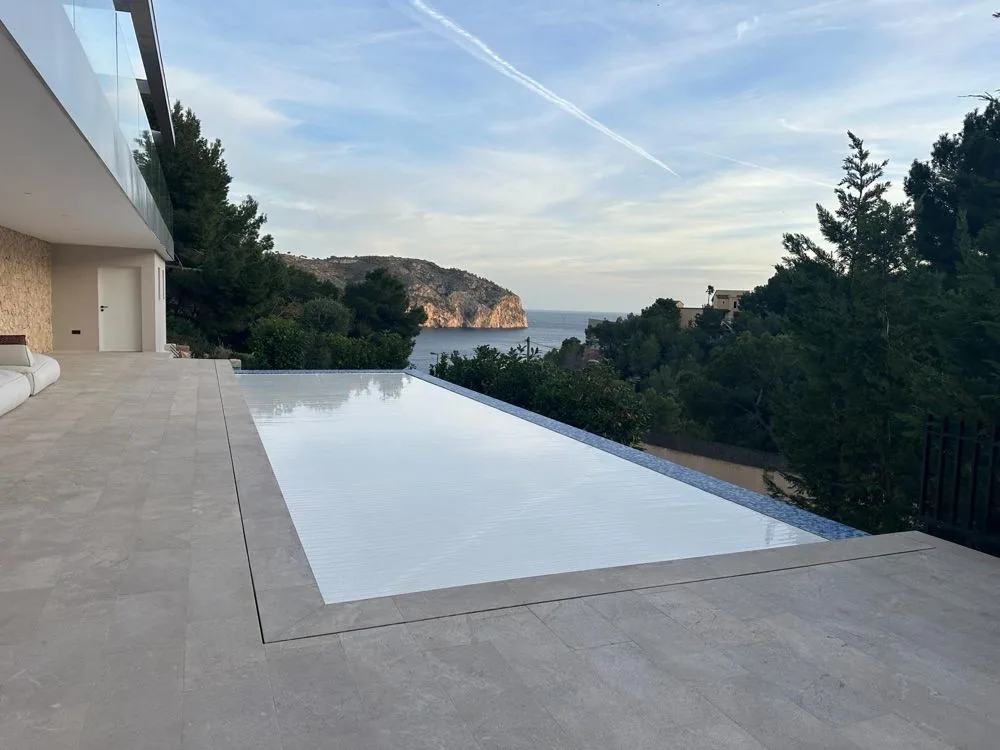
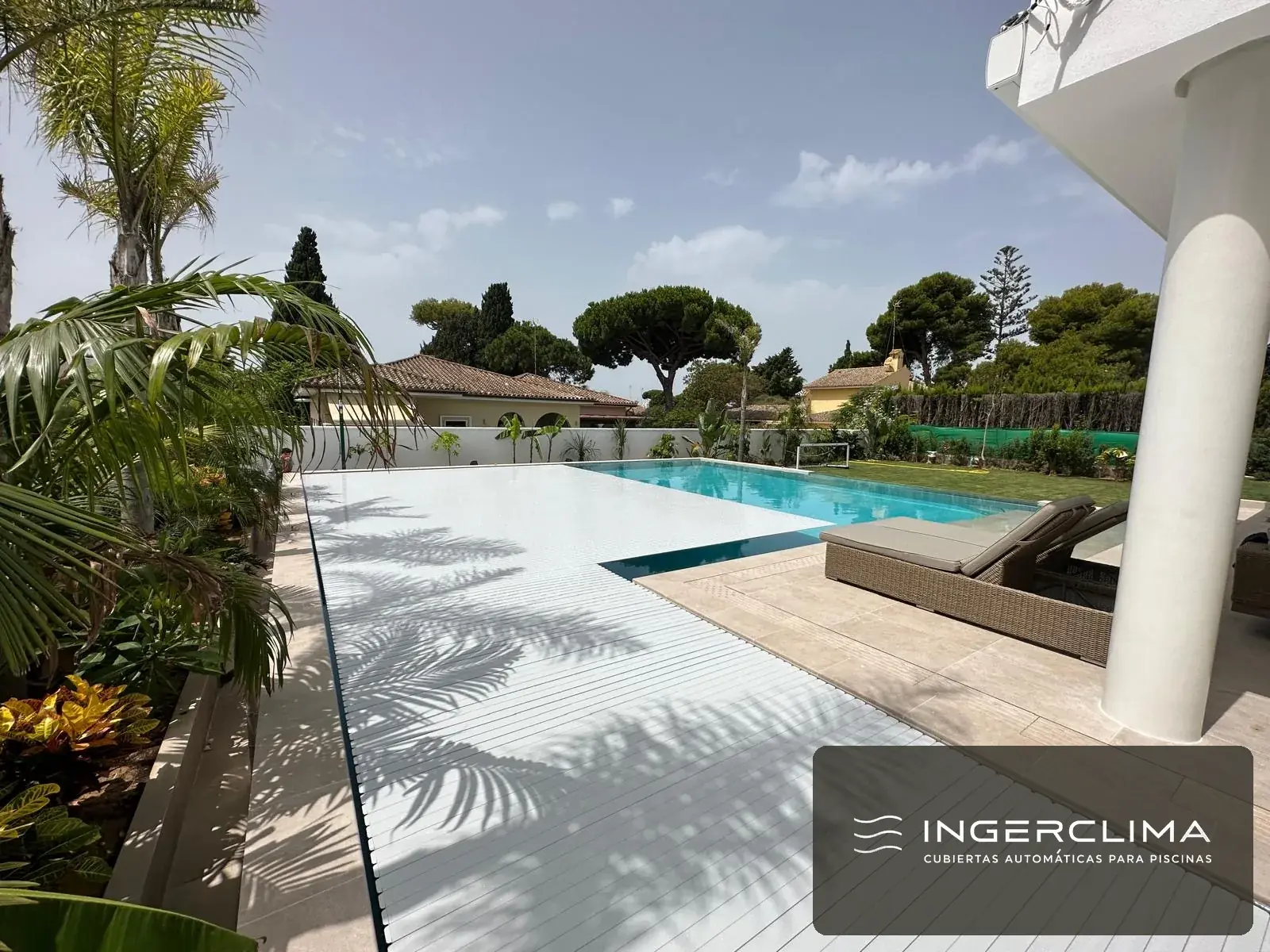
In practice, that profile — a family pool on its own plot — is the one a cover pays back fastest. Closed, it cuts evaporation by between 70% and 80%: in an 8×4 metre pool, 15,000 to 25,000 litres a year you do not have to replace. If there is a heat pump, consumption falls by between 50% and 60%, and with solar polycarbonate slats the water gains 6 or 7 °C during the day at no running cost. The other reason people call us is safety: closed, the slats form a continuous surface that keeps anyone out of the water and carries 100 kg, built to the NF P90-308 standard, a French standard, not a European one. That does not make it a walkable surface, and nobody should walk on it. You can see the whole province at pool covers in Girona and the region as a whole at pool covers in Catalonia.