Ingerclima — automatic slatted pool covers
+34 91 631 59 40 Get a Quote
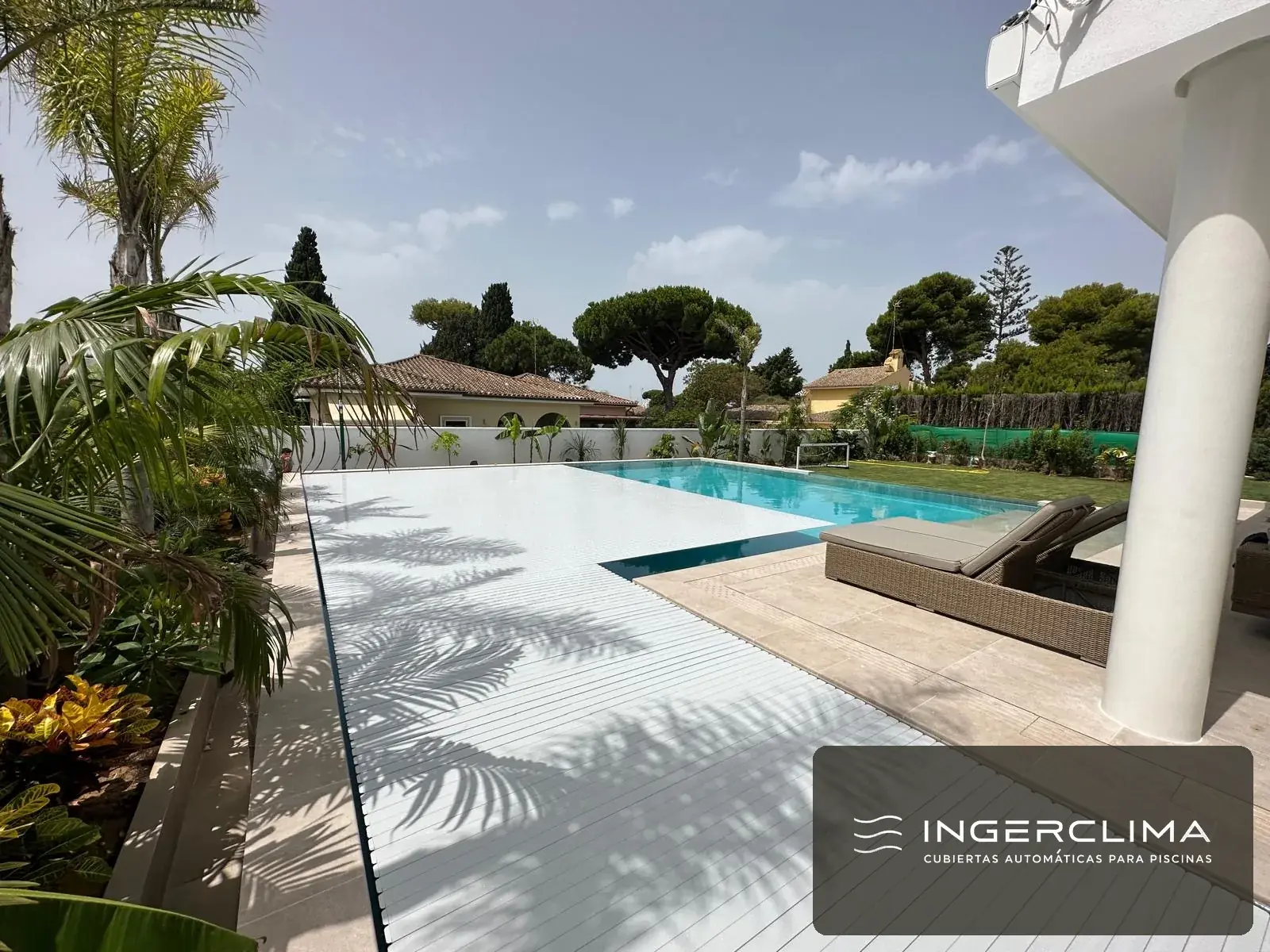
Automatic slatted cover closed over the pool of a villa on the Mediterranean coast
L’Escala · Alt Empordà, Costa Brava

Automatic Pool Covers in L’Escala

We build and fit automatic slatted covers across the whole municipality of L’Escala: the nucli antic and the harbour, Riells and Riells - Mas Estela, Montgó and Cala Montgó, Empúries and Sant Martí d’Empúries, and inland at Cinc Claus, Les Corts and Vilanera. Your cover is built to your measurements at our factory in Torrijos (Toledo) and fitted by our Barcelona team, which covers the whole of Catalonia: the visit, the measuring and the fitting are all local, and the three-year warranty is Ingerclima’s.

L’Escala has 2,159 pools and ranks fourth in the province of Girona

L’Escala fits into 16.3 km², sits 14 metres above sea level and has more than seven kilometres of shoreline at the southern end of the Golf de Roses. Those seven kilometres hold two quite different coasts, and that explains almost everything that follows. To the north, open sand: the Rec del Molí, the Empúries beaches and the platja de Riells, fine sand with nothing to break the wind. To the south, where the municipality climbs towards the Montgrí massif, the coast turns to rock and pine with small coves — el Portitxol, Illa Mateua, Salpatx, el Bol Roig — and Cala Montgó, at the foot of the Montgrí and shared with the neighbouring municipality of Torroella de Montgrí, is the one that lies sheltered from the north. In between sits the town itself: the nucli antic, born in the 16th century as the fishermen’s quarter of Sant Martí d’Empúries, the Port de l’Escala at la Clota, and the archaeological site of Empúries.

The pools follow that same split. The town centre, Riells and Empúries are almost flat and at sea level; the south, towards Montgó, is hillside — cliff, pine wood and plots won back with retaining walls. And there are a great many pools: the Land Registry records 2,159 uncovered pools in the municipality of L’Escala, fourth of the 221 municipalities in the province of Girona. That is more than 130 pools per square kilometre of municipality. And a second figure explains that stock: just over ten thousand people are on the register in L’Escala — 10,374 in 2025 — which works out at one registered pool for every five residents. That ratio does not belong to a town that lives all year round; it belongs to a second-home municipality.

What goes in here is exactly what we build. All our covers are motorised: there is no manual or crank version. As standard they are operated at the poolside with a key switch and on hold-to-run: the slats move only while you keep it pressed and with the pool in sight. A remote control and phone operation are options on the quote. The structure, the shaft, the brackets and the fixings are always AISI 316L stainless steel, the molybdenum grade made for marine air, and never anything else. The slats float on the water: there are no rails, no guides and no side profiles. What rests on the coping stone are the legs and, where the cover has one, the housing — which is not a bench to sit on. And it has no alarm and no obstacle sensors: it detects nothing and it does not stop on its own, so running it with something on top, or pulling the slats by hand, damages the mechanism without warning.

Every cover is made to measure and takes 4 to 5 weeks, plus the fitting, which is done in one or two days. They are built to the French NF P90-308 standard, and the warranty is three years on structure, motor, slats and fitting. One more thing, so you know who you are dealing with: we are the manufacturer, the cover is built to your measurements at our factory in Torrijos (Toledo), and the people who come to your house to measure and the people who fit it are our Barcelona team, which covers the whole of Catalonia: Barcelona, Girona, Tarragona and Lleida. The visit, the measuring, the fitting and the after-sales are all our Barcelona team’s — people based here, not someone passing through; we set the price ourselves and the three-year warranty is Ingerclima’s.

20+
years of experience
5,000+
covers installed
100%
built in our own factory in Spain
NF
P90-308 safety standard

What changes on a pool in L’Escala

The tramuntana, which here comes in head-on

L’Escala sits at the far end of the Golf de Roses, the corridor the tramuntana uses to come down into the Alt Empordà. You feel it inside the municipality: the beaches along the Empúries arc and at Riells are exposed, and Cala Montgó, sheltered by the Montgrí, is the one people use when it blows. For a pool that means two things: anything loose ends up in the water, and a blanket or a tarpaulin blows away. A slatted cover does not: it is fixed to the shaft and it has weight.

Salt air: 316L and nothing else

Seven kilometres of shoreline, a marina with almost a thousand berths and sea wind for a good part of the year leave salt on everything that stands on a terrace, and ordinary fixings do not forgive that. Our structure, the shaft, the brackets and the fittings are AISI 316L stainless steel, the molybdenum grade used in marine environments. All we ask of you is a rinse with fresh water now and then.

Houses that stand shut half the season

L’Escala has 10,374 residents on the register and 2,159 registered pools: the arithmetic alone says a good part of that stock is second homes — a flat in Riells, a house with a plot in Montgó or Empúries. These are houses that are shut up in October and opened in June. With the cover closed, pine needles and sand stay on top of the slats and come off with a hose: the bottom of the pool stays clean and chemical consumption falls by around 35%.

Where we install in L’Escala

We cover the whole municipality, from the nucli antic and the harbour to the platja de Riells, from Empúries and Sant Martí to the coves of the Montgó sector. And we carry on through the rest of the Alt Empordà and the Costa Brava.

Town and harbour

  • Nucli antic de l’Escala
  • Port de l’Escala i la Clota
  • El Riuet
  • Platja de les Barques
  • Port d’en Perris i El Codolar

Riells and Empúries

  • Riells i Riells - Mas Estela
  • Empúries i el Moll Grec
  • Sant Martí d’Empúries
  • Rec del Molí
  • Les Muscleres i La Creu

Montgó and the south

  • Montgó i Cala Montgó
  • Illa Mateua i Salpatx
  • Bol Roig i Portitxol
  • Cinc Claus, Les Corts i Vilanera

The comarca and the Costa Brava

An honest word about access, which here counts for as much as the pool itself: the shaft and the slats travel in long pieces, and a lorry cannot get into many streets in L’Escala. The lanes of the nucli antic and the tracks down to the coves of the Montgó sector mean access has to be looked at before the quote. If the only way in is by hand, we say so and we plan for it; we do not find out on fitting day. If your pool is in an area you cannot see on the list, ask for a quote.

The 2,159 pools on the Land Registry, and what that number does not tell you

According to the Land Registry there are 2,159 uncovered pools recorded in the municipality of L’Escala, 92 more than in 2022, when there were 2,067: a rise of 4.5% in four years. That puts L’Escala fourth of the 221 municipalities in the province of Girona, with almost 5% of the province’s pools. Only Castelló d’Empúries (3,066), Lloret de Mar (2,862) and Calonge i Sant Antoni (2,623) are ahead of it; behind come Begur (2,039), Roses (1,850) and Platja d’Aro (1,517). And L’Escala has almost twice as many as the city of Girona itself, which has 1,143.

Seen from further back, the figure says something about the whole province. Girona totals 46,007 pools across 221 municipalities and has gained 3,840 since 2022, a rise of 9.1%: it is the fastest-growing Catalan province. Catalonia holds 204,648 pools in 936 municipalities — Barcelona 108,322, Girona 46,007, Tarragona 41,968 and Lleida 8,351 — so almost one Catalan pool in four is in Girona. On the Spanish map, Madrid is the first province with 147,555 and Alicante the second with 132,495. And one detail worth reading properly: L’Escala is growing by 4.5%, below the provincial 9.1%. It is not that fewer pools are being built here: the municipality covers 16.3 km² and is already heavily built up, so what is left to do is, above all, to cover the pool that already exists.

That so small a municipality should hold 2,159 pools has a planning explanation: the local plan spreads L’Escala across distinct centres and estates — the nucli antic, Riells, Montgó and the Empúries area — and between them there is still room for a house with a garden. And one awkward clarification, because we would rather not sell you more than we know: there is no public statistic on the make-up of that housing stock. We have not found the share of second homes in L’Escala, nor the split between flats and houses with a plot, which is why we do not write it.

And another warning about the census. The Land Registry under-records: it is a floor, not a ceiling, because there are undeclared pools and shells that never make it onto the register. Nor does it tell a private pool from a communal one, or from a hotel’s or a campsite’s: the 2,159 are every registered body of water in the municipality, not 2,159 houses with a pool. And the figure goes no lower than the municipality: there is no official breakdown by centre or by estate, so nobody can say how many pools are in Riells and how many in Montgó. When we divide the area up by centres we do it by geography and by our own work, never by pinning figures on a neighbourhood. You can see the whole province in pool covers in Girona and the whole region in pool covers in Catalonia.
Tramuntana, salt and a real winter: what L’Escala demands of a cover

We are not going to invent a climate table for you. We do not have the official climate normals for L’Escala and we are not going to approximate them with figures from internet aggregators: you will not find an annual average on this page, nor millimetres of rain, nor hours of sunshine. The station with a long series on this coast is l’Estartit, measuring since 1974, and it stands in the neighbouring municipality of Torroella de Montgrí, not in L’Escala. What we do know, and it needs no figures, is how water behaves: a pool is slow to warm and slow to cool, while the air changes in a matter of hours. In autumn the water runs ahead of the air, and what decides whether you swim is how much heat the pool loses each night. That is where a cover does its work.

The first thing that decides matters here is the tramuntana. L’Escala sits at the southern end of the Golf de Roses, the corridor the north wind uses to enter the Alt Empordà, and the effect shows along its shoreline: the beaches of the Empúries arc and the platja de Riells face straight into it, while Cala Montgó, at the foot of the Montgrí, lies sheltered. We do not have mean wind speeds or maximum gusts for L’Escala, so we do not write them. What we do know is what the wind does to a pool: it drags whatever it finds into the water. A winter tarpaulin or a thermal blanket will not last there, and we do not make them. The slats are joined to one another and to the shaft, they float on the water as one continuous deck and they have weight of their own.

The second is the salt. Seven kilometres of coast, a marina with almost a thousand berths and sea wind for much of the year leave a salt film on everything that sits on a terrace in Riells or Montgó. That is why the structure, the shaft, the brackets and the fixings are AISI 316L stainless steel, the molybdenum-bearing grade made for marine air, and why we never use aluminium. Maintenance is next to nothing: a rinse with fresh water now and then. There are no rails or guides to grease, because the slats float on the water.

The third is what falls into the pool, and here everything does: pine needles and cones in the Montgó sector, fine sand along the Empúries and Riells strip when it blows hard, and mud when the rain comes all at once. With the cover closed that dirt stays on top and is washed off with a hose: the bottom stays clean and chemical use drops by around 35%.

The fourth is the winter, and here the Costa Brava is not the Levante coast: the swimming season is shorter than in Alicante or Málaga, and no cover on its own fixes that. What it does is stretch the season at both ends. A closed cover cuts evaporation by 70% to 80%, which is where most of the heat goes. With solar polycarbonate slats the sun passes through the slat and warms the water underneath, 6 or 7 °C during the day at no running cost, and if there is a heat pump the unit uses 50% to 60% less with the cover in place.

And the fifth is safety. Closed, the cover spans the whole pool and is built to the French NF P90-308 standard, the safety standard for pool covers. That does not make it walkable or something to step on: you must not walk on it. And we repeat the warning because it is safety, not small print: it has no alarm and no obstacle sensors, and it does not stop on its own. Whoever operates it has to do so beside the pool, with the water in view and nothing on top of it, and must never pull the slats by hand. We compare the three slats in slat types, and the roller units in cover models.

A finished pool in Riells or a shell under construction in Empúries: how each case is solved

With a housing stock that has been building up for decades, the commonest job here is covering a pool that already exists. That is solved with a roller unit above the water: the shaft rests on the coping stone on AISI 316L stainless steel brackets, visible or inside a housing, and the slats unroll floating. On the hillside plots of the Montgó sector, where the shell sits on a retaining wall and the coping is tight, what governs the job is the clear width available: the roller unit has to fit that measurement, not the one we would like. That is why the measuring is done by our Barcelona team, at your pool, before anything is cut.

If the pool is still a drawing — a new house in Montgó, in Les Corts or around Empúries — the submerged roller is an option: the shaft is hidden in a recess inside the pool itself and from the terrace you see nothing but water. The condition is the calendar: it has to be allowed for in the project, with its dimensions and its power supply point, before the concrete is poured. In both cases the sequence is the same: our Barcelona team measures at your house, we build to size in Torrijos in 4 to 5 weeks and the fitting is done in one or two days. After-sales stays with the same team, with original factory spare parts.

And there is one detail about L’Escala that is administrative, not technical: the municipality lies inside the Parc Natural del Montgrí, les Illes Medes i el Baix Ter, declared by Law 15/2010 of 28 May, with 6,155.20 hectares on land and 2,039.99 at sea, and L’Escala is the only municipality in the Alt Empordà included in the park. A slatted cover over an existing pool is not building work and does not alter the shell, but if your plot is on protected land or beside an archaeological site, the paperwork is set by the Town Council and the park authority. We give you the dimensions and the fixing details so that you can submit it.

Installations along the coast

See more photos in the gallery →

How many months can you swim in L’Escala?

We are not going to give you a fixed calendar: we do not have the official climate normals for L’Escala. Without a cover, the pool stays a summer pool, because the water loses at night what it gained during the day and the wind speeds up evaporation.

With a cover closed overnight the season stretches at both ends, and autumn is the best example: the water holds the summer heat well after the air has lost it, and what gets you out of the pool is what cools off in the small hours. The cover does two things at once: it slows evaporation by 70% to 80%, and if you choose solar polycarbonate slats it lets the sun through and warms the water underneath, 6 or 7 °C during the day at no running cost. If you want the same temperature right through the season, a heat pump with the cover in place uses 50% to 60% less energy.

What owners in L’Escala ask us

Our pool in Riells was built years ago. Can it be covered without building work?

Yes, and it is the job we are asked for most in L’Escala. We fit the roller unit above the water, resting on the coping stone on AISI 316L stainless steel brackets, either left on show or inside a housing. The pool shell is not cut into, the lining is not touched and the filtration plant stays as it is; we use the power supply that is already there. It is the usual answer in Riells and on the Montgó hillsides, where the pool is rarely a catalogue size. Our Barcelona team measures at your house and we build to those measurements: 4 to 5 weeks, plus one or two days of fitting.

With the tramuntana blowing, does the cover lift or blow away?

What blows away is a tarpaulin or a thermal blanket, and that is why we do not make them. A slatted cover is a different thing: the slats are joined to one another and to the shaft, they float on the water as one continuous mat and they have weight of their own, and the shaft is fixed to the coping stone on AISI 316L stainless steel brackets, or sits in its recess if it is submerged. There are no rails and no side guides: the slat rests on the water. That said, we are not going to give you a maximum gust rating or an average tramuntana speed for L’Escala: we do not have that figure and we are not going to improvise one.

We only come in season and the house is shut for half the year. How is that organised?

It is a very common situation in the town. Our Barcelona team can measure with the house shut if someone you trust lets them in, or whoever looks after the maintenance for you; we build in Torrijos meanwhile and the fitting is left for days when you are in L’Escala. The cover is operated beside the pool with a key switch and hold-to-run, so whoever looks after the house can open and close it, on one condition: you have to keep an eye on the pool, because there is no alarm and no obstacle sensors, and it does not stop on its own. With the cover closed over those months the bottom stays clean and chemical consumption falls by around 35%.

We are building in Montgó and we do not want to see anything on the coping stone. Is there an option?

Yes: the submerged roller unit. The shaft is hidden in a recess inside the pool itself and from the terrace you see nothing but water, which is exactly what you want when the house is sold on its views over the gulf. The condition is the timing: it has to be allowed for in the design, with its dimensions and its power supply point, before the concrete is poured. If the pool is already built, the answer becomes a visible shaft above the water, left on show or inside a housing; we supply that housing ourselves and it is not a bench to sit on. Call us while the pool is still a drawing and we will talk to your builder.

Who comes to the house to measure, and who fits the cover? And is there a hand-crank cover, with no motor?

The visit, the measuring and the fitting are done by our Barcelona team, which covers the whole of Catalonia — Barcelona, Girona, Tarragona and Lleida — and which also handles the after-sales: they are people from here, not someone passing through. We are the manufacturer: the cover is built to size in Torrijos (Toledo) and we set the price ourselves. And no, there is no hand-crank version: every cover is motorised. What you choose is two things: the roller unit (above the water, with or without a housing, or submerged) and the slat (PVC, solar polycarbonate or transparent). Nor do we make winter tarpaulins, thermal blankets, walk-on covers, telescopic enclosures, glazed enclosures or domes. The warranty is three years: structure, motor, slats and fitting.

Architects, builders and developers in L’Escala

If you are an architect, a building firm or a developer putting up housing in L’Escala, what matters is deciding the cover at design stage: the submerged shaft has to be allowed for in the shell before the concrete is poured, and if the cover only comes up at the end of the job the normal answer is a visible shaft on the coping stone. On the hillside plots of the Montgó sector, with a retaining wall and very little room on the coping, it is worth checking the clear width early, and the access for bringing the shaft up, as it travels in one piece. We build in Torrijos (Toledo), with structure and fittings in AISI 316L stainless steel, built to the NF P90-308 standard, and on site it is fitted by our Barcelona team. We give you dimensions, the electrical supply needed and the detail of the supports for the drawing, and manufacture is planned at 4 to 5 weeks plus the fitting.

How we work with professionals Talk to the factory →

L’Escala: a longer season without the running costs going up

Before choosing equipment it is worth knowing this: evaporation is the biggest route by which a pool loses heat, and a slatted cover cuts it by 70% to 80%. The running cost of the heating system drops with it by 50% to 60%. Without a cover, the heat pump works all night replacing what evaporates, and on a terrace exposed to the tramuntana that is throwing the heat straight into the air.

The order that works best is cover first, sizing second: a solar polycarbonate cover, which adds 6 or 7 °C during the day at no running cost, and then the equipment sized with the losses already under control, which almost always comes out smaller. We are an official Calorex distributor and, besides heat pumps, we work with chillers and dehumidifiers. It is all in pool heating.

Shall we talk about your pool in L’Escala?

Tell us where the pool is — in the nucli antic, in Riells, in Empúries or up in Montgó — and we will put a no-obligation quote together in under 24 hours. We build them ourselves in Torrijos; the visit, the measuring and the fitting are done by our Barcelona team, and the service calls come with original spare parts.

Chat with us on WhatsApp